Submitted by Kerry Summers on
Updated June 2026
By Kerry Summers (Content Marketing Coordinator, iVentiv)
Listen to the podcast on Spotify and Apple Podcasts now
Key Takeaways
- AI allows L&D to move beyond content production
- AI is more likely to reshape roles than replace them entirely
- Human judgment remains essential when implementing AI initiatives
- Learning should be measured through proficiency and business outcomes rather than completion rates
- AI-enabled learning can become genuinely adaptive
Moving Beyond the Fear of Replacement
Much of the debate around AI still begins with fear, with many professionals asking: Which jobs will disappear? Which tasks will be automated? How many people will organisations continue to need?
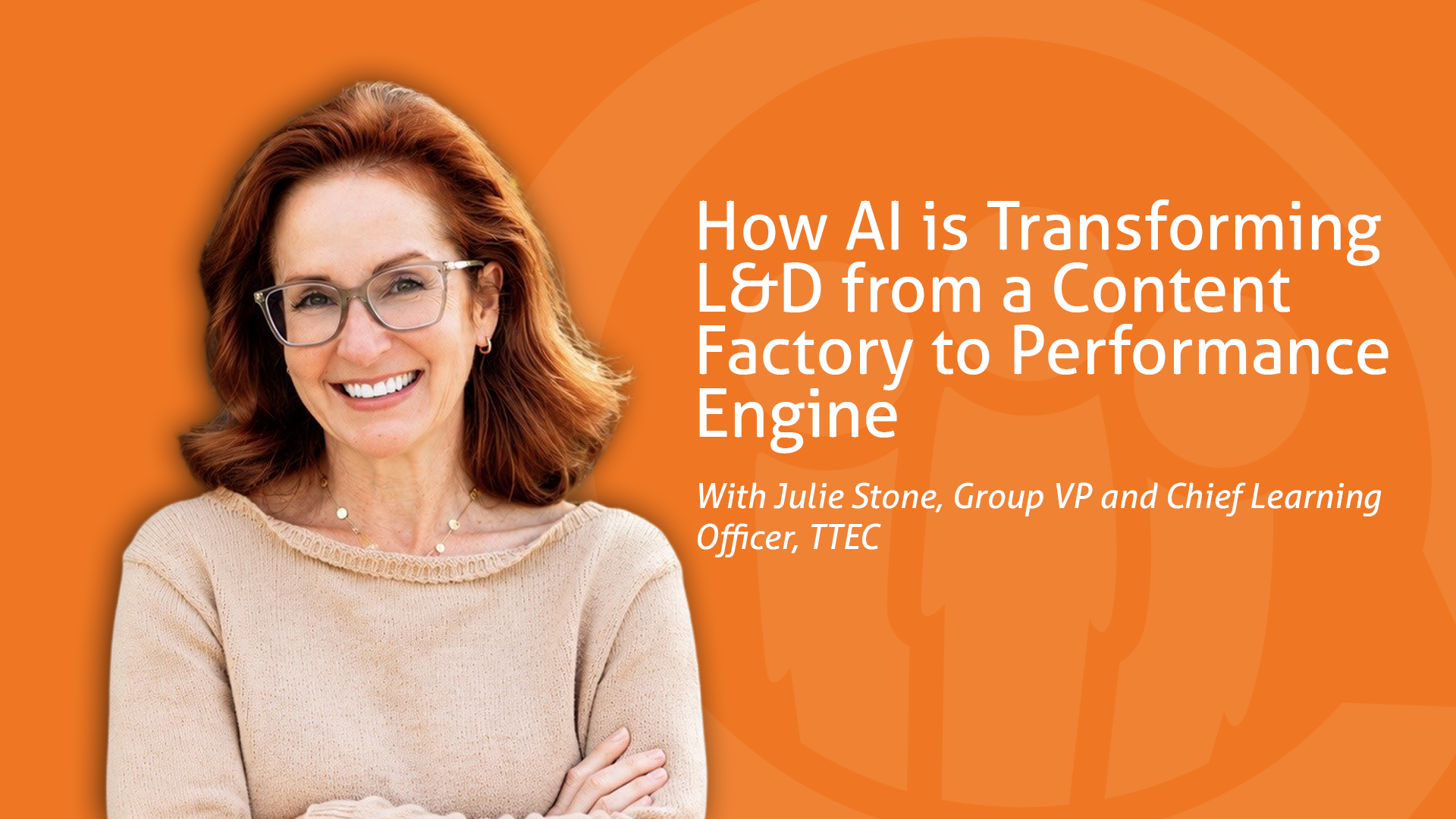
In Julie’s opinion, AI may take over portions of many roles, but relatively few roles are likely to be replaced in their entirety:
“It’s the rare job that gets 100% replaced, at least where we’re at right now… there’s a larger majority of jobs of which portions will be taken over by AI.”
- Julie Stone, Group VP and Chief Learning Officer, TTEC
In some areas, she acknowledges, increased productivity can create greater demand rather than contraction. The distinction here matters; when AI removes part of a role, it does not automatically remove the need for the person performing it. It can create capacity for different work, enable greater customisation, or allow an organisation to deliver services that were previously too costly or time-consuming.
Julie has seen this within her own Learning solutions business. By incorporating AI into discovery, design and development workflows, the team at TTEC initially reduced its reliance on some contingent design resources. But, at the same time, increased speed and quality generated greater client demand:
“We can design so much faster, we can deliver solutions so much faster and, I have to say, to a higher quality too… now we are massively hiring because our ability to speed up the discovery, the solution proposals, and the delivery to our clients has generated significantly more demand.”
- Julie Stone, Group VP and Chief Learning Officer, TTEC
For CLOs, the central question from Julie’s perspective is therefore not simply where AI can reduce effort, but rather where that capacity can create growth, improve quality, deepen personalisation, or solve a business problem that L&D could not address before.
Redesign the learning workflow, not just the learning asset
The first wave of generative AI adoption in L&D has focused heavily on production; Julie highlights that teams can generate scripts, images, videos, assessments and courses in a fraction of the time previously required. But the argument for Julie is that generating the same learning assets more quickly does not fundamentally transform the function; rather, it simply accelerates the existing content factory.
The more valuable application of AI, in her opinion, begins earlier in the workflow, with the performance problem itself. At TTEC, AI has been integrated much further upstream. Here, AI is being used during discovery to identify the performance gap, explore whether Learning is an appropriate response and determine the skills and behaviours required. Work that once took several weeks can now be completed in hours.
One caveat to the speed of production, however, is that although AI may produce an initial analysis in minutes, Julie observes that the element of human judgement remains essential:
“What AI doesn’t bring to the solution is context, judgment, or understanding of what fits for a particular culture and how it fits into broader solutions… we do still need that human in the loop.”
- Julie Stone, Group VP and Chief Learning Officer, TTEC
This, arguably, is the balance that Learning leaders must protect; AI can accelerate analysis, recognise patterns and apply repeatable logic, but what people do is provide organisational context, ethical judgement, cultural awareness, and a deeper understanding of the workforce.
What Julie and many other Learning professionals now believe is that a well-designed partnership between AI and humans is the strongest operating model for an organisation.
From Isolated Courses to Proficiency
In Julie’s opinion, what is perhaps the greatest limitation of the traditional content model is the assumption that completing a learning event produces capability. In her opinion:
“Nobody leaves a training class or finishes an e-learning course with new proficiency… what absolutely must happen is repeated practice with feedback specific to you and what you’re doing well and what you’re not doing well.”
- Julie Stone, Group VP and Chief Learning Officer, TTEC
This, Julie poses, is where AI could help L&D move beyond the course as its primary unit of value. By automating parts of analysis and production, instructional designers can spend more time considering the complete journey from initial exposure to sustained performance. That journey may include practice, assessment, manager involvement, peer feedback, coaching, workflow support and opportunities to apply a skill in real situations.
It also changes how Learning professionals think about measurement. Julie argues that a completion record indicates that an employee encountered content, but it says little about whether they can perform a task, exercise judgment or demonstrate the required behaviour under pressure.
She goes on to say that for organisations moving towards skills-based talent models, self-reported capability and learning participation will not be enough. Leaders will increasingly need credible evidence of proficiency.
Julie’s team measures whether people are developing proficiency, whether they are developing it faster and whether improved capability is influencing the operational measures for which they are accountable. This, she states, creates a direct line between learning activity and business performance:
“You do need to know what business outcome you are seeking to impact and by what KPI you are going to measure it”
- Julie Stone, Group VP and Chief Learning Officer, TTEC
The important shift for Julie is that learning success is no longer defined within the boundaries of the learning function.
Personalisation Becomes Adaptation
Julie also spoke about how AI challenges one of corporate Learning’s longest-standing compromises: designing for the average learner.
She argues that traditional programmes move cohorts through the same material at the same pace, despite significant differences in experience, confidence and existing knowledge. The content is typically calibrated to an imagined midpoint in the room. To Julie:
“There is no average in the room”
- Julie Stone, Group VP and Chief Learning Officer, TTEC
One learner, she argues, may excel in one module and struggle with the next. Another may arrive with deep technical knowledge but limited confidence in applying it. A standardised journey cannot respond effectively to both.
Adaptive learning, she says, offers a more responsive alternative. AI can adjust the complexity and support offered to an individual based on their prior knowledge and emerging performance. This is what Julie describes as:
“the N1 advantage - a sample size of one, customised to me.”
- Julie Stone, Group VP and Chief Learning Officer, TTEC
This does not diminish the value of the facilitator but rather elevates it; when AI supports knowledge transfer and adapts content to the learner, facilitators can devote more of their time to tasks such as coaching and feedback. Instead of delivering the same presentation repeatedly, they can help individuals work through specific challenges. For Julie:
“That’s where you get the most personal satisfaction… I get to work with everybody one-on-one, and I get to bring my expertise to help them develop at the pace that works for them.”
- Julie Stone, Group VP and Chief Learning Officer, TTEC
The human element is not removed and is instead redirected towards the moments where human connection and judgment create the most value.
Productivity is Not the End Goal
But Julie still sees a risk that organisations use AI simply to create more output. Employees may answer more emails, produce more presentations and fill the time saved by automation with a larger volume of familiar tasks:
“They haven’t changed the type of work they’re doing. They’re just doing more of it”
- Julie Stone, Group VP and Chief Learning Officer, TTEC
Julie argues that productivity gains do not automatically become strategic value, and that freed capacity must be deliberately reinvested. If AI reduces the time required to design a programme, what will the team do with those hours?
The same question applies to the workforce that L&D teams support. Julie observes that employees will not automatically use additional capacity for reflection, learning and innovation, and suggests that organisations must help people redesign their expectations and priorities.
She goes on to pose a practical challenge:
“We get all this time for deep thinking work, but has anybody actually blocked time on their calendar to do deep thinking?”
- Julie Stone, Group VP and Chief Learning Officer, TTEC
The argument here is that without deliberate choices, AI may increase activity without improving outcomes.
Transformation can begin with one idea
While the scale of this change can feel overwhelming, Julie acknowledges that leaders do not need to solve the entire future of L&D before they begin:
“We started with one idea… how do we use AI to help us do the curriculum design? That was our starting point.”
- Julie Stone, Group VP and Chief Learning Officer, TTEC
From there, Julie tells us that one use case led organically to another; curriculum design connected to skills identification, discovery, coaching, quality review and assessment. As the workflow evolved, the team updated its processes and standards alongside it.
This is an iterative approach that Julie acknowledges can be daunting, but equally practical and liberating:
“I don’t think people should be afraid… none of us knows what the end-state ideal solution is going to be. But that’s okay. Be open to learning and building it as you go.”
- Julie Stone, Group VP and Chief Learning Officer, TTEC
The task for CLOs here is therefore not to predict every development but to instead establish a clear business outcome, choose a meaningful starting point, and learn as you go.
A New Mandate for L&D
Julie makes clear that she sees AI making content creation easier, faster and cheaper. That inevitably reduces the strategic value of content production as a defining L&D capability, but it also opens the door to a much more influential role:
“At the end of the day, our remit is to build skills, proficiency and change behaviours… that’s what we need to do.”
- Julie Stone, Group VP and Chief Learning Officer, TTEC
The opportunity for L&D here, according to Julie, is to move from distributing learning, measuring participation, and producing generic learning experiences to engineering performance, demonstrating capability, and enabling adaptive, human-centred development.
Julie argues that whilst AI may be the catalyst, this transformation is ultimately about people, and gives Learning professionals the capacity to spend less time assembling assets and more time understanding context, coaching individuals, and solving the problems that matter to the business, becoming a strategic partner and performance engine for organisations and a powerful source of growth for their people.
Julie Stone is Chief Learning Officer and Group VP at TTEC, a global CX technology and services company, where she leads learning, leadership, and workforce capability across a 50,000+ employee global organisation, embedding AI, agentic systems, and performance-based learning into the flow of work to unlock enterprise value.
FAQs
How is AI changing the role of Learning and Development?
AI is helping L&D move away from operating primarily as a content factory. For Julie, the argument is that by automating parts of discovery, analysis, design and production, learning professionals can focus more on building capability, changing behaviour and improving business performance.
Will AI replace L&D professionals?
Julie suggests that AI is more likely to replace parts of roles rather than entire jobs. Tasks such as content production and initial analysis may become automated, but human skills such as judgement, coaching, cultural awareness and contextual understanding will remain essential.
Why is course completion no longer an effective measure of learning success?
Completion rates only show that someone has encountered the content. In Julie’s opinion, it does not demonstrate that employees can apply the skill, make good decisions or perform effectively in a real-world situation. Real capability, she continues, develops through repeated practice and feedback.
What is adaptive learning?
Adaptive learning uses AI to adjust the learning experience based on an individual’s existing knowledge and performance, reflecting Julie’s argument that there is no true “average learner”.
How can L&D connect learning to business performance?
In Julie’s opinion, L&D teams should begin by identifying the business outcome they want to influence and the KPI used to measure it. They can then assess whether learners are developing proficiency and whether that capability is improving the relevant operational results.
How should an organisation begin using AI in L&D?
Organisations do not need to redesign the entire learning function immediately. Beginning with one meaningful use case and then building on what they learn as their processes evolve is a simple and effective launch point. At TTEC, for example, this began by simply asking how AI could help with curriculum design.