Submitted by Kerry Summers on
Updated March 2026
By Kerry Summers (Content Marketing Coordinator, iVentiv)
Key Takeaways
- Learning culture is not a programme, it is how work gets done
- Continuous learning must replace episodic training
- Peer learning is a critical but underused lever
- Learning and business performance are inseparable
- The future of L&D requires unlearning, not just learning
Learning leaders are operating in one of the most consequential moments for the profession. AI is reshaping how work gets done, business strategies are shifting faster than ever, and organisations are demanding clear evidence that learning drives performance.
Against that backdrop, one question keeps surfacing: what does modern Learning leadership actually look like?
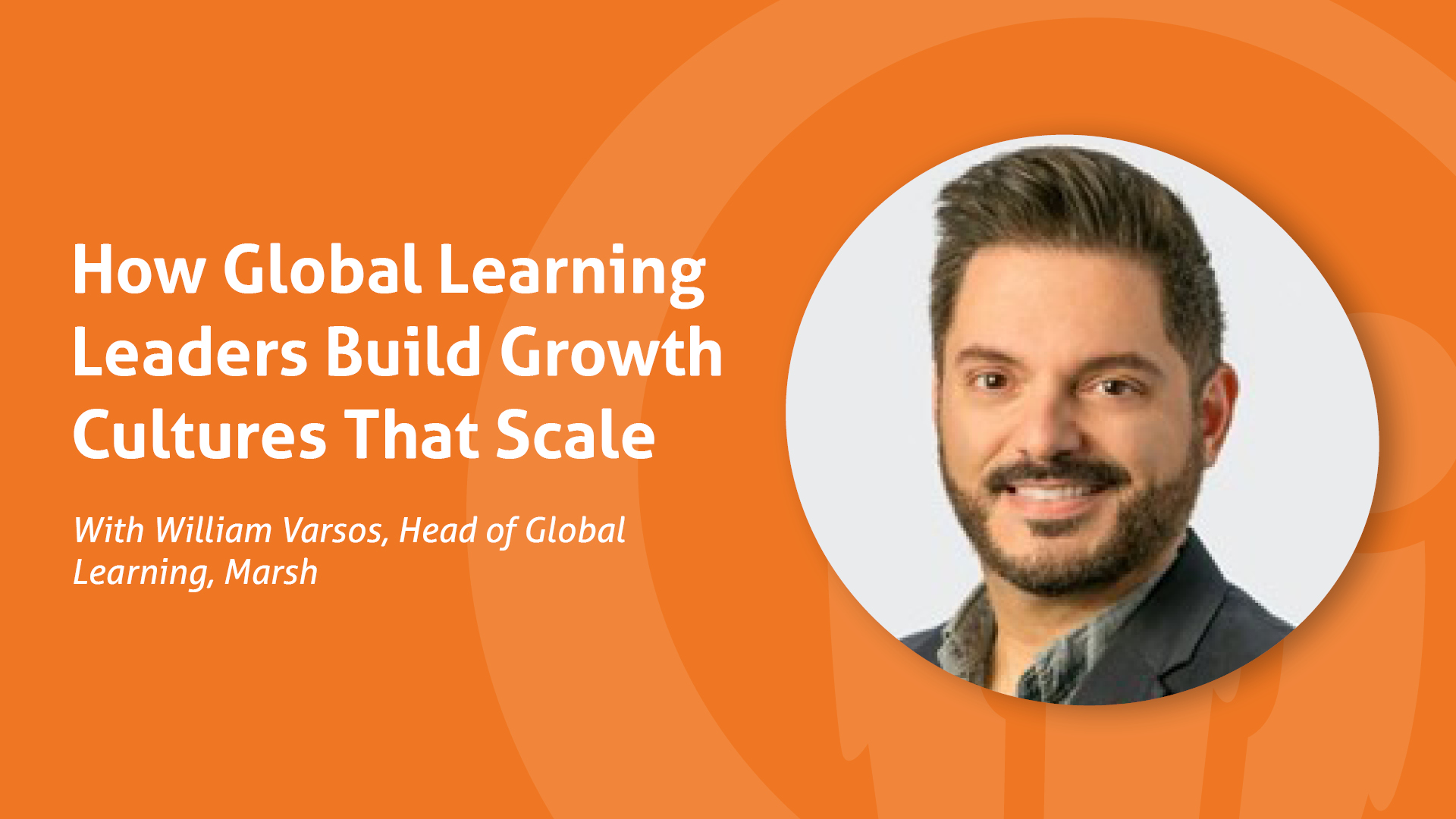
In a recent conversation with iVentiv, William Varsos, Head of Global Learning at Marsh, explored how Learning functions can embed development into the flow of work, align learning more tightly with business strategy, and navigate the growing noise of emerging trends.
His perspective offers a grounded view of the future of Learning, one built less on chasing the next big thing, and more on creating cultures where learning never stops.
What a True Learning Culture Looks Like in Practice
For many organisations, “learning culture” has become a familiar phrase. But translating the concept into reality is far more challenging. For William, the definition is simple, but powerful:
“To me, a growth culture really means creating a continuous learning culture, where learning isn't something you just step out of work to do, but it's embedded as part of how we work every day.”
- William Varsos, Head of Global Learning, Marsh
At Marsh, this philosophy sits at the heart of the organisation’s colleague value proposition, which emphasises a “learn without limits” culture. William sees this as an approach that moves beyond traditional training programmes toward a broader ecosystem of learning that includes:
- Open and nomination-based learning opportunities
- Structured learning journeys tied to specific roles
- Self-directed learning pathways
- Continuous experimentation embedded into daily work
The key shift, he believes, is moving learning from a discrete activity to an organisational habit.
William also highlights the importance in his view of empowering employees to teach each other, not just consume centrally produced content. One way Marsh does this is through global learning days, where colleagues across the organisation contribute sessions based on their own expertise.
William says this transforms learning from something delivered to employees into something created with them.
Why Senior Leaders Need a Different Learning Experience
While learning principles may remain consistent across the organisation, William believes senior leaders require a particularly intentional design approach.
His starting point? Recognising a simple reality: senior leaders are extremely time and attention constrained:
"We are all time and attention poor and senior leaders are especially so… you really do have to maximise the impact of the time that you do have with them.”
- William Varsos, Head of Global Learning, Marsh
To address that challenge, William recommends three key design principles:
1. Make learning practical and immersive
Many leadership programs rely heavily on lectures or panel discussions; an approach that William believes underestimates leaders.
Instead, he encourages active participation, even in executive settings:
“When you push them to actually do in the classroom, the results can be surprisingly good and memorable.”
- William Varsos, Head of Global Learning, Marsh
Hands-on exercises, simulations, and practical problem-solving help senior leaders translate ideas into action.
2. Prioritise peer learning
Leadership can be isolating. Creating space for peer interaction often becomes one of the most valuable parts of the experience. William says:
“Leaders often feel increasingly isolated in their roles… seeing similarities between themselves and learning from one another can be really positive.”
- William Varsos, Head of Global Learning, Marsh
Peer dialogue not only strengthens networks, he argues, it also reinforces that many leaders are navigating the same challenges.
3. Design for impact, not time spent
With limited time available, every moment of a leadership programme must deliver value. That, William believes, means focusing on practical application rather than theoretical coverage.
Aligning Learning Strategy with Business Strategy
One of the most persistent questions in the Learning profession is whether organisations should prioritise business impact or employee development.
William rejects the idea that these priorities compete, telling us that these are instead ‘synergies’:
“I’ve never really seen these as competing energies… investing in people’s development drives business performance.”
- William Varsos, Head of Global Learning, Marsh
From his perspective, the relationship between talent development and business results is direct:
- Stronger skills build organisational capability
- Capability improves performance
- Performance drives business outcomes
The role of the Learning function, therefore, is to ensure development initiatives connect clearly to business priorities.
That means designing programmes that contribute to measurable outcomes, such as:
- Increased productivity
- Improved customer experience
- Stronger leadership capability
- Greater innovation and change readiness
It also requires Learning leaders to work closely with business stakeholders, avoiding what William describes as the “ivory tower” trap where learning operates independently from strategic needs.
How to Build Learning Momentum Across the Organisation
William is clear that creating a sustainable learning culture rarely happens through one major initiative. Instead, it emerges through a series of reinforcing practices. On of the most effective approaches, he says, is crowdsourcing learning from the business itself.
Rather than prescribing topics centrally, Marsh’s learning team actively gathers input from across the organisation:
“Every time we initiate this process, we reach out through our partners in HR and the business to find out what our colleagues are really interested in.”
- William Varsos, Head of Global Learning, Marsh
This approach, as William explains it, keeps Learning aligned with real business needs while also increasing engagement.
Equally important for William is visible sponsorship from senior leaders. When leaders actively promote learning initiatives and participate themselves, he explains, it sends a powerful signal that development is not optional but expected.
And critically, the learning does not end when a session finishes. Recorded sessions remain available across the enterprise, allowing employees to revisit the material and continue learning long after the original event.
Avoiding the “Squirrel” Problem in Learning Strategy
Perhaps one of the most memorable moments in the conversation comes when William describes the challenge of navigating new Learning trends. He compares it to a scene from the animated film Up, where dogs become instantly distracted by a squirrel:
“There are a lot of squirrels in our work life and in our learning industry today.”
- William Varsos, Head of Global Learning, Marsh
The metaphor captures a real challenge facing learning leaders: the constant stream of new tools, frameworks, and ideas competing for attention. Rather than chasing every new development, William advocates focusing on foundational capabilities, which include:
- Leadership capability
- Critical thinking and problem solving
- Emotional intelligence
- Digital and AI literacy
These capabilities provide a stable foundation that enables employees to adapt to future changes.
If a Learning initiative does not strengthen either core skills or adaptive capability, William suggests it may not be a priority.
How AI Is Transforming Learning Functions
AI is now at the centre of most Learning conversations, and William believes Learning leaders must engage with it on two levels.
First, he says organisations need to help employees develop AI proficiency so they can use the technology effectively in their roles. But he also sees a second responsibility, often overlooked. Learning leaders must also rethink how AI transforms the learning function itself:
“We should be asking how we integrate AI not only in what we teach, but how people teach and how people learn.”
- William Varsos, Head of Global Learning, Marsh
This means investing in new capabilities within learning teams, such as:
- Training instructional designers to use AI tools
- Integrating AI into learning platforms
- Using AI to support personalised development
- Introducing AI-enabled learning assistants or tutors
AI also raises a difficult but necessary question: what learning methods might become less relevant?
William suggests Learning leaders should critically examine whether some traditional formats, such as large volumes of asynchronous or virtual learning, remain as effective as they once were.
A Challenge for Learning Leaders: Start Unlearning
Perhaps the most provocative idea from the conversation is William’s call for Learning leaders to reflect on their own habits.
In a moment of rapid change, he believes the profession must be willing to unlearn as much as it learns:
“What are some of those ‘unlearn’ moments when it comes to learning that we can retire for now?”
- William Varsos, Head of Global Learning, Marsh
The shift required may be uncomfortable, but it also represents an opportunity for learning leaders to demonstrate the very capabilities they promote, adaptability, curiosity, and continuous growth.
As he puts it, this moment demands that Learning professionals “drink our own medicine.”
If learning leaders can evolve alongside the organisations they serve, in this view, they will play a central role in shaping the future of work.
William Varsos is a global Talent, Leadership, and Learning executive known for building high-performing teams and delivering enterprise development strategies that drive measurable business impact. He currently serves as Head of Global Learning at Marsh, leading a team of professionals to design, scale and deliver Learning solutions that support leadership growth, AI transformation, client growth, and career development for 90,000 colleagues worldwide.
FAQs
What does a true learning culture look like in practice?
A true Learning Culture embeds development into everyday work rather than treating Learning as a separate activity. This means providing accessible learning resources, encouraging self-directed development, enabling peer-to-peer knowledge sharing, and creating opportunities for employees to continuously build new skills while performing their roles.
How can Learning leaders align L&D with business strategy?
Learning leaders can align with business strategy by designing programmes tied directly to measurable outcomes such as productivity, innovation, customer experience, and leadership capability. Close collaboration with business stakeholders ensures learning initiatives support the organisation’s most pressing priorities.
Why is peer learning important for senior leaders?
Leadership roles can be isolating. Peer learning allows leaders to connect with others facing similar challenges, exchange perspectives, and build networks that support ongoing development and problem solving.
What makes Leadership Development effective for senior executives?
Senior leaders benefit from Learning experiences that are practical, immersive, and time-efficient. Interactive exercises, real-world problem solving, and opportunities for peer learning are particularly valuable, helping leaders apply insights directly to their roles.
How can organisations build momentum toward a stronger Learning Culture?
Organisations can build momentum by engaging employees in shaping Learning priorities, crowdsourcing expertise from across the business, and ensuring leaders visibly support development initiatives. These steps help create shared ownership of learning.
How is AI transforming corporate learning?
AI is reshaping learning by enabling personalised development pathways, intelligent learning assistants, and more adaptive content delivery. It also requires Learning teams themselves to develop new capabilities in how they design, deliver, and manage Learning experiences.
Should Learning leaders rethink traditional Learning formats?
Yes. As employee expectations evolve and digital fatigue grows, organisations may need to reassess the effectiveness of traditional asynchronous or virtual Learning models and explore more engaging, practical, and integrated Learning approaches.