Submitted by Kerry Summers on
Updated March 2026
By Kerry Summers (Content Marketing Coordinator, iVentiv)
Listen to the podcast on Spotify and Apple Podcasts now.
Key Takeaways
- L&D must shift from training delivery to performance enablement
- Expertise, not competence, is the true competitive advantage
- Embedding learning in the flow of work accelerates capability building
- AI’s real value lies in augmenting performance, not just producing content
- Leadership must treat skills transformation as strategic infrastructure
“Every single leader, especially in Germany and Europe, will realise they need to invest in their people, otherwise they will lose this competition.”
- Katrin Marx, Head of Corporate Learning, Bosch
The race for talent is no longer about recruitment alone. For multinationals navigating economic changes, AI disruption, and intensifying competition, the real differentiator is how fast organisations can reskill and transform the capabilities of their existing workforce.
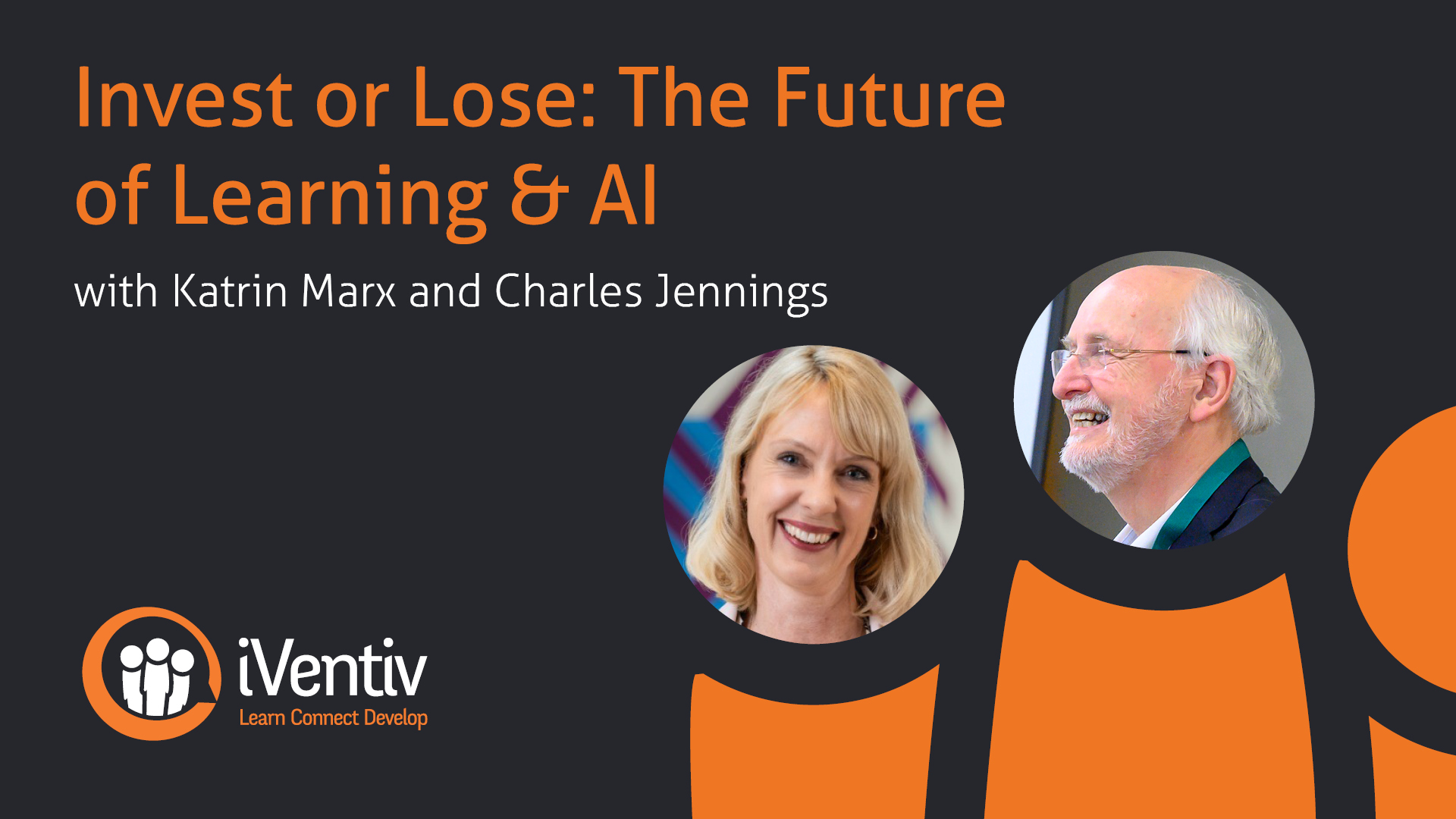
This was the core message from a recent conversation between iVentiv’s Hannah Hoey, Katrin Marx, Head of Corporate Learning, Bosch and Charles Jennings, Co-Founder of the 70:20:10 Institute. Both leaders agree: traditional learning models — designing courses, pushing content, and measuring satisfaction — are obsolete. The new mandate is to create performance-driven ecosystems where skills development is continuous, embedded in work, and tightly linked to business outcomes.
From Training to Performance
Charles Jennings, Co-Founder of the 70:20:10 Institute, has observed the evolution of corporate learning over the years, and believes the sector is at a decisive inflection point:
“L&D has often operated as a fulfilment service…someone asks for training, we design and deliver it, everyone feels satisfied, and nothing really changes. There’s no time for that anymore. Unless we demonstrate tangible value, we’ll always be seen as a cost centre.”
This shift demands more than rebranding courses as “skills academies.” It calls for a performance mindset:
- Defining the real problems to solve (not just the training requested)
- Measuring outcomes upfront — productivity, customer impact, innovation
- Embedding learning into daily work rather than treating it as a separate activity
The 70:20:10 framework — 70% experiential, 20% social, 10% formal — underpins this approach, emphasising that expertise grows through rich experiences, reflection, and collaboration, not classroom hours.
Technological Reinvention and Market Disruption at Bosch
At Bosch, Katrin faces the dual pressures of technological reinvention (e-mobility, software-defined vehicles, AI) and market disruption:
“We’re in radical business transformation…and fierce competition from Asia. We can’t recruit our way out of skill gaps anymore; we must reskill our existing workforce, especially older employees who have been doing mechanical engineering for decades.”
Bosch’s workforce of 400,000 spans generations and geographies. While younger employees in India or Latin America may embrace new skills rapidly, European teams often wrestle with cultural inertia:
Negative perceptions of learning
Many still associate training with remediation — “I have to learn because I’m falling behind” — rather than seeing it as an investment in future endeavours.
Time, not tools, as the bottleneck
Bosch offers extensive upskilling programmes, scholarships, and AI-driven learning platforms like Ask Bosch, but participation lags because employees struggle to prioritise learning amid daily pressures.
Leadership commitment gaps
Without managers actively championing skill development, even the best programmes risk becoming “nice to have.”
Skills are the Currency, But Expertise Wins the Race
Both Katrin and Charles highlight a critical nuance: competence isn’t enough. In a hypercompetitive market, good is not good enough; organisations need expertise.
Charles frames it starkly:
“No organisation aspires to have a merely competent workforce. What drives great companies is expertise — people who go beyond ‘safe to work’ to deliver extraordinary value.”
According to the two, bridging this gap requires:
- Challenging, real-world experiences that stretch employees
- Opportunities to practise and iterate — not just learn once
- Strong communities and networks for peer learning
- Reflective practice to embed insights and drive continuous improvement.
This expertise-centric view redefines what executives should ask of L&D: not “How many courses were completed?” but “How is our workforce developing mastery in the capabilities that matter most?”
AI as a Catalyst for Performance, Not Just Content
AI looms large in both leaders’ visions, but not in the way many expect. For Charles, AI’s real promise is performance augmentation:
AI as a coach
Guiding teams in real time, suggesting solutions, and shortening feedback loops.
AI as an accelerator
Reducing costs of content creation and personalising learning pathways.
AI as a mirror
Providing insights into how work is performed, enabling reflection and optimisation.
But AI also demands a mindset shift. Katrin observes that technologists often build tools assuming adoption will follow automatically — yet even brilliant solutions like Bosch’s internal AI assistant remain underused without robust change management.
The takeaway for executives?
Don’t invest in AI for learning without investing equally in adoption and culture change.
Embedding Learning in the Flow of Work
A recurring theme is the integration of learning and work. Charles mentions that the principle of “identical elements,” first articulated in 1901, still applies: the closer the learning context mirrors the work context, the stronger the transfer.
For Bosch, this means moving from one-off campaigns (“learning is fun!” videos) to ritualised team practices:
- Regularly assessing skills against future business needs
- Embedding learning goals in team routines and leadership agendas
- Showcasing internal role models to scale best practices across regions.
This approach not only builds skills faster but also normalises learning as part of business-as-usual, not a special initiative.
Katrin goes on to underscore a challenge familiar to many multinationals: reskilling older workforces. With recruitment no longer a viable solution for every skill gap, companies must help seasoned employees reinvent themselves — often alongside colleagues the age of their children.
Success requires empathy and creativity: designing pathways that respect experience, reduce stigma, and make learning aspirational rather than remedial. As Katrin puts it,
“We need new, attractive ways — especially for older people — to learn and adapt.”
Leadership's Role in Community Shaping
Perhaps the most profound shift is in leadership itself. Charles cites Henry Mintzberg’s concept of leaders as “community shapers”:
“The new leaders manage communities — not just spreadsheets. They extend beyond financial lenses to people lenses, building environments that enable expertise to flourish.”
For the C-Suite, this reframes learning as strategic infrastructure: not a perk, but a core enabler of transformation, resilience, and competitive advantage. It also calls for visible sponsorship — making skills a board-level priority, not an HR initiative.
What Does All of This Mean for Global Heads?
- Redefine success: Shift from counting courses to measuring performance and expertise
- Champion learning visibly: Make skills a leadership agenda item, not just an HR deliverable
- Integrate, don’t isolate: Embed learning into workflows, team rituals, and real-world challenges
- Leverage AI wisely: Focus on augmentation and adoption, not just automation
- Invest in culture, not just content: Reframe learning as aspirational, not remedial — especially for seasoned employees
- Build and tap networks: Internally and externally, collaboration is the engine of resilience
As Katrin warns, the stakes are existential:
“If we don’t invest in our people, we will lose this competition.”
The organisations that heed this call — and treat learning not as cost but as competitive currency — will define the next era of global business leadership.
Executives who make skills transformation a board-level priority will not only weather disruption but shape it.
Related Resources
- From Experimentation to Transformation: The Future of Learning and AI
- Leading in the Age of AI: The Future of Learning, Talent, and Leadership
- The Future of Skill Development: Balancing AI, Expertise, and Learning
- The Future of Learning, Leadership, and AI: with HEC Paris, Akkodis, Reckitt and The Learning Hack Podcast
- AI and the Future of L&D with Trish Uhl, Senior AI Specialist, Keynote, Advisor, and author of Learning AI
Katrin will host Learning Futures Stuttgart at Bosch Haus Heidehof on 30 September - 1 October, 2025. Charles Jennings will also be in place to chair this session and guide conversations throughout the two days. Register now.
Katrin joined the Bosch Group in 2010 starting in BSH Home Appliances as an Inhouse Strategy Consultant and later on as Head of BSH Academy. As Head of Corporate Learning at Bosch, Katrin manages the transformation of learning itself with regards to global structures, processes, technologies and innovation.
As a respected consultant, advisor, author and speaker, Charles is particularly known for his work with the 70:20:10 model and its use in helping to re-focus L&D’s efforts beyond formal training. Charles co-founded the 70:20:10 Institute which provides global services, strategic consultancy, accelerators, toolkits, clinics, and accreditation programs to help L&D leaders improve their business impact using the 70:20:10 and Performance-Based Learning Methodology.