Submitted by Kerry Summers on
Updated May 2026
By Kerry Summers, Content Marketing Coordinator, iVentiv
Listen to the Podcast on Spotify and Apple Podcasts now.
Key Takeaways
- Wellbeing must move from a “benefit” to a leadership capability
- Sustainable performance depends on recovery, not heroic resilience
- Burnout cannot be solved through awareness alone, it requires practice and immersion
- Senior leaders play a critical role in giving employees “permission” to recover
- Sustainable leadership is about purposeful performance, not doing more
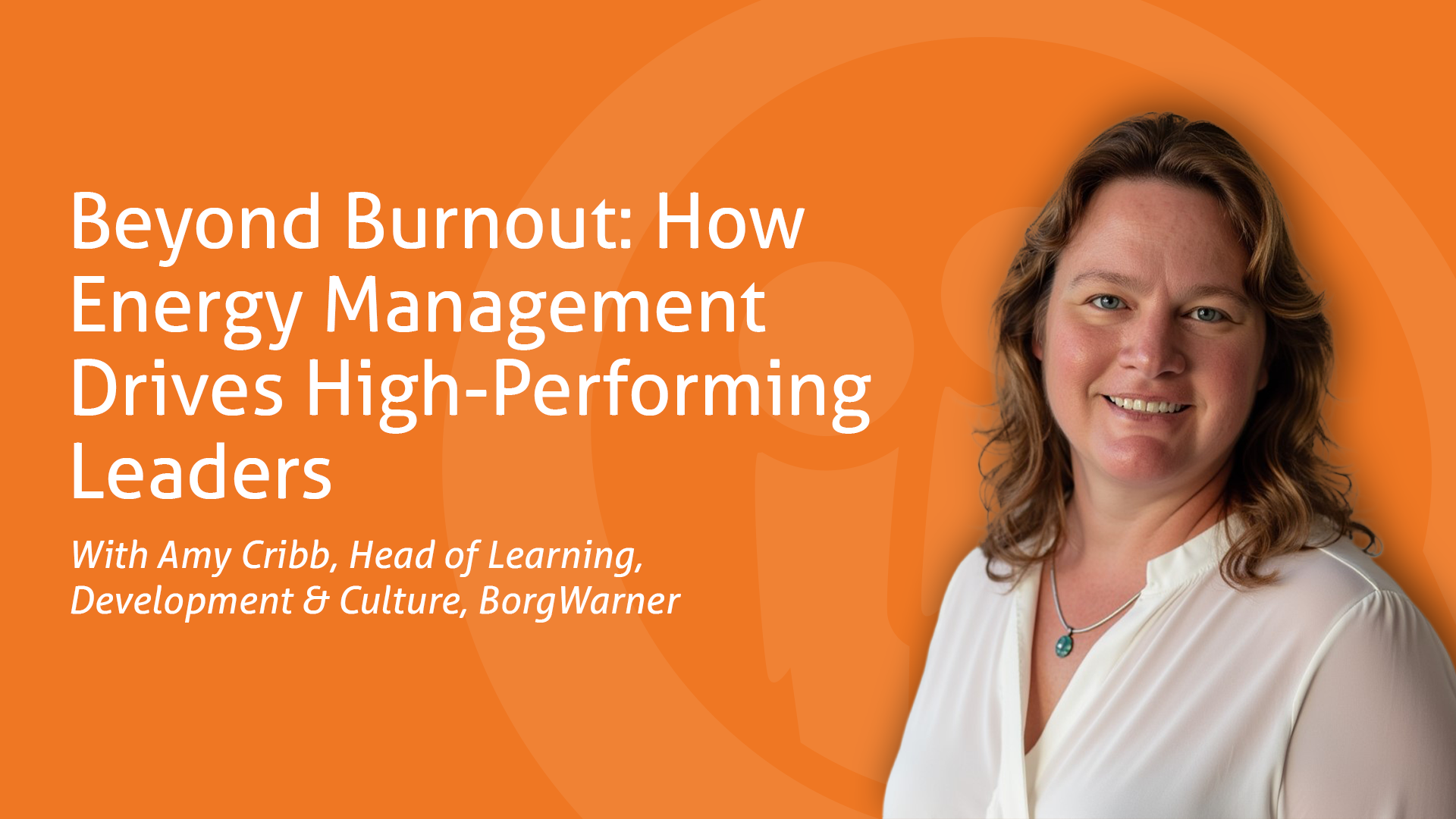
From immersive executive energy retreats and the science of sleep to the importance of visible leadership sponsorship, iVentiv’s Hannah Hoey, Content Manager and Amy Cribb, Head of Learning, Development & Culture at BorgWarner, highlight how organisations can create environments where leaders perform sustainably, not relentlessly. Amy also discusses the role of recovery in decision-making, why burnout cannot be solved through awareness alone, and how businesses can scale wellbeing initiatives beyond senior leadership.
At its core, this conversation challenges organisations to ask a bigger question: if sustainable performance is the goal, how do we build sustainable humans?
Why Sustainable Leadership Starts with Recovery, Not Resilience
Amy observes that, for years, conversations around burnout have centred on resilience. Leaders were encouraged to push through pressure, adapt to change, and keep performing at pace. But at through her experiences at BorgWarner, she believes organisations need a fundamentally different approach:
“We really recognised that sustained performance requires energy management, not just resilience and heroic actions,” she explains.
- Amy Cribb, Head of Learning, Development & Culture at BorgWarner
That shift in thinking became the foundation for a broader cultural transformation around leadership wellbeing, one that reframed recovery not as a luxury, but as a business-critical capability.
From Leadership Moments to Leadership Movements
According to Amy, BorgWarner’s focus on burnout did not begin with an L&D programme or a predefined learning objective. She says that “It actually started as a leadership moment."
Following Covid-19, amid organisational transformation, mergers, and the rapid move into electrification, Amy explains that the business was navigating intense and sustained change. During that period, one senior leader openly shared their own struggles with stress and modelled recovery behaviours in a personal and visible way. A moment that Amys says:
“Really legitimised the conversation of burnout and that we’ve got to do something different.”
- Amy Cribb, Head of Learning, Development & Culture at BorgWarner
The impact, Amy points out, was immediate. Wellbeing stopped being viewed as a “nice to have” and instead became connected to leadership capacity and long-term performance.
Crucially, BorgWarner also reframed resilience itself:
“We reframed resilience into understanding that recovery is part of resilience. It’s not a luxury. It’s a performance requirement.”
- Amy Cribb, Head of Learning, Development & Culture at BorgWarner
Burnout is not Solved with Awareness
One of the most striking insights from Amy’s approach is the belief that burnout cannot be solved through awareness campaigns alone:
“Burnout isn’t solved with awareness,” she says. “It has to be solved through practice.”
- Amy Cribb, Head of Learning, Development & Culture at BorgWarner
That philosophy led BorgWarner to develop immersive executive and leadership energy retreats designed to remove leaders from day-to-day operating pressures and help them experience recovery in real time.
Amy explains that the retreats are three-day offsite experiences focused on sleep science, movement, nutrition, mindfulness, and physiology. Rather than simply discussing wellbeing concepts, leaders are encouraged to test what recovery feels like and understand how it impacts performance:
“They can experiment with things like sleep and focus and movement to see how it’s impacting them in that moment.”
- Amy Cribb, Head of Learning, Development & Culture at BorgWarner
Activities range from guided hikes and pickleball sessions to tailored nutrition plans and expert-led sessions on physiology and energy management. For Amy,
“It’s really about having them see in real time what impact it makes on their mental clarity.”
- Amy Cribb, Head of Learning, Development & Culture at BorgWarner
The result is a deeply human approach to leadership development, with Amy hhighlighting that: “our real impact and our real goal here is for you to be a healthy human.”
The Growing Importance of Human-centred Leadership
Amy also highlights an important reality often overlooked in discussions about executive burnout: leaders are managing pressures far beyond work itself. She observes that
“Every person that comes to work is a human and has multiple dimensions to their life.”
Senior leaders are often balancing strategic decision-making alongside caring responsibilities, family commitments, financial concerns, and questions about long-term purpose and identity. BorgWarner’s approach acknowledges that these dimensions are interconnected:
“We know we’re linked. We can’t compartmentalise ourselves and pretend that issues at work don’t impact home, and issues at home don’t impact work.”
- Amy Cribb, Head of Learning, Development & Culture at BorgWarner
It is that recognition, she says, that is helping shift the conversation from productivity alone toward sustainable leadership.
Scaling Wellbeing Beyond the Executive Retreat
One of the challenges many organisations face with immersive wellbeing programmes is, as Amy observes, scale. BorgWarner addressed this by expanding the principles of energy management into a broader portfolio of learning experiences.
The organisation now offers virtual instructor-led programmes for wider employee groups, alongside separate immersion experiences for executives and senior leaders. These programmes focus on practical ways employees can integrate recovery and energy management into daily life.
Amy argues that certain themes have resonated especially strongly. Shockingly: “Sleep,” Amy says simply, “people think that sleep is a luxury.”
Another key learning area for Amy and her team has been the connection between physical movement and stress recovery:
“Understanding the linkage between micro movement and recovery in the day-to-day moments of stress has been really powerful.”
- Amy Cribb, Head of Learning, Development & Culture at BorgWarner
Importantly, BorgWarner’s engineering-led culture responded strongly to the scientific foundations behind the programmes, with Amy expressing that:
“When you help show them [leadership] the science behind it, it becomes something that they can engage with in a more purposeful way.”
- Amy Cribb, Head of Learning, Development & Culture at BorgWarner
Why Visible Leadership Sponsorship Matters
Perhaps one of the most powerful aspects of BorgWarner’s approach has been the role senior leadership has played in normalising recovery.
Amy recalls an initiative where members of the executive leadership team recorded unscripted “messages of hope” for employees:
“It was amazing how many people who had attended the retreat focused on what they had learned and what they hoped for others in energy management.”
- Amy Cribb, Head of Learning, Development & Culture at BorgWarner
Even the CEO spoke openly about prioritising sleep and turning off to recover properly, aomething that Amy said was “a resounding moment for our people to feel like they had permission.”
Amy goes on to argue that the idea of ‘permission’ is critical. In many organisations, employees still feel pressure to remain constantly available, responsive, and productive. Visible leadership behaviours can fundamentally reshape those expectations.
BorgWarner has also started to see measurable outcomes. While Amy is careful not to claim direct causation, BorgWarner has identified positive retention trends among employees who participated in the programmes.
Sustainable Leadership in the Age of AI
As organisations increasingly explore how AI can improve efficiency, Amy believes there is an opportunity to rethink how leaders use the time technology creates:
“It’s not about filling your day with more activity,” she says. “It’s about filling your day with purposeful activity.”
- Amy Cribb, Head of Learning, Development & Culture at BorgWarner
In a world obsessed with optimisation, that mindset feels increasingly important. More efficiency does not necessarily need to mean more output. It could also mean more balance, better decision-making, and healthier leaders:
“Thirty seconds to breathe can fuel you for another 90 minutes to make really great decisions.”
- Amy Cribb, Head of Learning, Development & Culture at BorgWarner
Rethinking Wellbeing as Leadership Development
For Amy, one of the biggest misconceptions in the L&D space is where wellbeing sits organisationally. She argues that “people still believe that wellbeing belongs in benefits... I really feel that it is leadership development.”
That distinction matters because, in Amy’s opinion:
“If we’re going to build sustainable performance, we have to design sustainable humans.”
- Amy Cribb, Head of Learning, Development & Culture at BorgWarner
It is a powerful challenge to organisations everywhere: stop treating wellbeing as a side initiative and start recognising it as a core leadership capability.
Amy Cribb is a dynamic leader in enterprise learning and development, currently serving as the Sr. Director of Enterprise Learning, Development, and Culture at BorgWarner, a global vehicle technology company with an annual revenue of $15 billion, employing 40,000 people across 87 locations in 24 countries.
FAQs
Why is executive burnout becoming such a strategic issue?
Leaders are facing sustained pressure from organisational transformation, economic uncertainty, technological disruption, and personal responsibilities. Amy tells us that burnout impacts decision-making, retention, engagement, and long-term business performance.
How did BorgWarner approach wellbeing differently?
Rather than launching a traditional wellbeing campaign, BorgWarner treated recovery and energy management as leadership capabilities tied directly to sustainable performance.
Why are immersive retreats more effective than awareness programmes?
According to Amy, burnout “isn’t solved with awareness”. Immersive experiences allow leaders to practise recovery behaviours in real time and understand their physiological impact firsthand.
What wellbeing themes resonated most strongly with leaders?
Sleep, movement, and understanding the science behind recovery were particularly impactful. Leaders responded strongly to evidence-based approaches that connected wellbeing to performance and brain function.
What role do senior leaders play in changing wellbeing culture?
Amy tells us that visible leadership sponsorship is critical. When executives openly model recovery behaviours, such as prioritising sleep or setting boundaries, employees feel greater permission to do the same.