Submitted by Kerry Summers on
Updated March 2026
By Kerry Summers (Content Marketing Corordinator, iVentiv)
Listen to the podcast on Spotify and Apple Podcasts now.
Key Takeaways
- Change leadership is becoming a core L&D capability
- Skills, engagement, and culture must operate as one system
- Link learning to what business leaders care about most
- Focus on high-impact levers that create ripple effects
- Human connection will become the ultimate differentiator in the AI era
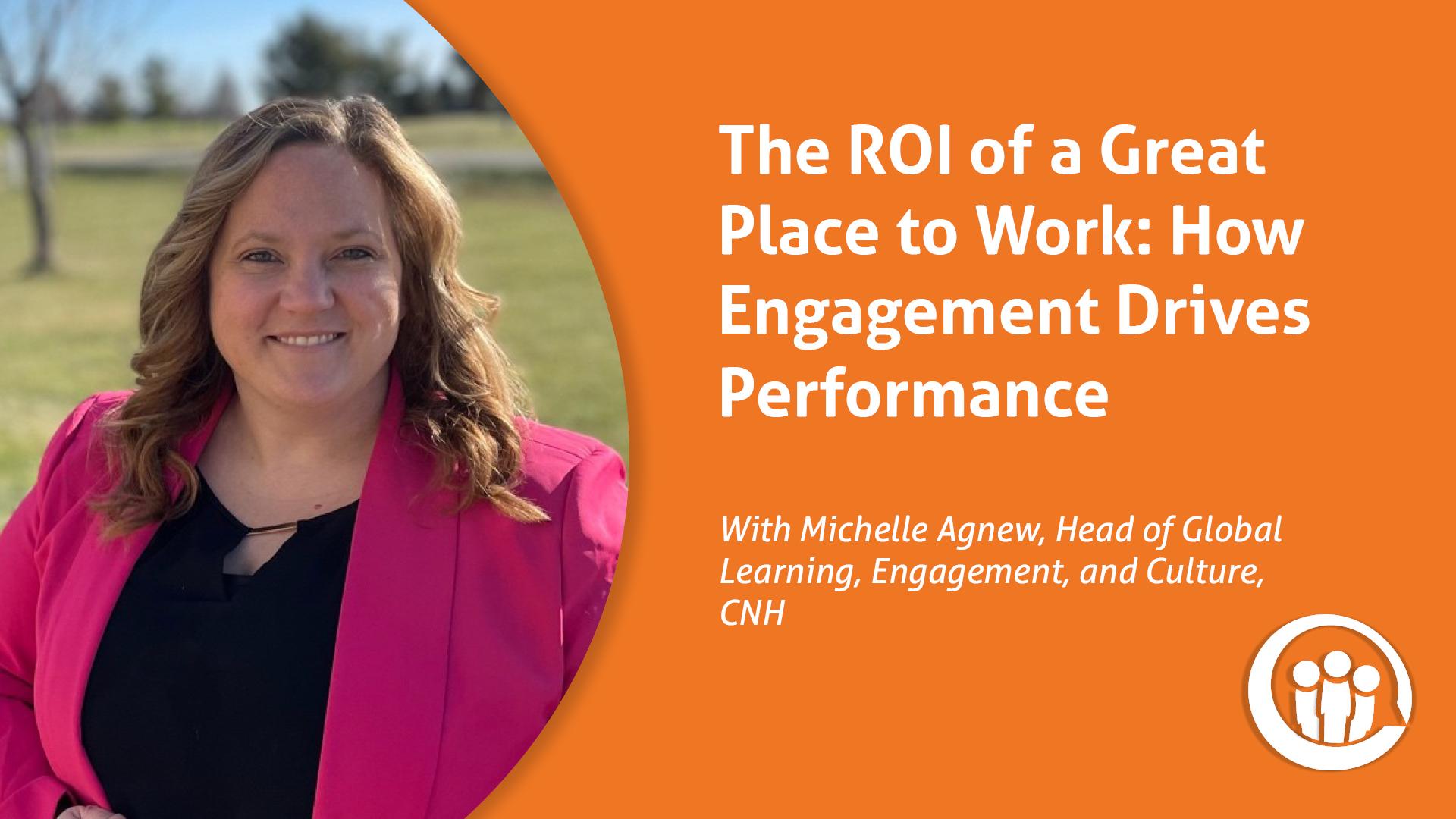
For Michelle Agnew, Global Head of Learning, Engagement, and Culture at CNH Industrial, the work of L&D goes far beyond delivering skills training. It’s about creating an environment where “people want to come to work, and they’re excited about that and giving it back.”
With more than 20 years of experience in HR and Talent Development which includes senior roles at the American Red Cross, Michelle has built a career around connecting learning to culture, engagement, and ultimately, business performance.
In this conversation, Michelle shares her views on where L&D is headed, how to link learning to ROI, and why human connection may become the ultimate differentiator in the age of AI.
The Pace of Change and Why L&D Feels “Behind”
Michelle is candid about a feeling many L&D leaders will recognise. The speed of transformation, accelerated by the pandemic and the shift to remote work, has left many organisations scrambling to keep up.
She believes the future of L&D will hinge on one core competency: change leadership.
“People are getting burnt out as a whole. They’re fatigued by the amount of change that we are asking them to complete.”
- Michelle Agnew, Global Head of Learning, Engagement, and Culture at CNH Industrial
The challenge isn’t just about delivering new skills, it’s about helping employees understand *why* change is happening, and equipping them to adapt without losing trust or engagement.
What does Michelle advocate for?
Embedding change as “part of what’s expected every day” so that employees become “change champions and excited about that change versus resisting it.” This means involving them early, giving them a voice in shaping initiatives, and fostering a culture where change is not an occasional disruption, but the norm.
Beyond Skills: Creating Great Places to Work
When asked to distinguish between an organisation focused purely on skills and one concerned with engagement and culture, Michelle argues for a holistic view. Too often, she says, organisations take a “siloed approach” to developing people.
From the employee’s perspective:
“they’re bombarded with all this feedback and all of these different work streams… it creates a lot of noise that people have a hard time sifting through.”
- Michelle Agnew, Global Head of Learning, Engagement, and Culture at CNH Industrial
Her own role is about connecting the dots so that the experience feels coherent and energising. To explain it to her teenage daughters, she uses a simple analogy:
“Think about how you feel when you’re getting ready to go to school on a Sunday night. Do you want to go? Are you excited about something? My job is to connect all these pieces so that people want to come to work.”
- Michelle Agnew, Global Head of Learning, Engagement, and Culture at CNH Industrial
This, she says, is the heart of building a culture where engagement isn’t just a metric, it’s a lived experience. And for L&D leaders, that means recognising that skills development and culture-building aren’t separate workstreams, but deeply intertwined drivers of performance.
The ROI Challenge and How to Tackle It
For any Global Head of Learning, the question of ROI looms large. How do you prove that learning and engagement initiatives drive tangible business outcomes?
Michelle tells us that it’s difficult to isolate how specific activities can be shown to have a specific impact. But while isolating variables can be tricky, the business case is strong.
“There’s plenty of research out there that shows that employee engagement… makes an impact on the bottom line.”
- Michelle Agnew, Global Head of Learning, Engagement, and Culture at CNH Industrial
The key, she says, is to make it personal for business leaders; ask what’s important to them and show them how you can use these tools to help them win.
For organisations with more advanced data analytics, she says engagement surveys can help draw correlations, such as comparing teams whose managers completed leadership development programmes versus those who didn’t.
Even without complex systems, Michelle says that there’s value in tracking participation rates, leader advocacy, and whether initiatives are being pulled into teams organically or pushed from the top down.
And sometimes, Michelle tells us, focusing on one well-chosen lever, like action-taking after engagement surveys, can have a ripple effect:
“If you focus on one thing, you’re going to have a positive correlation of increasing three or four other things as well.”
- Michelle Agnew, Global Head of Learning, Engagement, and Culture at CNH Industrial
The Case for Human Connection in an AI World
When asked for her most controversial L&D opinion, Michelle offers a provocative thought:
“Someday the need for any kind of technical expertise would be gone… what would differentiate a person is really much more about their people skills.”
- Michelle Agnew, Global Head of Learning, Engagement, and Culture at CNH Industrial
While she acknowledges this is an extreme view, and that technical expertise will always have value, she sees the trajectory clearly. With AI and other technologies handling more of the “instant knowledge” work, the competitive edge will come from human skills: building trust, navigating relationships, and collaborating effectively.
“One thing AI can’t reproduce is human connection,” she says. And those “power skills” will be transferable across roles, industries, and career stages, making them essential for long-term employability.
Strategic Takeaways for Heads of Learning
- Build skills, mindsets, and cultures that make change an ongoing capability, not a disruptive event.
- Integrate learning, engagement, and culture to create an employee experience that drives discretionary effort.
- Frame learning initiatives in terms of what matters most to business leaders, using data where possible to demonstrate correlations.
- Prepare for a future where technical expertise may be commoditised, but human connection remains irreplaceable.
For Michelle, the thread running through all of this is connection between people, between initiatives, and between learning and the business. “All those pieces are truly connected,” she says, “and you can make a positive impact just even by focusing on one thing at a time.”
In a world of accelerating change, it’s easy for L&D leaders to feel “behind.” But as Michelle’s approach shows, the answer may not be to try to control every moving part, but rather how to help people thrive amid the movement. That means embracing change as a constant, championing culture alongside capability, and investing in the human connections that make transformation stick.
Michelle Agnew is the Global Head of Learning, Engagement, and Culture at CNH Industrial. Michelle’s experience spans various sectors, including for-profit, non-profit, government, manufacturing, agriculture, construction, and biomedical. With over 20 years of increasing HR responsibility in complex, global, matrix environments, she has a proven track record of creating and implementing strategies and programmes around learning, leadership, growth and development, engagement, and culture.
Related Resources
- Delivering ROI: Skills and Learning and Development Strategy at Boehringer Ingelheim
- Mindfulness as a Core Executive Leadership Skill, with Matthias Birk
- From Experimentation to Transformation: The Future of Learning and AI
- Leading in the Age of AI: The Future of Learning, Talent, and Leadership
- Sandvik's Holistic, Integrated Approach to Talent Optimisation
- Culture, Team-Centric Leadership, and AI with The Learning Hack Podcast