Submitted by Kerry Summers on
Updated May 2026
By Kerry Summers (Content Marketing Coordinator, iVentiv)
Listen to the Podcast on Spotify and Apple Podcasts now.
Key Takeaways
- L&D leaders in 2026 are shifting focus from strategy to execution, with implementation now the primary challenge
- Learning functions are taking on a more strategic role, increasingly owning transformation and embedding change at scale
- Human-centric learning design is regaining importance, with a focus on experience, engagement, and usability
- Skills-based approaches are becoming embedded in business language rather than standalone initiatives
- AI is now seen as an organisational shift, not just a technology, reshaping workflows, decision-making, and capability building
How is Change and Shifting Context Impacting Learning and Leadership
Across regions and functions one factor seems to be shaping everything else: uncertainty. The macroeconomic and geopolitical environment, from what Kristy is seeing at iVentiv events, is directly impacting organisational priorities and decision-making. Leaders, she observes, are operating in a space where long-term planning is increasingly difficult, and adaptability has become essential. Rather than working towards a single defined future, organisations are preparing for multiple potential scenarios at once.
Hannah argues that this has brought leadership capability back into sharp focus. ‘Resilience’, she says, has re-emerged as a critical priority, not just as a future skill, but as something leaders need right now. At the same time, Kristy can see that there is a renewed emphasis on strategic thinking, with organisations recognising the importance of leaders who can navigate ambiguity and make informed decisions in complex environments.
Learning & Development is Shifting from Strategy to Execution
Against this backdrop, the role of Learning & Development is evolving. If the start of the year was about setting direction, the reality of 2026 so far is about execution. Kristy argues that there is little debate anymore around whether AI, skills, or culture are important; we know that they are. The real challenge, she says, lies in implementation.
This is particularly evident in conversations around AI. Earlier discussions, Kristy observes, focused on its potential, what it could do, how it might transform learning. Now the tone has shifted and organisations are instead grappling with the practicalities of embedding AI into workflows, driving adoption across teams, and understanding how to measure its impact. What seemed straightforward in theory has proven far more complex in practice.
That complexity is amplified in large, global organisations where consistency is difficult to achieve. Kristy goes on to say that a solution that works well in one business unit or geography does not necessarily translate elsewhere and that, as a result, implementation has become less about deploying technology and more about navigating organisational realities.
Who Owns Transformation in a Business?
Both Kristy and Hannah also highlight an interesting shift that is taking place around ownership. One of the biggest points of discussion is no longer what transformation looks like, but who is responsible for delivering it.
AI provides a clear example. While it may sit technically within IT, the responsibility for ensuring it is actually used and embedded is increasingly falling to Learning & Development. For Kristy:
‘In some organisations now, Learning is being looked to as the experts that are going to make it happen… and really make sure that it's embedded through workflows.’
- Kristy Kitson, L&D Strategist, iVentiv
This positions L&D in a much more strategic role. Rather than simply supporting change, Learning teams are being asked to enable it at scale, acting as the link between capability and execution.
However, this shift is not without its challenges. Kristy argues that questions around measurement, accountability, and scope are still being worked through, and approaches vary significantly from one organisation to another.
The Reality Gap: From Ambition to Impact
At the same time, there is a growing recognition that progress is not always as fast or as smooth as expected. Many organisations are experiencing a gap between ambition and reality. Kristy, in her observations, says that:
‘There's an agreement on where organisations need to be going. The disagreement is how much is actually working or how much is actually making a difference and a measurable impact.’
- Kristy Kitson, L&D Strategist, iVentiv
Hannah argues that there is also an inherent tension between being proactive and reactive. While Learning leaders aspire to get ahead of change, the pace of external disruption means that some level of reactivity is unavoidable. The most effective organisations, she suggests, are those that accept this balance, recognising that different types of work require different approaches and measures of success.
Importantly, these challenges are not necessarily negative. They reflect the reality of transformation. As Hannah put it:
‘Learning by its very nature is acknowledging that there is a gap… and so perhaps it's about not being afraid that there is a gap… so when those things do fall down, it's not being too harsh and saying, ‘we picked the wrong priority’, but that priorities will shift and change.’
- Hannah Hoey, Content Director, iVentiv
She argues that the presence of friction, uncertainty, and iteration is not a sign that something is going wrong, but an indication that meaningful change is taking place.
AI as an Organisational Shift, and Re-Centring the Human Experience
One of the most significant developments since the team made their 2026 Predictions is a broader understanding of AI’s role. For Hannah, Kristy, Richard, and the wider iVentiv community, AI is no longer seen purely as a technological advancement, but as an organisational shift. Its impact, we understand, extends beyond tools and processes, influencing how work is structured, how decisions are made, and how people develop.
Kristy argues that Learning leaders are often ahead of the curve in this space. Having already experienced the impact of AI within their own function, they are well positioned to guide the wider organisation. At the same time, Hannah highlights that conversations around governance are becoming more prominent, reflecting a growing awareness of the need for responsible and ethical implementation.
Despite the focus on technology, there has been a notable return to the human element of learning. Hannah suggests that organisations are placing greater emphasis on the learner experience and the broader employee experience. Kristy goes on to underscore the growing recognition amongst Learning and Talent leaders that while technology can enable learning,
‘Our humans are how work gets done, and our leaders need to be preparing them.’
- Kristy Kitson, L&D Strategist, iVentiv
This, both Hannah and Kristy acknowledge, is leading to more deliberate thinking around how learning is designed and delivered. Rather than simply adopting new tools, organisations are considering how those tools fit into the overall experience. In this sense, engagement, motivation, and usability are becoming just as important as capability.
At the same time, there is a clear focus on talent retention and development. Based on her conversations at events earlier this year Kristy highlights that:
‘There's a lot of talk at the moment about retaining talent rather than sourcing new talent, and that reskilling and upskilling piece, of course, has always been there. I think how intentional Learning leaders are [being] in that space is really great to hear.’
- Kristy Kitson, L&D Strategist, iVentiv
In a challenging external environment, organisations are increasingly looking inward, prioritising reskilling and upskilling over external hiring, and reinforcing the importance of Learning functions as key contributors to organisational resilience.
Revisiting the 2026 Predictions
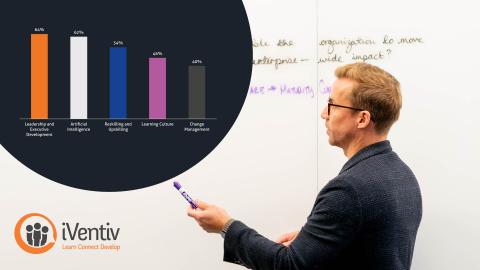
Looking back at the team’s 2026 predictions, it is clear that many of the core themes still hold true; Richard shared that, based on iVentiv Pulse data, the topics of AI, leadership, learning culture, and reskilling and upskilling remain central to the conversation, but their role is evolving.
The idea of skills-based organisations appears to be moving from a distinct initiative to a more embedded way of thinking. Hannah states that rather than being treated as a standalone priority, skills are becoming part of the ‘language of business’. The focus, Kristy argues, is shifting from implementation to application, from building frameworks to using them to inform decisions.
Similarly, the conversation around AI governance is gaining traction, although its exact shape is still emerging. As AI becomes more integrated into everyday work, Hannah highlights that questions around responsibility, ethics, and control are becoming harder to ignore.
What Comes Next for Learning, Leadership and Talent?
Perhaps the most encouraging takeaway is the mindset of Learning leaders themselves. Despite the complexity and uncertainty they are navigating, there is a strong sense of confidence and adaptability. As Hannah, Kristy, and Richard mention, many leaders are not just responding to change but actively shaping it, experimenting, iterating, and learning in real time.
In many ways, this reflects a broader shift in the role of Learning and Development in that it is no longer just about delivering training, but is also about enabling organisations to evolve. As Kristy put it: ‘can organisations really afford not to learn?’
As 2026 continues to unfold, that question feels increasingly relevant. The themes identified at the start of the year have not disappeared, but they have deepened, with the challenge for leaders evolving from understanding what matters, to making it happen in a way that delivers real, measurable impact.
FAQs
What are the biggest priorities for Chief Learning and Talent Officers in 2026?
The priorities themselves have not dramatically changed, AI, skills, leadership, and culture remain central. What has changed is the emphasis on execution. Leaders are no longer debating what matters, what we see instead, is that they are focused on how to implement initiatives effectively, scale them across global organisations, and prove measurable impact.
Why is execution proving more difficult than strategy?
Execution is complex because organisational realities vary widely across regions, business units, and cultures. What works in one context does not always translate to another. In addition, new technologies like AI require not just deployment but behavioural change, workflow integration, and clear measurement frameworks, all of which take time to mature.
How is AI reshaping Learning and Development functions?
AI is no longer viewed as a standalone tool but as a broader organisational shift. It is influencing how work is structured, how decisions are made, and how employees develop. For L&D, this means moving beyond experimentation to embedding AI into everyday workflows, while also guiding the organisation on adoption, governance, and ethical use.
Who owns transformation within organisations today?
Kristy observes that ownership is increasingly shifting toward Learning and Development. While functions like IT may manage the technical side of transformation, L&D is being tasked with ensuring adoption, capability building, and long-term behavioural change. This positions Learning teams as strategic enablers rather than support functions.
How are organisations responding to ongoing uncertainty?
Rather than planning for a single future, organisations are preparing for multiple scenarios. This has increased demand for leaders who can think strategically, navigate ambiguity, and make decisions in complex environments. What Hannah and Kristy observe are that adaptability and resilience are now critical capabilities, not just future skills.
Why is the human element becoming more important again in Learning?
As technology adoption accelerates, organisations are recognising that tools alone do not drive performance. The learner experience, including engagement, motivation, and usability, is becoming just as important as the technology itself. Ultimately, people remain central to how work gets done.
What mindset sets leading organisations apart right now?
The most effective organisations are those that embrace experimentation and iteration. They recognise that friction and uncertainty are part of meaningful transformation. Instead of aiming for perfect execution, Hannah argues that they focus on learning in real time and adapting as priorities evolve.