The ROI of a Great Place to Work: How Engagement Drives Performance

Updated March 2026
By Kerry Summers (Content Marketing Corordinator, iVentiv)

Key Takeaways

  • Change leadership is becoming a core L&D capability
  • Skills, engagement, and culture must operate as one system
  • Link learning to what business leaders care about most
  • Focus on high-impact levers that create ripple effects
  • Human connection will become the ultimate differentiator in the AI era

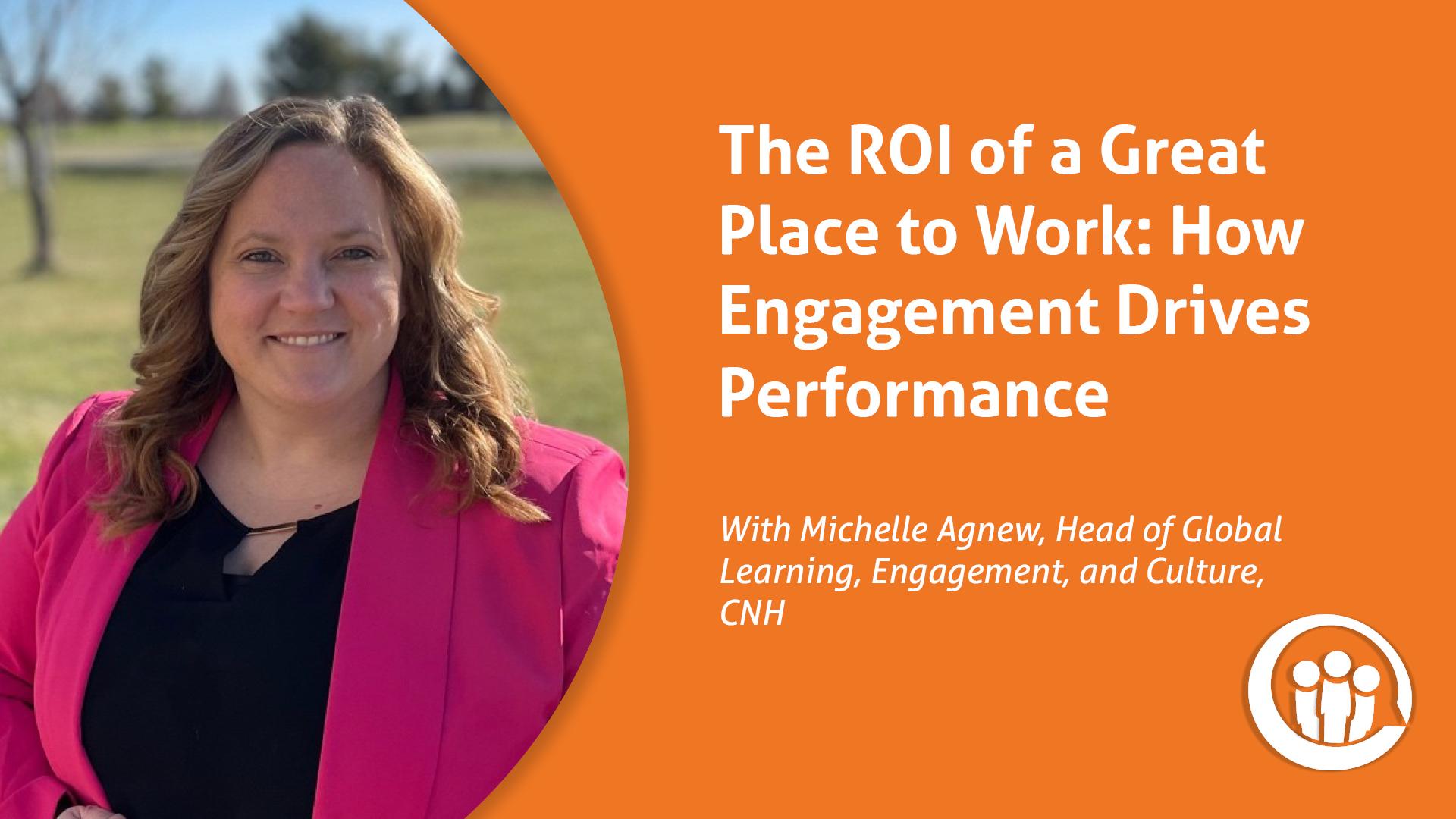
For Michelle Agnew, Global Head of Learning, Engagement, and Culture at CNH Industrial, the work of L&D goes far beyond delivering skills training. It’s about creating an environment where “people want to come to work, and they’re excited about that and giving it back.”

With more than 20 years of experience in HR and Talent Development which includes senior roles at the American Red Cross, Michelle has built a career around connecting learning to culture, engagement, and ultimately, business performance. 

In this conversation, Michelle shares her views on where L&D is headed, how to link learning to ROI, and why human connection may become the ultimate differentiator in the age of AI.

The Pace of Change and Why L&D Feels “Behind”

Michelle is candid about a feeling many L&D leaders will recognise. The speed of transformation, accelerated by the pandemic and the shift to remote work, has left many organisations scrambling to keep up.

She believes the future of L&D will hinge on one core competency: change leadership. 

“People are getting burnt out as a whole. They’re fatigued by the amount of change that we are asking them to complete.” 
       - Michelle Agnew, Global Head of Learning, Engagement, and Culture at CNH Industrial

The challenge isn’t just about delivering new skills, it’s about helping employees understand *why* change is happening, and equipping them to adapt without losing trust or engagement.

What does Michelle advocate for?

Embedding change as “part of what’s expected every day” so that employees become “change champions and excited about that change versus resisting it.” This means involving them early, giving them a voice in shaping initiatives, and fostering a culture where change is not an occasional disruption, but the norm.

Beyond Skills: Creating Great Places to Work

When asked to distinguish between an organisation focused purely on skills and one concerned with engagement and culture, Michelle argues for a holistic view. Too often, she says, organisations take a “siloed approach” to developing people. 

From the employee’s perspective:

“they’re bombarded with all this feedback and all of these different work streams… it creates a lot of noise that people have a hard time sifting through.”
       - Michelle Agnew, Global Head of Learning, Engagement, and Culture at CNH Industrial

Her own role is about connecting the dots so that the experience feels coherent and energising. To explain it to her teenage daughters, she uses a simple analogy:

“Think about how you feel when you’re getting ready to go to school on a Sunday night. Do you want to go? Are you excited about something? My job is to connect all these pieces so that people want to come to work.”
      - Michelle Agnew, Global Head of Learning, Engagement, and Culture at CNH Industrial

This, she says, is the heart of building a culture where engagement isn’t just a metric, it’s a lived experience. And for L&D leaders, that means recognising that skills development and culture-building aren’t separate workstreams, but deeply intertwined drivers of performance.

The ROI Challenge and How to Tackle It

For any Global Head of Learning, the question of ROI looms large. How do you prove that learning and engagement initiatives drive tangible business outcomes?
Michelle tells us that it’s difficult to isolate how specific activities can be shown to have a specific impact. But while isolating variables can be tricky, the business case is strong. 

“There’s plenty of research out there that shows that employee engagement… makes an impact on the bottom line.”
       - Michelle Agnew, Global Head of Learning, Engagement, and Culture at CNH Industrial

The key, she says, is to make it personal for business leaders; ask what’s important to them and show them how you can use these tools to help them win.

For organisations with more advanced data analytics, she says engagement surveys can help draw correlations, such as comparing teams whose managers completed leadership development programmes versus those who didn’t. 

Even without complex systems, Michelle says that there’s value in tracking participation rates, leader advocacy, and whether initiatives are being pulled into teams organically or pushed from the top down.

And sometimes, Michelle tells us, focusing on one well-chosen lever, like action-taking after engagement surveys, can have a ripple effect: 

“If you focus on one thing, you’re going to have a positive correlation of increasing three or four other things as well.”
       - Michelle Agnew, Global Head of Learning, Engagement, and Culture at CNH Industrial

The Case for Human Connection in an AI World

When asked for her most controversial L&D opinion, Michelle offers a provocative thought:

“Someday the need for any kind of technical expertise would be gone… what would differentiate a person is really much more about their people skills.”
       - Michelle Agnew, Global Head of Learning, Engagement, and Culture at CNH Industrial

While she acknowledges this is an extreme view, and that technical expertise will always have value, she sees the trajectory clearly. With AI and other technologies handling more of the “instant knowledge” work, the competitive edge will come from human skills: building trust, navigating relationships, and collaborating effectively.

“One thing AI can’t reproduce is human connection,” she says. And those “power skills” will be transferable across roles, industries, and career stages, making them essential for long-term employability.

Strategic Takeaways for Heads of Learning

  • Build skills, mindsets, and cultures that make change an ongoing capability, not a disruptive event.
  • Integrate learning, engagement, and culture to create an employee experience that drives discretionary effort.
  • Frame learning initiatives in terms of what matters most to business leaders, using data where possible to demonstrate correlations.
  • Prepare for a future where technical expertise may be commoditised, but human connection remains irreplaceable.

For Michelle, the thread running through all of this is connection between people, between initiatives, and between learning and the business. “All those pieces are truly connected,” she says, “and you can make a positive impact just even by focusing on one thing at a time.”

In a world of accelerating change, it’s easy for L&D leaders to feel “behind.” But as Michelle’s approach shows, the answer may not be to try to control every moving part, but rather how to help people thrive amid the movement. That means embracing change as a constant, championing culture alongside capability, and investing in the human connections that make transformation stick.

Michelle Agnew is the Global Head of Learning, Engagement, and Culture at CNH Industrial. Michelle’s experience spans various sectors, including for-profit, non-profit, government, manufacturing, agriculture, construction, and biomedical. With over 20 years of increasing HR responsibility in complex, global, matrix environments, she has a proven track record of creating and implementing strategies and programmes around learning, leadership, growth and development, engagement, and culture.

Related Resources

Thumbnail: 
News category: 
Learning & Development
ROI and Data

More Insights

Data-driven decision-making, personalisation, and measuring impact to enhance learner engagement were hot topics at iVentiv’s Learning Futures Basel event in October of this year.

Adam Lacey, Co-Founder of Assemble You and Host of the L&D Challenges Podcast took the time to join us for those discussions, and got into the thick it with key thought-leaders in his most recent podcast episode: How Roche and STMicroelectronics are Harnessing the Power of Data and AI in L&D.

Sam Zalcman, Global Head of Learning & Development at STMicroelectronics, Priyakumar Nair, Global Head of Learning Services at Roche, and Professor Peter Fisher, Associate Professor of Marketing & Academic Director of Creative Destruction Labs’ AI stream at HEC Paris made up this episode’s panel of distinguished leaders, and the discussions illuminated cutting-edge strategies in L&D and their implications for organisational transformation.

Join us as we listen in on a podcast that provides a wealth of insights for C-suite executives in multinational organisations, focusing on how L&D leaders are leveraging data, AI, and cultural shifts to address modern challenges.

In a dynamic and transformative era, the Learning & Development sector is grappling with profound questions about innovation, technology, and leadership. The Learning Hack Podcast, hosted by John Helmer, offers rich insights into these themes through candid conversations with global leaders. 

In a recent episode inspired by conversations at iVentiv’s Learning Futures Basel Executive Knowledge Exchange, three thought leaders — Anne-Valérie Corboz (Dean, HEC Paris), Jane Underwood (Global Head of Learning, Reckitt), and Sarah Otley (SVP, Global Head of Akkodis Academy) — came together to share their perspectives on navigating the future of L&D, with discussions covering the evolving nature of leadership, the role of generative AI in L&D, and the enduring challenges of aligning learning strategies with business goals. 

Read more

The advent of generative AI has sparked widespread discussions across industries, but for Learning and Development, its potential remains a double-edged sword.

On the one hand, for many leaders, AI promises to revolutionise the way learning is designed and delivered. On the other, it risks reinforcing old habits and hindering meaningful change.

In a recent episode of The Learning Hack Podcast, hosted by John Helmer, guest Charles Jennings— iVentiv Advisory Board member, regular iVentiv Event Chair, pioneer in L&D transformation, and Co-Founder of the 70:20:10 framework—offered deep insights into these challenges.

This blog unpacks the key themes from their conversation and asks how can L&D leaders avoid complacency? How can they leverage AI responsibly? How can they refocus on performance improvement over outdated methodologies?

Read more

In an age of constant change, Zurich Insurance has embraced a skills-based approach as a core strategy to future-proof its workforce and drive business success. 

In an interview with iVentiv, Adrian Stäubli, former Group Head of Skills Development Solutions at Zurich Insurance, highlighted Zurich’s commitment to identifying, developing, and deploying skills across its global workforce. 

This model isn’t just a tool— to Adrian it’s a "secret ingredient" that touches every aspect of employee development, from career progression to job design, setting Zurich apart as a truly agile and resilient organisation.

Watch our interview now to see how Adrian embraced skills, and how it’s transformed Zurich’s employee experience.


In the ever-evolving world of executive education and corporate learning, partnerships are key to success. iVentiv has nurtured a long-standing relationship with HEC Paris, a prestigious European business school that was founded in 1888, since 2010 and has become a leading institution in Executive Development. Through this collaboration, HEC Paris has not only elevated its presence within the corporate learning community but has also provided valuable insights and support to iVentiv’s events worldwide.

Join us as we dive into the partnership between iVentiv and HEC Paris, how it's bloomed over the years, and where it will go next.

In today’s complex global landscape, even the most experienced L&D executives face a persistent challenge: ensuring alignment and collaboration within large Learning & Development teams spread across geographies, business units, and time zones.

Too often, L&D functions in multinational companies operate in silos. Teams set objectives independently, repeat each other’s work unknowingly, or miss opportunities to scale successful initiatives. Despite good intentions, the lack of structured knowledge-sharing and alignment can hinder progress, dilute impact, and ultimately affect how well organisations respond to change. 

So, how do you create an event designed to build a strong, connected L&D team that learns from each other and works towards a shared vision? Read on to find out.

Whether you’re launching a new initiative, or planning a team-building day, internal corporate events need more than just good food and a decent venue. Without the right strategic groundwork, even the most beautifully executed event can fall flat. 

Instead, before diving into logistics, you should pause and ask the foundational questions that shape a purposeful, effective experience.

This guide explores the key questions to ask before you start planning an internal event to help you clarify objectives, understand your audience, and align the event with your broader organisational goals. Read more.

In today’s competitive, hyper-informed market, you can’t win customer loyalty with a strong product or slick branding alone. Instead, you need trust, relevance, and a consistent demonstration that you understand your customers' needs. 

That’s where customer education events come in. 

These aren’t just glorified sales pitches. They’re strategic opportunities to deliver value, deepen relationships, and build communities around your offering.
When done well, these events don’t just teach; they transform customers into advocates. They help your business stay front-of-mind while giving your clients the tools and insights to succeed with your product or service at the centre of their strategy.

Curious to learn more? Read now.

Large, global Learning and Talent teams are both a strategic advantage and a serious leadership challenge. They stretch across regions, time zones, and business units, and are expected to deliver transformation while operating in a constant state of change themselves. 

For many Chief Learning Officers, the only regular opportunity to bring their teams together is the annual offsite or occasional away day.

The result often defaults into “team building”. Although icebreakers, marshmallow toothpick towers, and trust falls are activities that might boost morale, they rarely help a learning professional facing the practical pressures of AI adoption, skills taxonomies, or strategic workforce planning. 

Global teams need more than a bonding experience. They need shared language, shared strategy, and shared confidence to deliver. 

They need knowledge transfer, not just camaraderie. 

They need team learning.

This is where the distinction matters, and this is exactly what our blog discusses. Read it now.

Leading a global Learning and Development function is both a privilege and a puzzle. You have talent in every corner of the world—people who understand local markets, cultures, and business needs—who often work in silos, separated by time zones, priorities, and communication styles.

The irony is clear: the very people responsible for enabling learning across the business often struggle to learn from each other. When global L&D teams rarely connect, knowledge gets trapped, duplication creeps in, and alignment suffers.

That’s where a well-designed team event comes in. Whether virtual or in-person, a thoughtfully structured gathering can do more than boost morale—it can create alignment, build capability, and spark collaboration that carries through the rest of the year.

This blog offers a practical framework for running effective L&D events for global teams—one that transforms an annual offsite or virtual workshop into a shared learning experience with measurable business impact. Read it now.

Pages