Submitted by Kerry Summers on
Updated June 2026
By Kerry Summers (Content Marketing Coordinator, iVentiv)
Listen to the podcast on Spotify and Apple Podcasts now
Key Takeaways
- AI literacy is no longer enough. Organisations must focus on AI fluency more than ever
- Learning strategies must become tool-agnostic and agile
- The most effective AI learning happens inside the flow of work
- AI transformation must be business-led
- Learning leaders are becoming strategic enablers who shape workforce transformation, organisational capability, and future-ready leadership
Why AI Literacy Alone Is Not Enough
Many organisations are investing heavily in AI literacy initiatives, helping employees understand what artificial intelligence is and how various tools function. But according to Fabio, that is only the starting point:
“I would say AI literacy means foundational understanding in plain language… what AI can do, what AI can’t do, limitations, responsible use of AI,” he explained. “But literacy is half of the equation.”
- Fabio Sacoman, VP, Learning & Development, Expedia Group
The second half, he argues, is all about fluency.
For Fabio, AI fluency is the ability to apply AI effectively in real-world situations. In his opinion, it is about judgment, discernment, and practical application. Employees need to know how to verify outputs, integrate AI into workflows, and critically evaluate where AI should and should not be used.
That distinction, he argues, is increasingly important for enterprise Learning leaders. Organisations that succeed with AI transformation will not necessarily be the ones that train the most employees on AI tools, instead, they will be the ones that create workforces capable of applying AI safely, intelligently, and strategically.
As Fabio put it:
“Are people capable of using AI well, safely and with judgment? If we can answer that question, that’s when you’re combining literacy and fluency.”
- Fabio Sacoman, VP Learning & Development, Expedia Group
Why Learning Strategies Must Become Tool-Agnostic
One of the biggest mistakes organisations can make, Fabio believes, is designing learning strategies around specific AI technologies:
“In two weeks we can have different tools, completely different tools, more innovative than the ones you have in your portfolio,” he said, “so it doesn’t make sense to do that.”
- Fabio Sacoman, VP Learning & Development, Expedia Group
At Expedia Group, this has led to a deliberately “tool agnostic and role agnostic” approach to AI capability building. Instead of focusing on teaching employees one platform or application, the emphasis is on developing adaptable skills and frameworks that can evolve alongside rapidly changing technology.
This philosophy also changes how learning roadmaps are built. Rather than creating static 12-month strategies, Expedia Group operates in shorter cycles:
“It doesn’t make sense to do this for 12 months,” Fabio explained. “So we changed the narrative here; we run three-month sprints.”
- Fabio Sacoman, VP Learning & Development, Expedia Group
That level of agility reflects a wider shift happening across Learning and Talent functions globally; AI is forcing organisations to rethink how they plan, design, and deliver capability building. Learning teams are increasingly operating more like product teams, iterating quickly, testing approaches, and adapting continuously as technologies evolve.
Embedding AI Learning Into the Flow of Work
One of the most compelling parts of the discussion focused on how AI learning can, and should, move beyond traditional training formats.
Employees do not want another standalone compliance course. In Fabio’s experience, they want learning that feels relevant, immediate, and connected to the work they are already doing.
To address this, Fabio described how Expedia Group has found success by embedding AI capability building into what he calls “moments that matter.” Rather than separating learning from work, the organisation integrates AI discussions directly into leadership offsites, strategic conversations, and business problem-solving sessions. Leaders explore organisational challenges using AI tools and frameworks in real time, making the learning immediately practical and highly contextual.
The response has been significant, with Fabio sharing that:
“100% of those interventions have at least someone saying, ‘I would love to have this with my teams’”
- Fabio Sacoman, VP Learning & Development, Expedia Group
This approach highlights an important evolution in enterprise learning strategy that L&D Heads across industries are talking about: increasingly, the most effective learning experiences are not happening in isolated classrooms or course portals, but are instead happening, as Fabio explains, inside live business conversations, embedded directly into operational workflows and leadership decision-making.
AI Transformation Must Be Business-Led
Throughout the conversation, Fabio repeatedly returned to the importance of strategic alignment. In his view, AI transformation cannot sit solely within HR or Learning & Development. It must be clearly owned and championed by the business itself:
“This AI strategy decision should come from the top,” he said. “It is something top down, not because it’s mandatory, but because it’s aligned with the strategy.”
- Fabio Sacoman, VP Learning & Development, Expedia Group
At Expedia Group, AI capability building is visibly supported across the executive team, from the CEO through to the CTO. That alignment matters because, as Fabio highlights, it affects workforce planning, innovation, customer experience, organisational design, and performance strategy, far more than just Learning alone.
Fabio goes on to argue that, for Learning leaders, this fundamentally changes the role of L&D:
“And with that, Learning, I see us as strategic enablers,”
- Fabio Sacoman, VP Learning & Development, Expedia Group
That distinction is critical; Learning Teams, in Fabio’s opinion, are influencing how businesses think about capability, performance, behavioural change, and future workforce design, and are no longer simply delivering courses or responding to training requests.
Rethinking Learning Metrics in the AI Era
Another major theme in our conversation with Fabio was measurement.
Fabio argues that traditional learning metrics such as completions and attendance rates are becoming increasingly disconnected from business value. Instead, Expedia Group is focusing on indicators tied to behavioural change and operational impact. The organisation looks at factors such as productivity improvements, cycle time reductions, adoption patterns, time-to-launch for new products, and how employees apply AI capabilities in practice.
Fabio went on to describe a “two-by-two matrix” that measures AI literacy against AI fluency to identify different employee personas and learning needs, reflecting a broader trend emerging across enterprise learning: future learning analytics will increasingly focus on capability application rather than content consumption.
For Fabio and Expedia Group’s stakeholders, the most valuable metrics will measure adaptability, business impact, and behavioural change rather than simple participation.
Leadership in the Age of AI Requires Courage and Curiosity
Our conversation with Fabio also explored the personal impact AI is having on leaders themselves. For Fabio, leadership in this moment requires honesty, courage, and humility:
“Be brave and courageous to ask the questions that you need to ask,”
- Fabio Sacoman, VP Learning & Development, Expedia Group
Those questions, he acknowledges, are not always comfortable. They include conversations about changing roles, organisational redesign, evolving workforce expectations, and the reality that many long-standing assumptions about work may no longer apply.
Importantly, Fabio warns leaders against relying too heavily on past success models; a mindset that he argues may become one of the defining leadership capabilities of the AI era:
“Try to use your previous experiences to support your answers right now, not to define your answers right now.”
- Fabio Sacoman, VP Learning & Development, Expedia Group
That experience remains valuable, but organisations can no longer assume that past solutions will automatically solve future problems. Leaders, he says, must stay curious, adaptable, and open to entirely new ways of working.
Fabio also reflected on a particularly powerful moment during an HR leadership gathering at Expedia Group, when senior leaders collectively realised how fundamentally AI could reshape roles across the organisation:
“That moment there was some awkward silence when we realised, ‘Oh my gosh, I think some roles will be different moving forward.’”
- Fabio Sacoman, VP Learning & Development, Expedia Group
For many leadership teams globally, those conversations are only just beginning.
The Future of the LMS and Enterprise Learning
Perhaps the most provocative insight came when Fabio discussed the future of the Learning Management System (LMS).
Rather than static course catalogues and rigid curricula, he envisions AI-powered learning ecosystems that surface support dynamically in response to real business problems, and “meet people where they are.”
In this future, he envisions that employees may no longer search through learning portals at all. Instead, AI systems could act as learning partners, responding to natural language questions, identifying capability gaps, and recommending contextual learning experiences in the flow of work.
For learning technology leaders, this signals a profound shift: the future LMS may become increasingly invisible, embedded directly into workflows, collaboration tools, and AI-enabled work environments.
Why Human Connection Will Matter More Than Ever
Despite the heavy focus on technology, Fabio was equally clear about the importance of human connection; AI may automate preparation, personalise content, and streamline capability development, but, in his opinion, it cannot replace meaningful human interaction:
“We are a social species... we need that.”
- Fabio Sacoman, VP Learning & Development, Expedia Group
Further, that balance between AI enablement and human experience, he says, may ultimately define the most successful Learning organisations of the next decade.
Our conversation with Fabio offers an important reminder for Learning and Talent leaders navigating this moment of transformation: the future of learning is about helping people adapt, grow, and thrive in an environment where change has become constant.
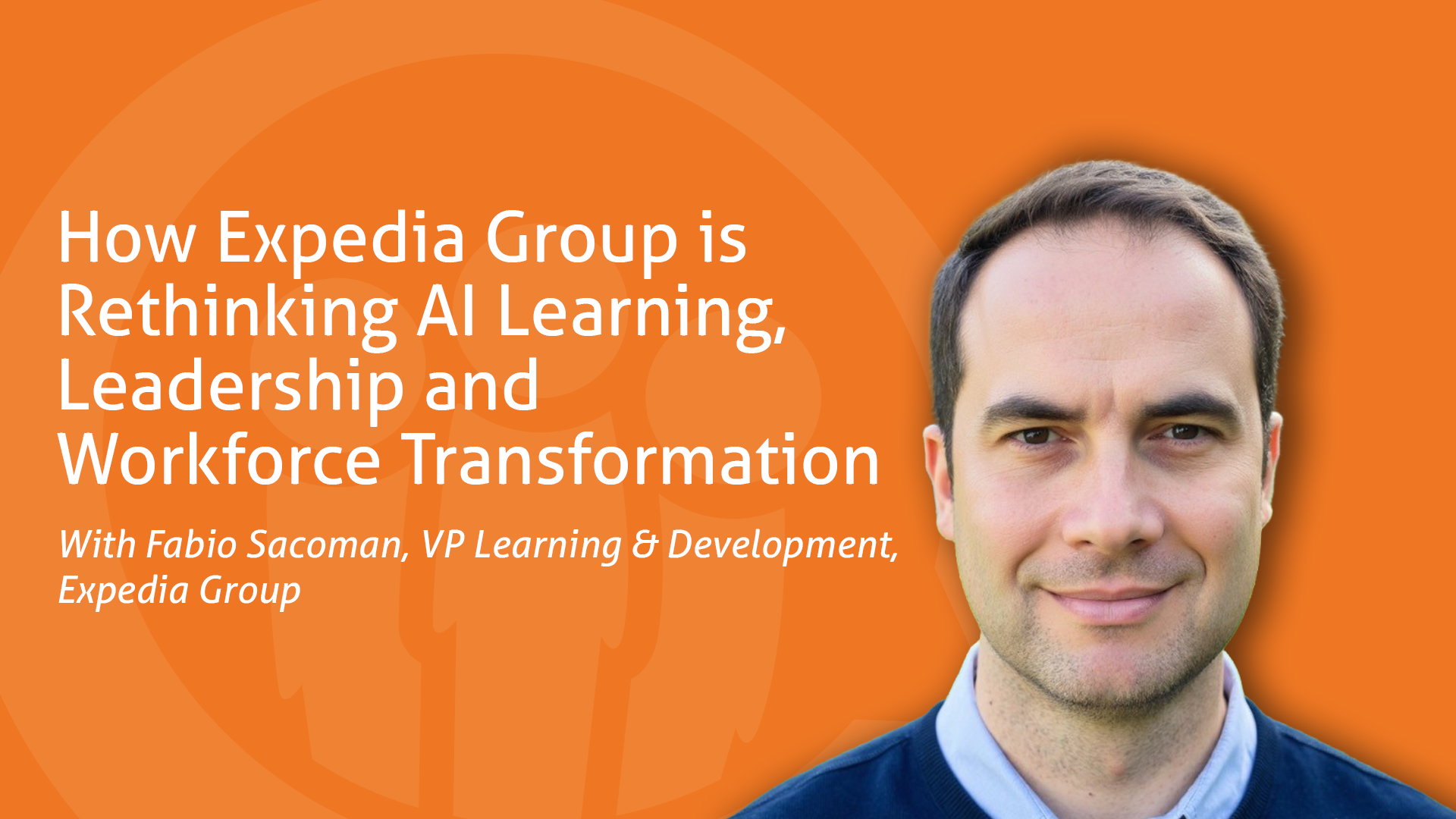
Fabio Sacoman is Vice President of Learning and Development at Expedia Group, where he is helping shape the future of work through AI, culture, and business-led learning. Based in London, Fabio leads Expedia’s AI curriculum, building enterprise-wide AI literacy, accelerating adoption, and ensuring measurable impact across the organisation. He has also transformed Learning into a strategic Centre of Excellence within HR, integrating Talent, Culture, OD, and Learning to solve real business challenges at scale.
FAQs
What is the difference between AI literacy and AI fluency?
Fabio highlights that AI literacy refers to understanding the fundamentals of AI, including what it can and cannot do, its limitations, and responsible usage. AI fluency, on the other hand, goes further and focuses on applying AI effectively in real-world workflows using judgment, critical thinking, and practical business understanding.
Why should Learning and Development teams become tool-agnostic?
Experts across Learning, Talent, and Leadership functions argue that AI technologies evolve extremely quickly, and that building Learning programmes around specific tools can make training obsolete within months. A tool-agnostic strategy, for Fabio, focuses on transferable skills, adaptability, and frameworks that remain relevant despite changing technologies.
How can organisations embed AI learning into the flow of work?
Rather than relying solely on courses or formal programmes, Fabio argues that organisations can integrate AI capability-building into leadership meetings, project work, strategic conversations, and operational problem-solving. Learning, he says, becomes more relevant when employees apply AI directly to real business challenges.
What metrics should organisations use to measure AI capability?
Traditional completion metrics are becoming less valuable, according to Fabio. Instead, he suggests that organisations should focus on behavioural and operational indicators such as productivity improvements, cycle time reductions, adoption rates, applied capability, time-to-launch, and measurable business impact.
What role should senior leadership play in AI transformation?
In Fabio’s opinion, successful AI transformation requires visible executive sponsorship and strategic alignment. He suggests that AI capability-building should be driven from the top of the organisation because it impacts workforce strategy, organisational design, innovation, and long-term business performance.
What is the future of the LMS in an AI-powered workplace?
The traditional LMS model is evolving. In Fabio’s opinion, future learning ecosystems are likely to become more embedded, AI-driven, and workflow-integrated, surfacing learning support dynamically based on real-time employee needs and business problems.