Submitted by Kerry Summers on
Updated April 2026
By Kerry Summers (Content Marketing Coordinator, iVentiv)
Listen to the Podcast on Spotify and Apple Podcasts now.
Key Takeaways
- Make Learning a habit, not an event
- Curiosity should be treated as a performance behaviour
- Learning must live inside the flow of work
- Small, consistent actions drive culture change
- Leaders make or break learning culture
For years, organisations have invested heavily in training programmes, learning platforms and content libraries. Yet throughout that time, Global Heads of Learning have grappled with the question of why doesn’t learning truly stick?
For many, the answer lies in a fundamental shift, from delivering training to building a learning culture rooted in daily habits.
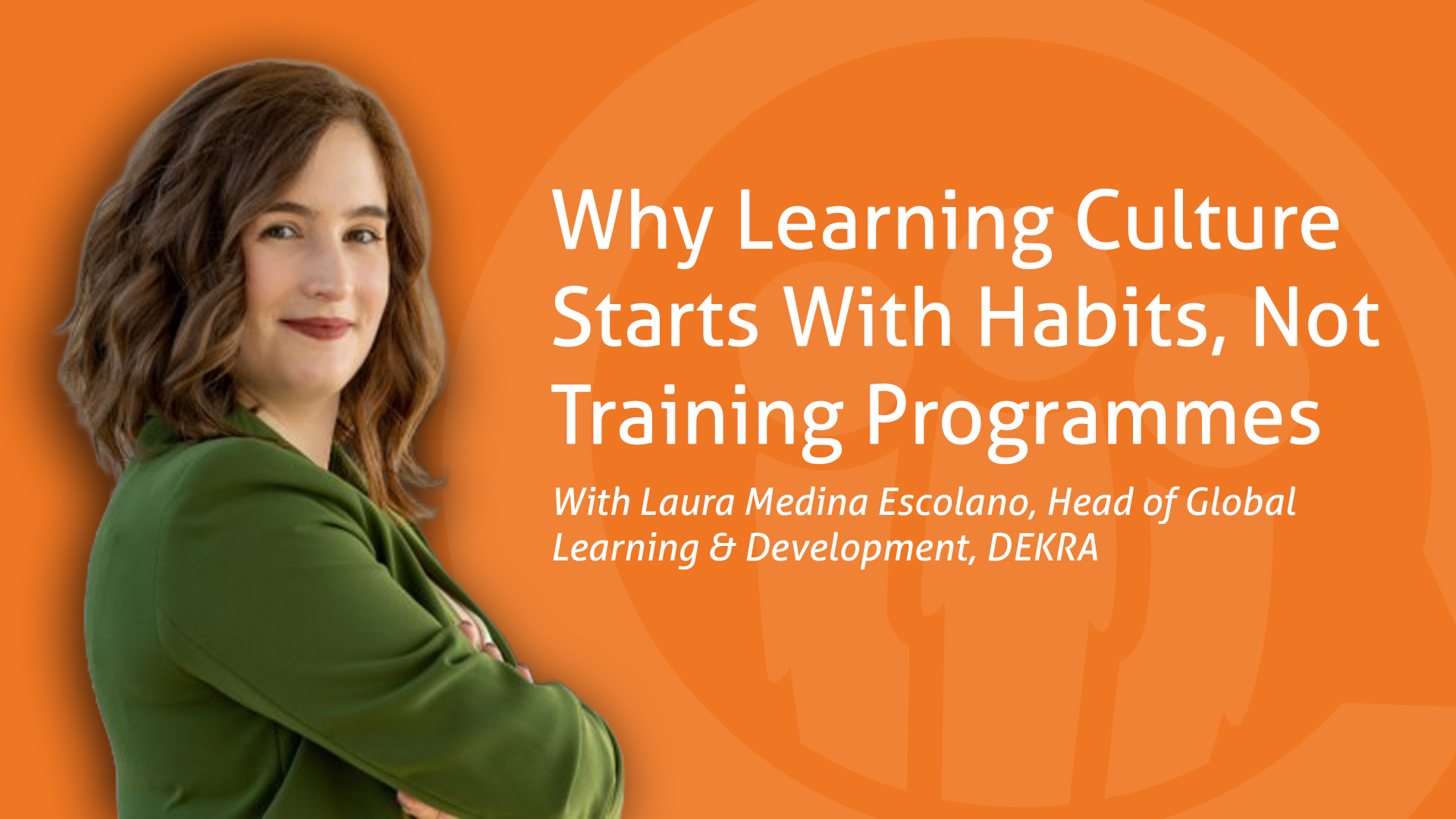
In a recent conversation with Laura Medina Escolano, Head of Global Learning & Development at DEKRA, one idea stood out above all: learning is not an event. It is a behaviour. And more importantly, it is a habit.
This blog explores what it really takes to build a learning culture that lasts, and why habit formation, not programmes, is the key to future-ready organisations.
Why Learning Culture Must Replace Traditional Training Models
One of the most significant shifts in L&D over the last two decades has been the move from reactive learning to proactive capability building.
Laura argues that the pace of change means that waiting to reskill is no longer viable. Instead, organisations must cultivate environments where learning is continuous, self-directed and embedded into everyday work.
Traditional training models, she says, treat learning as something delivered to employees. A learning culture, by contrast, positions learning as something employees actively engage in. It is less about attending sessions and more about developing the instinct to learn continuously.
From Learning Programmes to Learning Habits
If learning culture is the goal, Laura makes the case that habits are the mechanism that make it real.
As she puts it:
“learning has to become part of strategic… second nature… that’s what’s then going to lead into actions and habits.”
Laura Medina Escolano, Head of Global Learning & Development, DEKRA
This is where many organisations, she says, fall short. They invest in programmes but fail to influence behaviour. The real shift for L&D leaders in this conception is to move beyond designing interventions and instead shape how learning shows up in everyday life.
When learning becomes habitual, therefore, it stops feeling like an additional task. It becomes something that naturally fits into the rhythm of work, reinforcing itself over time.
Curiosity as a Core Performance Behaviour
Often, the heart of a sustainable learning culture is curiosity. However, Laura believes that the way we think about curiosity needs to evolve.
Rather than treating it as a personality trait that some people naturally possess, Laura reframes it as something far more practical:
“curiosity becomes more of a performance behaviour”
Laura Medina Escolano, Head of Global Learning & Development, DEKRA
This subtle shift has big implications; if curiosity is a behaviour, it can be encouraged, reinforced and embedded into daily routines. It becomes something organisations can actively cultivate rather than passively hope for.
In this context, Laura describes curiosity as being what drives individuals to look ahead, to question what is coming next, and to take ownership of their own development. It transforms learning from a reactive necessity into a proactive habit.
Embedding Learning into the Flow of Work
One of the most commonly cited barriers to building learning habits is the separation between learning and work. When learning sits outside of work, it competes with it and often loses.
That is why embedding learning into the flow of work could be so critical. As Laura explains:
“learning has to be linked to that thing that you do every day”
Laura Medina Escolano, Head of Global Learning & Development, DEKRA
For Laura, this requires a different approach to design. Instead of pulling employees away from their work to learn, organisations need to bring learning directly into the moments where it is needed most.
In practice, this might mean integrating guidance into existing tools, surfacing insights at the point of decision-making, or using AI to provide real-time support. The aim, Laura underscores, is to make learning feel like a natural extension of work rather than an interruption to it.
Small Actions, Big Impact: The Power of Micro-Habits
While the idea of transforming learning culture can feel overwhelming, the reality is that it often starts with small, consistent actions.
Laura highlights this with a simple but powerful example:
“set aside 15 minutes a week… an hour… make it part of your daily life.”
Laura Medina Escolano, Head of Global Learning & Development, DEKRA
This kind of micro-habit may seem insignificant on its own, but over time Laura says that it builds momentum. Regular, intentional moments of learning begin to shape behaviour, and behaviour, Laura believes, begins to shape culture.
The organisations that succeed in this space are not necessarily those with the most sophisticated learning ecosystems, she explains, but those that make learning easy, repeatable and visible in everyday routines.
The Role of Leaders in Shaping Learning Culture
If habits are the mechanism of learning culture, leadership is the catalyst.
“Leadership has, at their hand, to make things second nature,” Laura explains. “My micro behaviour is going to directly influence the learning behaviour of my people.”
Laura Medina Escolano, Head of Global Learning & Development, DEKRA
This is where learning culture becomes deeply human. It is shaped not by systems or platforms, but by the everyday actions of leaders.
Something as simple as asking a team member what they learned in the past week can reinforce the importance of development. Over time, Laura says these small signals create an environment where learning is expected, valued and shared.
Importantly, Laura notes that this influence is not limited to formal leadership roles. She says that anyone who shapes the behaviour of others contributes to the culture, making learning culture a collective responsibility rather than a top-down initiative.
Creating Psychological Safety for Learning and Experimentation
At its core, learning requires change. And change, for many people, feels uncertain and uncomfortable.
As Laura points out:
“when I try to change a mindset… that’s ultimately very, very scary.”
Laura Medina Escolano, Head of Global Learning & Development, DEKRA
This is why she sees psychological safety as so critical. Without it, employees are unlikely to take the risks required to learn and grow.
Leaders, she says, play a central role:
“What we as leaders… do, is we make the environment around us safe for change, for experimenting, for failure, ultimately.”
Laura Medina Escolano, Head of Global Learning & Development, DEKRA
In her experience, creating this kind of environment does not require large-scale initiatives. It often starts with simple behaviours, such as openly sharing mistakes, reflecting on what was learned and demonstrating that failure is part of the process.
When trust is present, fear begins to diminish. And when fear diminishes, learning accelerates.
Rethinking Failure as Part of the Learning Journey
The idea of failing safely is often discussed, but, Laura suggests, is rarely explored in depth.
Laura offers a more nuanced perspective. Early in a career, individuals should be encouraged to experiment and make mistakes when the consequences are low. As responsibility increases, so too does the need for precision.
This highlights the importance of creating environments where learning can take place without real-world risk. Simulations, cohort-based learning and emerging technologies such as VR, she explains, all offer opportunities for individuals to test ideas and build confidence before applying them in high-stakes situations.
In this sense, failure is not something to eliminate, but something to relocate, away from critical moments and into controlled learning environments.
Aligning Learning Culture with Business Strategy
A learning culture cannot exist in isolation. It must be grounded in the strategic direction of the organisation.
As Laura sees it, the starting point should always be the same:
“where does my organisation want to be in five years?”
Laura Medina Escolano, Head of Global Learning & Development, DEKRA
From there, learning becomes a means of enabling that future. It connects individual development with organisational ambition, and this, crucially for Laura, creates a shared sense of purpose.
This alignment is particularly important for engaging today’s workforce. Employees increasingly want to understand why they are learning something and how it contributes to both their personal growth and the success of the organisation.
For Laura, when learning is tied to purpose, it becomes far more meaningful and far more effective.
Seeing Learning as a Strategic Lever rather than a cost
One of the most persistent challenges in L&D is perception. Often, learning is viewed as a cost rather than an investment.
Laura challenges this directly:
“learning… is not a cost centre… you should rather look at it as a lever or as an enabler for business strategy.”
Laura Medina Escolano, Head of Global Learning & Development, DEKRA
She sees this shift in mindset as essential. When learning is positioned as a strategic lever, it moves from the margins to the centre of organisational decision-making and becomes something that drives performance, enables transformation and supports long-term growth.
The Future of Learning Cultures: Habit, Not Initiative
Ultimately, for Laura, the future of learning will not be defined by better programmes or more content. Instead, it will be defined by behaviour.
Building a learning culture is not about launching the perfect initiative. It is about:
- Embedding small, consistent habits that make learning part of everyday life
- Curiosity becoming routine
- Development becoming part of how work gets done
For organisations that embrace this shift, Laura tells us that the payoff is significant. They will cultivate, not just a more skilled workforce, but a more adaptable, resilient and future-ready one.
And in a world defined by constant change, that may be the most valuable capability of all.
Laura’s passion lies in enabling transformation through learning, leadership, and innovation. As Head of DEKRA’s Centre of Excellence for Learning & Development, she defines global standards and drives strategic initiatives that empower teams across more than 50 countries. With a background in IT strategy, organisational change, and international consulting, Laura combines analytical depth with a hands-on mindset to shape impactful learning experiences and foster a culture of growth in a rapidly evolving world of work.
FAQs
What is a learning culture in an organisation?
A learning culture is an environment where continuous development is embedded into everyday work, rather than delivered through occasional training programmes. Employees are encouraged to take ownership of their learning, driven by curiosity and supported by leadership behaviours and systems that make learning part of daily routines.
Why is learning culture important for L&D leaders today?
Learning culture is critical because the pace of change means skills quickly become outdated. As highlighted in the discussion, organisations can no longer rely on reactive learning. Instead, they must enable employees to proactively build skills, making learning a continuous and strategic capability rather than a one-off activity.
How do you build a learning culture in practice?
Building a learning culture starts with shifting focus from programmes to behaviours. This includes embedding learning into daily workflows, encouraging curiosity, creating psychological safety and ensuring leaders actively model learning behaviours. Over time, these actions help turn learning into a habit rather than an event.
What is the role of habits in learning culture?
Habits are the foundation of a learning culture. When learning becomes part of regular routines, such as setting aside time each week or integrating learning into everyday tasks, it becomes sustainable. As noted by Laura, learning needs to become “second nature” to drive consistent actions and behaviours.
How can L&D teams encourage employees to learn continuously?
L&D teams can encourage continuous learning by reducing friction. This means making learning easy to access, relevant to current tasks and embedded into tools employees already use. Encouraging small, consistent learning moments is often more effective than large-scale training initiatives.
Why is curiosity important in a learning culture?
For Laura, curiosity is the driver of continuous learning. It prompts individuals to ask questions, explore new ideas and anticipate future skill needs. Importantly, curiosity can be developed as a behaviour, not just a personality trait, making it something organisations can actively nurture.
What role do leaders play in building a learning culture?
Leaders play a critical role by shaping everyday behaviours. Their actions, such as asking about learning, sharing their own development or discussing mistakes, directly influence how employees perceive learning. As Laura highlights, leadership behaviour can make learning feel natural and expected across the organisation.