For decades, Learning & Development has been organised around a familiar production model; a business identifies a need, L&D designs a programme, content is created, employees complete it, and despite a genuine desire to measure business impact, success is often reported through attendance, completion rates and satisfaction scores. But the advent of AI is beginning to dismantle that model, not because it can generate a course, produce a video or build a presentation faster, but because it allows L&D to move beyond producing learning assets and take greater responsibility for workforce performance.
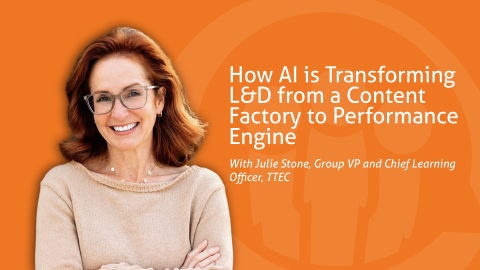
Few leaders are exploring this shift as practically as Julie Stone, Chief Learning Officer and Group VP at TTEC. Drawing on more than 20 years of experience across global organisations, Julie is helping to embed AI, adaptive learning and performance-based development into the flow of work. Her perspective challenges many of the maligned assumptions that have shaped the way L&D is perceived for decades, particularly the idea that the function’s primary role is to produce training content.
In this blog, we explore Julie’s view of an AI-enabled L&D function that is faster, more adaptive and more commercially relevant, while remaining deeply human. It is a vision in which AI takes on repetitive and production-heavy work, enabling Learning professionals to focus on judgment, coaching, context and the complex work of changing behaviour. Watch it now.