Submitted by Kerry Summers on
Updated April 2026
By Kerry Summers (Content Marketing Coordinator, iVentiv)
Listen to the podcast on Spotify and Apple Podcasts now.
Key Takeaways
- Moving from consuming information to repeated, contextual practice drives real behaviour change
- AI is becoming a teammate, not just a tool
- Fear, uncertainty, and mindset are slowing adoption more than the technology itself
- Curiosity is now a core leadership capability
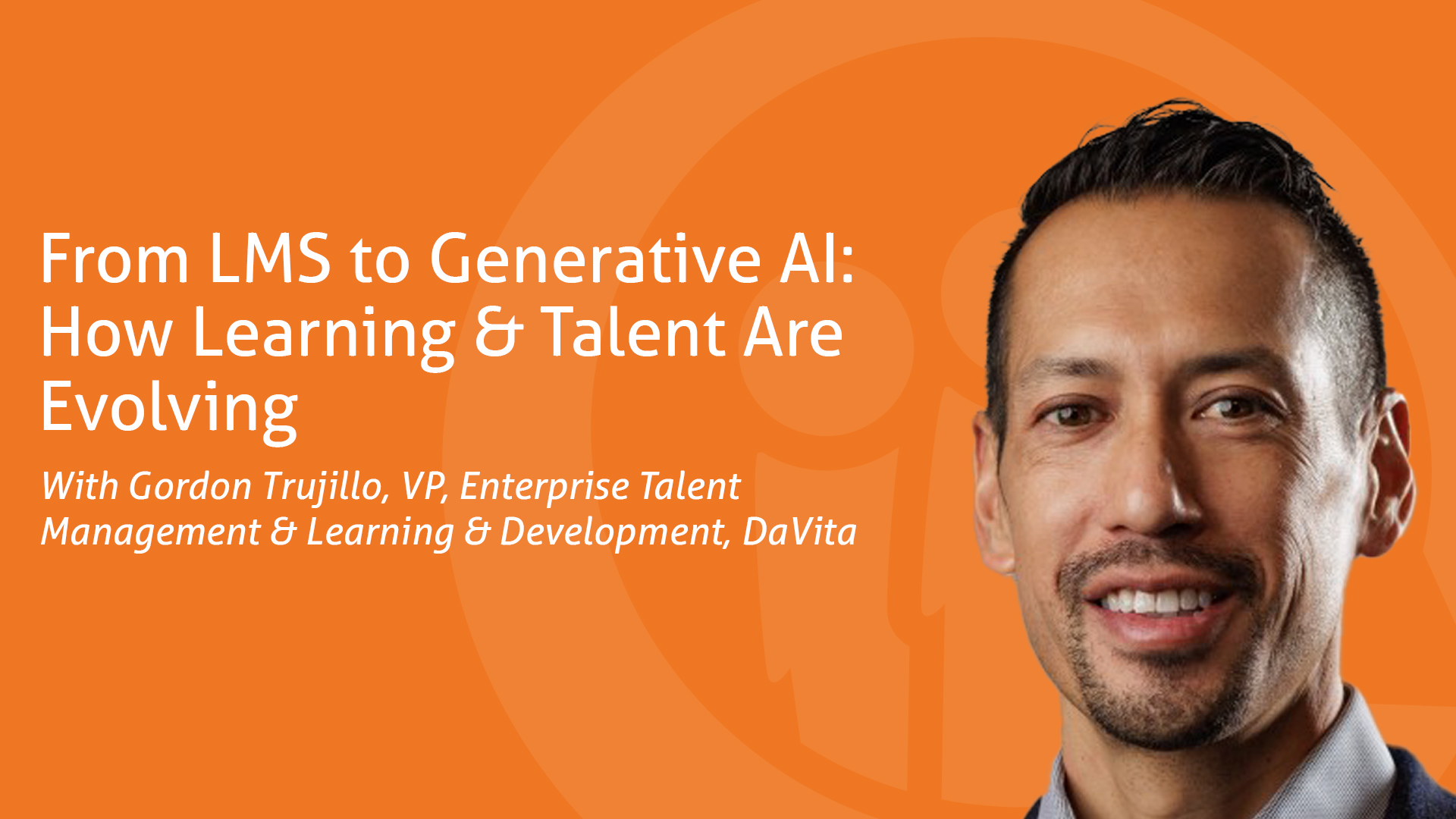
“We as practitioners, we as leaders in this field, need to continue to be comfortable with the fact that technology will continue to disrupt and force us to adapt and think differently.”
- Gordon Trujillo, VP, Enterprise Talent Management and Learning & Development, DaVita
There are moments in history where technology doesn’t just enhance work but instead redefines it. For Chief Learning Officers and Talent leaders like Gordon, the rise of artificial intelligence represents one of those inflection points.
From the early days of Learning Management Systems to today’s generative AI tools, Gordon Trujillo has witnessed multiple waves of transformation. Yet, as he reflects, today’s shift feels fundamentally different. AI is not simply another tool in the ecosystem. He says that it is fundamentally reshaping how we learn, how we lead, and how organisations operate.
For leaders across the iVentiv community, the challenge is not whether to engage with AI, but how to do so thoughtfully, responsibly, and effectively.
From LMS to AI: The Evolution of Learning Technology
Gordon’s career spans the evolution of workplace learning, from implementing early LMS platforms to navigating today’s AI-driven landscape.
Each technological wave, he explains, has expanded access and scalability. The internet enabled digital learning. Mobile brought learning into the flow of work. Cloud technologies connected systems and data. Now, AI is redefining what’s possible altogether. A quote that sticks with Gordon when he thinks back on the evolution of tech as he’s experienced it:
“Today’s AI is the worst AI you’ll ever use.”
- Gordon Trujillo, VP, Enterprise Talent Management and Learning & Development, DaVita
This is an observation that captures the pace of change. AI is not static, it is improving continuously, and rapidly. For Learning leaders, according to Gordon, this means that waiting for maturity is not a viable strategy. Instead, curiosity and experimentation must become core capabilities.
AI as a Catalyst for Personalised, Scalable Learning
Arguably, one of the most compelling opportunities AI presents is the ability to deliver truly personalised learning at scale.
Gordon tells us that, historically, high-impact learning experiences, i.e, those that drive real behaviour change, have required significant investment: time, facilitation, and in-person interaction. These experiences, he says, have often been difficult to scale across large organisations.
AI, however, is changing that equation.
By enabling immersive simulations, conversational role-play, and adaptive feedback, organisations can now create learning environments that are both engaging and scalable:
“We can create more opportunities for practice in a more immersive way… that leads to behaviour change faster.”
- Gordon Trujillo, VP, Enterprise Talent Management and Learning & Development, DaVita
In healthcare, for example, this translates into high-stakes skill development through simulated environments. In Leadership Development, it means practicing difficult conversations with AI-driven scenarios. Across industries, Gordon observes that the implications are profound, and that the goal is not just knowledge acquisition, it is confidence, capability, and performance.
The Power of Practice: From Content to Capability
A key shift highlighted in our conversation is the move from content delivery to experiential learning. Gordon says that AI enables what many organisations have long aspired to achieve: continuous, contextual practice.
Rather than attending a single training session, learners can now engage in repeated, personalised interactions that reinforce skills over time. These “moments of practice” increase the likelihood of real-world application and lasting behaviour change.
This shift aligns closely with what we know CLOs have been striving for; learning that is embedded in work, not separate from it.
Barriers to AI Adoption: Mindset Over Technology
Despite the excitement surrounding AI, adoption remains uneven.
Gordon points out that a significant portion of the global population has yet to meaningfully engage with AI tools. Even within organisations, enthusiasm often coexists with uncertainty.
“I think this particular technology… creates a lot of anxiety because it feels so human.”
- Gordon Trujillo, VP, Enterprise Talent Management and Learning & Development, DaVita
This human-like capability is both AI’s strength and its challenge. It raises questions about job security, creativity, and identity, questions that, Gordon argues, cannot be addressed through technology alone.
For learning leaders, this underscores the importance of:
- Normalising experimentation
- Providing clear use cases
- Supporting mindset shifts
- Creating safe environments for exploration
Importantly, an observation is made that leaders must recognise that hesitation is not resistance, but that it is a natural response to change.
Redefining Leadership in the Age of AI
Perhaps the most profound implication of AI lies in how it reshapes leadership itself.
Gordon introduces a powerful concept: rethinking our “operating system” as leaders. In his opinion, by offloading routine tasks to AI such as information gathering, summarisation, or process execution, leaders can reclaim time for higher-value activities which includes:
- Coaching and developing teams
- Strategic thinking
- Building relationships
- Driving innovation
Gordon goes on to say that, in this context, AI is not just a tool, but is instead a collaborator:
“We have to consider now that we have new team members… technologically enabled.”
- Gordon Trujillo, VP, Enterprise Talent Management and Learning & Development, DaVita
This shift requires leaders to become more versatile, balancing human skills like empathy and influence with technological fluency. The most effective leaders will be those who can integrate both seamlessly.
From Specialists to “Full-Stack” Talent
AI is also transforming how roles are defined and executed. Traditionally, creating a learning experience required multiple specialists: instructional designers, content creators, video producers, and more. Now, AI enables individuals to perform many of these functions themselves.
This gives rise to what Gordon describes as a more “full-stack” approach to roles:
“I really think we have to start thinking about what does the full stack… creator actually look like.”
- Gordon Trujillo, VP, Enterprise Talent Management and Learning & Development, DaVita
Rather than eliminating roles, this shift is about collapsing complexity and increasing capability. It allows organisations to move faster, iterate more frequently, and unlock greater creativity.
For CLOs, this presents both an opportunity and a responsibility: to redefine skills, redesign roles, and reskill the workforce accordingly.
Curiosity as a Core Leadership Capability
Throughout our conversation, one theme emerges consistently: curiosity.
In a rapidly evolving landscape, no leader has all the answers. What matters to Gordon is the willingness to explore, experiment, and learn.
“The sooner you become curious, the sooner you start using… it gets more fun and more exciting.”
- Gordon Trujillo, VP, Enterprise Talent Management and Learning & Development, DaVita
This mindset is critical not only for individual growth but for organisational success, and leaders who model curiosity create cultures where innovation can thrive.
For learning leaders, the path forward involves embracing uncertainty, prioritising experimentation, and staying grounded in what matters most: human capability.
As Gordon emphasises, technology will continue to evolve. By focusing on practice, personalisation, and purpose, CLOs can ensure that AI enhances rather than replaces the human experience of learning.
Gordon Trujillo is a seasoned human capital and workforce transformation executive, known for shaping high-impact talent strategies across Fortune 300 organisations. Currently with DaVita Kidney Care, he brings deep expertise in talent development, learning, and people analytics, helping organisations unlock performance through their people. A recognised thought leader, Gordon operates at the intersection of data, leadership, and culture, championing human-centered approaches in an increasingly digital world. He is particularly passionate about leveraging analytics and AI to drive smarter workforce decisions while maintaining a strong focus on employee experience and growth.
FAQs
What is the role of AI in Learning and Development?
AI enables personalised, scalable, and immersive learning experiences. It supports adaptive learning pathways, real-time feedback, and simulation-based practice, helping organisations move from content delivery to capability building.
How can AI personalise learning at scale?
AI analyses learner behaviour, skill levels, and preferences to tailor content and experiences. It can simulate real-world scenarios, provide targeted feedback, and adapt learning journeys in real time, making personalisation achievable across large workforces.
What are the biggest challenges of AI adoption in organisations?
The primary challenges are not technical but human. These include fear of change, lack of understanding, and uncertainty about AI’s impact on roles. For Gordon, clear use cases, leadership support, and a culture of experimentation are essential to overcoming these barriers.
How is AI changing leadership skills?
AI is shifting leadership from task execution to strategic and human-centred activities. Gordon argues that leaders must balance technological fluency with skills like empathy, critical thinking, and influence, while learning to work alongside AI as a collaborator.
Will AI replace jobs in Learning and Development?
Rather than replacing roles, AI is reshaping them. It enables professionals to become more versatile, taking on broader responsibilities and focusing on higher-value work such as strategy, creativity, and behaviour change.