The iVentiv Pulse: What Are The Top Priorities for Heads of Learning and Talent in 2025?

As we step into 2025, the landscape of Learning and Talent Development is evolving at an unprecedented pace. 

The 2025 iVentiv Pulse report sheds light on the key priorities and challenges that Heads of Learning, Talent, and Executive Development are grappling with. This comprehensive report, based on iVentiv pre-event questionnaire responses from 563 leaders across 448 companies, offers a unique glimpse into the future of work and the strategies that will shape it.

You can download the full report here, or read on for a summary of the top five topics:
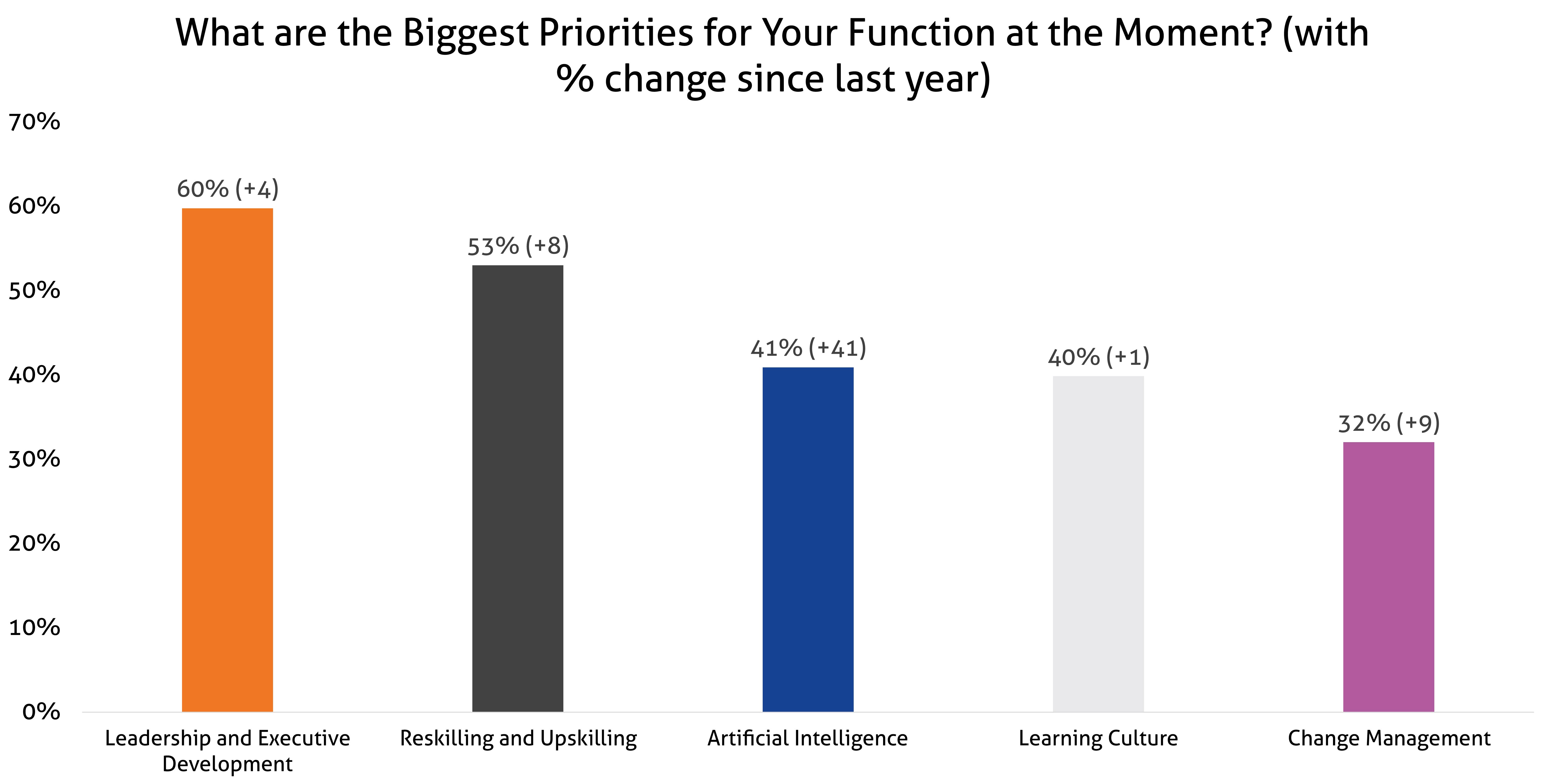
 

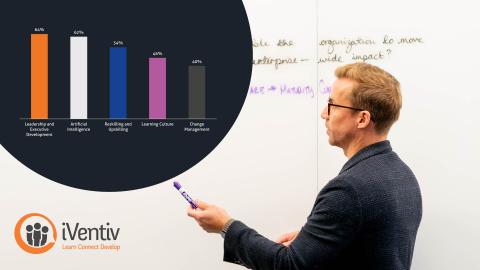
A graph showing Leadership Development (60%), Reskilling and Upskilling (53%), Artificial Intelligence (41%), Learning Culture (40%), and Change Management (32%) under the heading 'What are the Biggest Priorities for Your Function at the Moment? (with % change since last year)'

1. Leadership and Executive Development 

Selected by: 60% of Respondents (+4% compared to 2024)

Leadership and Executive Development continues to be the most selected topic overall, reflecting the onus that L&D leaders are placing on leaders when it comes to navigating the complexities of today's business environment. Leaders are not only expected to steer their organisations through economic uncertainties and technological disruptions, but also to foster a culture of curiosity and continuous learning. 

2. Reskilling and Upskilling: Building the Skills-Based Organisation

Selected by: 53% (+8%)

The rise of Reskilling and Upskilling as a top priority underscores the urgency organisations and Learning teams feel to equip their employees with the skills required to adapt to new technologies and ways of working. The shift towards skills-based organisations is another key factor, with leaders emphasising the importance of flexible and inclusive talent practices that can meet the demands of a dynamic workforce.

3. Artificial Intelligence: Can L&D Lead?

Selected by: 41% (+41%)

Artificial Intelligence (AI) is taking a lot of the headlines and Learning & Development is clearly no different. The report reveals a growing interest in leveraging AI to augment learning experiences, provide personalised learning, and support workforce transformation. 

4. Learning Culture: Curiosity, Continuous Improvement, and Change

Selected by: 40% (+1%)

Learning Culture was the fourth most popular topic among respondents this year, with Learning Executives concerned about remaining competitive and innovative. The report highlights the perceived importance of leaders in setting the tone for a learning culture that encourages self-led, on-the-job learning. For Heads of Learning and Talent, this approach is particularly vital in times of upheaval and change, where the ability to adapt and learn quickly can make the difference between success and failure.

5. Change Management: Underpinning Everything?

Selected by: 32% (+9%)

The rapid changes impacting businesses and Learning teams are everywhere, with some level of change underlining the focus on each of the other top topics detailed in this report. Whether it’s technology, a restructured learning team, or political disruption, L&D leaders clearly feel that navigating and driving change will be a big priority for them in 2025. 

The iVentiv Pulse 2025 report provides a rare insight into the priorities and challenges facing Learning and Talent leaders today. As organisations navigate the complexities of the modern business landscape, the focus from L&D executives on leadership, skills development, AI integration, learning culture, performance management, and employee engagement. By embracing these priorities, organizations can build a resilient and adaptable workforce ready to meet the demands of the future.

Read the full report for a detailed analysis of the data, with expert reflections from Nigel Paine, Stefaan van Hooydonk, Vidya Krishnan, Jay Moore, Brian Murphy, and Gary Kildare.
Download here.
 

Thumbnail: 
News category: 
Latest Trends in Learning

More Insights

As AI rapidly reshapes how work gets done, Leadership Development is facing a defining moment. If knowledge, once the cornerstone of leadership capability, is becoming increasingly commoditised, that could mean that judgement, the ability to make sound decisions, align people, and lead through uncertainty, will matter far more. 

In this interview, Abilitie’s Bjorn Billhardt, Founder and CEO, and Alex Whiteleather, Managing Director for Europe, at Abilitie explore how AI-enabled leadership simulations are transforming development by immersing leaders in realistic, high-stakes decision environments that build critical thinking, business acumen, and cross-functional collaboration.

For Chief Learning and Talent Officers navigating organisational change, flatter structures, and accelerating decision cycles, this perspective could offer a practical framework for rethinking Leadership Development in the age of AI, and a compelling case for why judgement, not knowledge, could provide the true competitive advantage. Watch the interview now and read about how Abilitie is shaking the world of Leadership Development with their brand new Case Challenges experiences.

Learning, Talent, and Executive Development, and the businesses they serve, are undergoing rapid change. AI is changing the way that employees work and learn. External disruption means that the markets businesses operate in are nothing like they were ten years ago. And the expectations on Learning and Talent leaders are enormous.

As a leader in L&D and Talent, what should you prioritise? iVentiv has surveyed almost 500 Global Heads of Learning, Talent, and Executive Development from 394 companies in 16 cities across 8 countries on three continents to find out what they are focusing on in their work. Together, their views provide a unique perspective on the state of Learning and Talent in 2026.

Read the full report for a detailed breakdown of the top topics, with expert comment from some of the leading thinkers in Learning and Talent Development. In this blog, we share some of the headline takeaways.

In this conversation, iVentiv’s Richard Parfitt (Marketing Director), Hannah Hoey (Content Director), and Kristy Kitson (L&D Strategist) share three key learning and development trends that they predict could shape the 2026 agenda for Chief Learning Officers.

Drawing on insights from conversations with Global Heads of Learning, Talent, and Executive Development across industries, they explore how L&D is moving into organisational design, why skills-based approaches are becoming standard practice, and how the AI conversation is evolving from experimentation to responsible, human-centred integration. 

Informed by conversations with Heads of Learning and Talent at hundreds of companies, this conversation is a unique perspective on what might be in store in 2026 for Learning leaders navigating the future of work. Read the blog now.

Artificial intelligence is no longer a project, an initiative, or a phase of digital transformation. It is fast becoming the environment in which modern organisations operate. 

That is the central message of the Udemy Business Global Learning & Skills Trends Report; a data-rich analysis built from more than 17,000 global enterprises and 85,000 instructors and brought to life in a recent iVentiv interview with Gráinne Wafer, Global Head of Field Enablement at Udemy Business.

For senior executives, the implications are becoming impossible to ignore: AI fluency, not just AI skills, is emerging as the defining strategic capability for the years ahead.

Watch our interview now and read Udemy’s report here.

The topic of Artificial Intelligence has been impossible to escape in L&D over the past few years. For some, it stands to displace the entire function and render most of its skills and roles obsolete. For others, it represents an opportunity for Learning to reach more employees in more meaningful ways than ever before.

In this blog and report, we look in more detail at what Heads of Learning say they are really doing about AI

In a world where the shelf life of skills is shrinking from years to mere months, the question facing every Learning leader is no longer if we move to a skills-based model, but how fast. For Comcast, the answer has been a bold, enterprise-wide journey called Skill Forward.

Spearheaded by Sara Dionne, Chief Learning Officer at Comcast, Skill Forward is a data-driven approach that redefines how the business identifies, develops, and embeds skills. What began with conversations with just over 1,000 business leaders has grown into an integrated system shaped by more than 3,000 voices, weaving skills into hiring, strategy, and day-to-day operations.

But transformation at this scale is never simple. How do you balance enterprise-wide consistency with the needs of individual business units, or even individual learners? How do you make assessment meaningful at volume? And how do you keep pace when skills are being redefined almost quarterly by technologies like AI?

In this blog, we explore Sara’s insights from leading Comcast through this transformation, and what every L&D leader can learn about scaling skills, converging human and digital capabilities, and preparing the workforce for constant change. Read it now.

At Boehringer Ingelheim, the “university” concept has been reimagined as a global ecosystem serving every one of the company’s 54,000 employees.

In conversation with iVentiv, Martin Hess, Chief Learning Officer at Boehringer Ingelheim, outlined how his team has created a federated model that unites more than 500 contributors worldwide, built a skills-based approach that directly connects capability to business goals, and implemented a vendor management system that reframes L&D as a value creator rather than a cost centre. The impact, he says, is measurable in both euros saved and credibility gained.

This blog explores Martin’s perspective and Boehringer Ingelheim’s journey, offering insights on skills, ROI, and personalisation that are directly relevant to anyone leading learning at scale. Read it now.

In August, iVentiv brought together a group of Chief Learning Officers and senior learning leaders in Foster City, California. Against the backdrop of Silicon Valley—arguably the global epicentre of technological disruption—the group explored a central question:

How can learning enable organisations to move from AI experimentation to enterprise-wide impact?

Over two days of candid dialogue, Collaborative Cafés, and breakout sessions, CLOs reflected on what it really takes to scale AI, reimagine skills strategies, foster learning cultures, and prepare leaders for disruption. What follows is a synthesis of their key insights, designed to help CLOs worldwide think about the opportunities and challenges ahead.

Read more.

For Michelle Agnew, Global Head of Learning, Engagement, and Culture at CNH Industrial, the work of L&D goes far beyond delivering skills training. It’s about creating an environment where “people want to come to work, and they’re excited about that and giving it back.”

With more than 20 years of experience in HR and Talent Development which includes senior roles at the American Red Cross, Michelle has built a career around connecting learning to culture, engagement, and ultimately, business performance. 

In this conversation, Michelle shares her views on where L&D is headed, how to link learning to ROI, and why human connection may become the ultimate differentiator in the age of AI. Read it now.

“Every single leader, especially in Germany and Europe, will realise they need to invest in their people — otherwise they will lose this competition.”
- Katrin Marx, Head of Corporate Learning, Bosch

The race for talent is no longer about recruitment alone. For multinationals navigating economic changes, AI disruption, and intensifying competition, the real differentiator is how fast organisations can reskill and transform the capabilities of their existing workforce. 

This was the core message from a recent conversation between iVentiv’s Hannah Hoey, Katrin Marx, Head of Corporate Learning, Bosch and Charles Jennings, Co-Founder of the 70:20:10 Institute. Both leaders agree: traditional learning models — designing courses, pushing content, and measuring satisfaction — are obsolete. The new mandate is to create performance-driven ecosystems where skills development is continuous, embedded in work, and tightly linked to business outcomes.

Curious to learn more? Read and watch now.

Pages