Submitted by Kerry Summers on
Updated October 2026
By Kerry Summers (Content Marketing Coordinator, iVentiv)
Listen to the podcast on Spotify and Apple Podcasts now
Five Key Takeaways
- Change leadership is becoming a core business capability
- Leadership commitment does not automatically translate into confidence
- AI fluency and human leadership skills must develop together
- The true measure of leadership development is behavioural change
- The most underestimated part of learning may be learning from others
What happens when the speed of organisational change outpaces leaders' confidence in their ability to manage it?
Across S&P Global, this question has become central to how the organisation thinks about leadership development. With technological advances accelerating, priorities shifting and business decisions becoming increasingly complex, its people leaders are being asked to deliver today's performance while simultaneously preparing their teams for a different tomorrow.
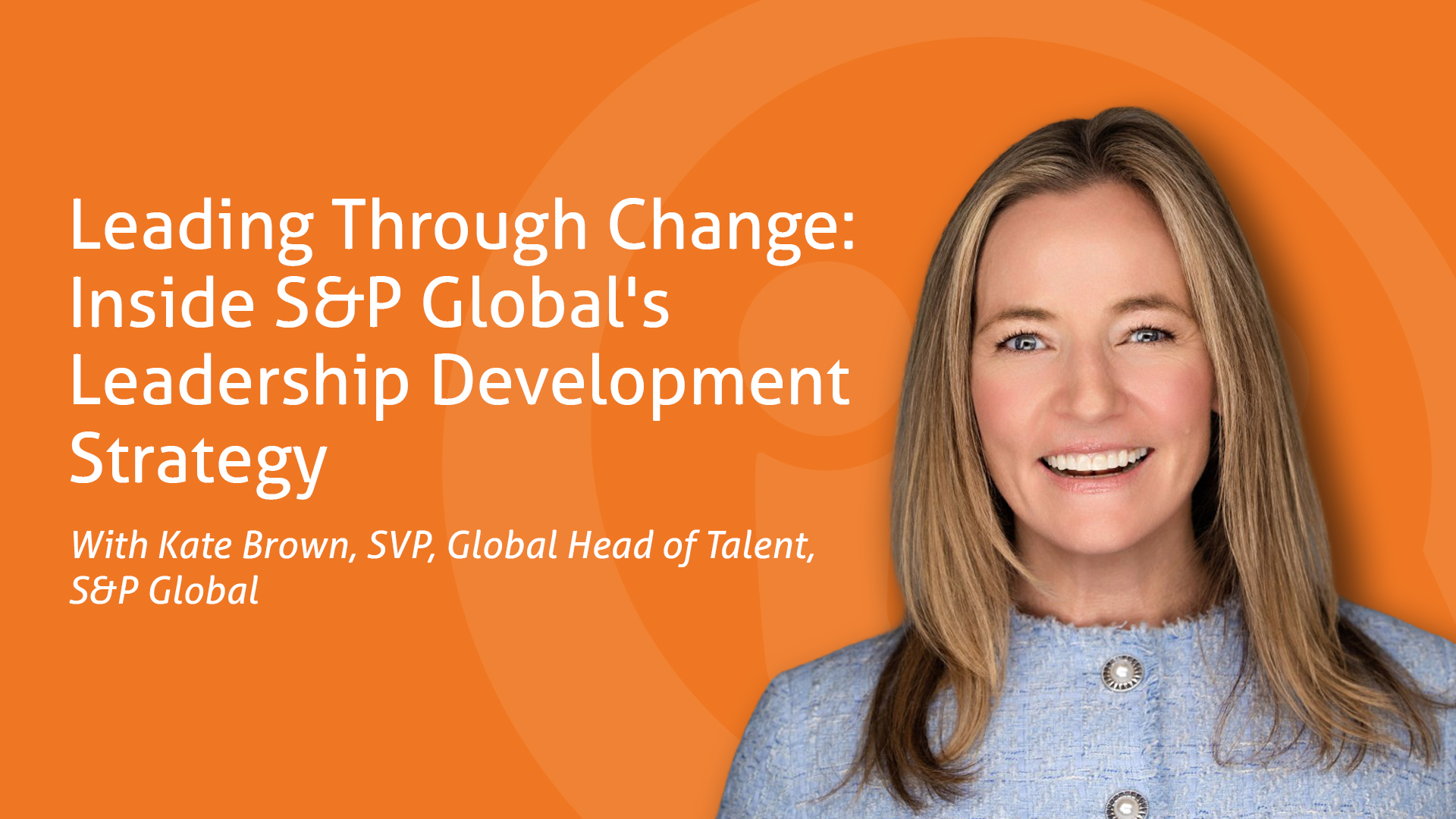
For Kate Brown, SVP, Global Head of Talent at S&P Global, the challenge is not necessarily that leaders lack the willingness to adapt. Rather, they need practical opportunities to translate strategic ambition into everyday action.
In conversation with iVentiv, Kate shares how S&P Global is responding through a large-scale leadership development initiative designed to strengthen change leadership and encourage leaders to take greater ownership of transformation.
Her reflections raise questions for Learning, Talent and Executive Development communities globally:
- Are leadership development programmes keeping pace with the realities of modern management?
- Are organisations giving leaders the authority and space to change how work gets done?
- How can businesses know whether their investment in leadership development is making a difference?
The Leadership Development Challenge: When Change Becomes a Constant
For many organisations, change management has traditionally focused on helping people navigate defined periods of transformation.
At S&P Global, the accelerating pace of change prompted a reassessment of what its people leaders needed most. As Kate explains, the organisation already had foundational management development in place. What was missing was support for a more demanding reality: leaders making faster decisions, responding to continued disruption, and helping their teams maintain direction when priorities evolve.
The objective was not simply to make managers better at coping with uncertainty; instead, it was to give them the capabilities to lead more effectively through it. This ambition, Kate highlights, also reflected the direction set by S&P Global's Chief People Officer, Girish Ganesan, who emphasised the importance of developing a growth mindset and leading confidently in an increasingly digital, AI-enabled environment.
The resulting challenge was considerable: how could S&P Global develop an experience that its approximately 7,000 people leaders would actively want to participate in, despite mounting demands on their time?
For Kate, this was less about repackaging existing management training, and more about building leadership development around the challenges leaders were already experiencing, rather than treating learning as something separate from the demands of the business. In her words:
‘‘We want our people leaders to make the strategy real for their teams, regardless of where you sit or what level you are, be able to see yourself in that work, in the strategy."
Kate Brown, SVP, Global Head of Talent, S&P Global
Building Leadership Capability at Scale: Why Executive Buy-In Starts Before the Programme is Finished
One of the biggest obstacles to large-scale leadership development, Kate explains, is not necessarily the quality of the learning itself, but securing the organisational commitment needed to turn learning into a priority.
S&P Global approached this by involving senior leaders before its leadership development programme had been fully designed. Rather than presenting a completed solution for approval, Kate and her team interviewed senior executives, gathered broader input through surveys and partnered with leading providers to shape the programme.
The partnership was important not only for its contribution to the content, but also because it signalled a substantial investment in leadership development. Crucially, however, Kate wanted the programme to feel specific to S&P Global:
"It's also important that we contextualise it for S&P Global and help people see that this is ours. We didn't want anything to feel off the shelf… we’ve got to slow down a little bit to bring people along."
Kate Brown, SVP, Global Head of Talent, S&P Global
Senior leaders were also invited to experience the learning through a taster session at the organisation's annual Senior Leader Summit, allowing them to understand the approach firsthand and see how their input had influenced its design.
That early involvement created opportunities for executives to become visible sponsors of the initiative, thereby encouraging their teams to make time for development.
Kate's experience highlights an important distinction between securing executive approval and developing genuine executive ownership. S&P Global did not simply ask its senior leaders to endorse an initiative but invited them to help create it and demonstrate its relevance.
For an organisation trying to respond to accelerating change, slowing down to involve the right people might appear counterintuitive. Yet Kate describes investment in consultation and contextualisation as an important part of building momentum.
The Leadership Confidence Gap: Why Understanding Change Is Not the Same as Leading It
One of the clearest findings from S&P Global's research, according to Kate, concerned the difference between recognising the importance of change and feeling equipped to deliver it.
Kate shared that in a survey of approximately 1,600 leaders, 97% identified ‘leading change’ as critical to their role: a distinction that became a defining consideration in the programme's design.
As she explains, leaders understood that their responsibilities were changing, but many were less certain about how to put new expectations into practice. They were being asked to deliver immediate business results while simultaneously preparing their teams for an uncertain future.
The problem, Kate says, was not a lack of commitment, but a gap between strategic understanding and practical execution. Two particular frustrations emerged from this:
1. The first was a need for focus: Leaders wanted clearer priorities and permission to stop doing certain things before being asked to take on additional responsibilities. Kate reflects on one leader’s feedback:
"One leader described it as I need to cut work before I add more work… you can't keep being additive in this process and do all of those things well."
Kate Brown, SVP, Global Head of Talent, S&P Global
Without focus, her concern was that transformation risked becoming an accumulating set of demands rather than a meaningful reconsideration of how work should be organised.
2. The second was decision-making authority: Leaders wanted more decisions to be made closer to the work itself, allowing teams to move faster and take greater ownership:
"This is what we'd really like the academy to support. Helping leaders move from reacting to change, to thinking about how they shape that change and having the power to do it."
Kate Brown, SVP, Global Head of Talent, S&P Global
Both concerns raised by Kate point to an important challenge for organisations developing leadership capability: teaching leaders how to navigate change may achieve little if the surrounding environment prevents them from acting differently.
S&P Global's ambition is therefore to help leaders move beyond reacting to disruption and towards actively shaping the changes affecting their teams. Practical tools form part of that approach, but so does giving managers the opportunity to exchange experiences and consider how new behaviours can be incorporated into everyday work.
For Kate, the aim is to create both the capability and the space for leaders to act with greater confidence, even when they do not have all the answers.
AI Fluency Without Human Skills: Are Organisations Developing Only Half the Leadership Capability They Need?
As AI becomes increasingly embedded in business operations, leadership development faces another fundamental question: should organisations prioritise technical fluency, or concentrate on the human capabilities that enable leaders to guide people through change?
For Kate, separating the two misses the nature of the challenge.
AI is accelerating changes in how work is performed, but it also brings renewed attention to the importance of judgment, adaptability and communication:
"They need to be adaptable in the moment. They need to be able to lead people through this uncertainty. And I don't think you can really separate those two anymore."
Kate Brown, SVP, Global Head of Talent, S&P Global
Leaders, she says, need to understand AI and digital tools well enough to make informed decisions and identify opportunities to redesign workflows. At the same time, they must be able to communicate the reasons for change and guide people through unfamiliar ways of working.
As Kate puts it:
"If you only build AI fluency without human capability, it just doesn't stick."
Kate Brown, SVP, Global Head of Talent, S&P Global
The reverse, she explains, is equally problematic. Developing interpersonal capabilities without helping leaders understand how technology is changing work leaves them inadequately prepared for the realities of an AI-enabled organisation.
This relationship between human and technological capability is particularly visible in the feedback S&P Global has gathered from its leaders: preparing teams for AI consistently emerges as a priority, yet when leaders explain what support they need, their concerns extend beyond understanding the technology itself.
Kate’s view is that leaders want to know how to communicate why changes are happening, explore tools with their teams and identify opportunities to rethink existing processes.
For S&P Global, this is why AI fluency and human capability are being developed together in a programme intended to help leaders translate organisational strategy into something meaningful for their teams and identify how technology might fundamentally change the way work is undertaken.
The challenge for Learning and Talent leaders, Kate emphasises, is therefore not simply to add AI training to an existing leadership curriculum. Instead, Kate’s experience suggests that developing leaders for an AI-enabled future requires a more integrated understanding of what effective leadership now demands.
The Future of Leadership Development: Building Organisations That Can Adapt, Not Just React
Throughout the conversation, Kate returns to a consistent theme: leadership development must respond to the reality of the work leaders are being asked to do.
At S&P Global, that means preparing leaders to deliver business results while navigating ongoing disruption and bringing their teams through technological change.
For Kate:
- Confidence matters, but so do clear priorities
- Decision-making skills matter, but so does the authority to make decisions
- AI fluency matters, but so does the human judgment required to use technology effectively
While learning programmes can create momentum, their longer-term value depends on whether leaders have the opportunity, support and accountability to apply what they’ve learned.
S&P Global's leadership academy offers an example of how one organisation is approaching these challenges at scale, while acknowledging that the ultimate measure of success will emerge over time.
Perhaps the most significant question raised by Kate's experience is not whether organisations are investing enough in leadership development, but whether those investments are sufficiently connected to the changes businesses need their leaders to make.
Kate Brown is Global Head of Talent at S&P Global, where she leads initiatives to attract, develop, and empower talent across the organisation. Overseeing recruitment, learning, performance, coaching, and organisational effectiveness, Kate is passionate about creating opportunities for growth and driving meaningful transformation.
FAQs
Why is change leadership becoming an essential capability for modern managers?
For Kate Brown, the growing importance of change leadership reflects a fundamental shift in the demands placed on people leaders. As organisations navigate accelerating technological disruption, shifting priorities and increasing uncertainty, managers must deliver immediate business results while simultaneously preparing their teams for the future.
At S&P Global, this challenge prompted a move beyond traditional management development towards building leaders' confidence and capability to navigate continuous change.
Kate explains:
"We really want to help our people leaders adapt to constant change so that they can help their teams, and we want them to be able to help their teams to thrive, not just cope."
Kate Brown, SVP, Global Head of Talent, S&P Global
However, recognising the need for change does not automatically translate into the ability to lead it. In S&P Global's survey of approximately 1,600 leaders, 97% identified leading change as critical to their roles, yet confidence in translating strategy into action was considerably lower.
For Kate, closing this gap means equipping leaders with practical tools, clearer priorities and greater decision-making ownership. The ambition is to develop managers who can move beyond reacting to disruption and begin actively shaping how their organisations respond.
Is social learning the most underestimated element of effective leadership development?
When asked to identify her biggest L&D red flag, Kate challenged the way organisations interpret the familiar 70:20:10 learning model, suggesting that the 20% associated with learning from others is frequently undervalued.
While formal development provides valuable frameworks and practical experience creates opportunities to apply them, Kate argues that neither necessarily guarantees meaningful learning. As she explains:
"Experience on its own doesn't guarantee learning."
Kate Brown, SVP, Global Head of Talent, S&P Global
Leaders can repeat established behaviours for years without fundamentally improving how they approach challenges. The difference, Kate suggests, comes through reflection, constructive feedback, coaching and observing how others navigate difficult situations.
This is particularly relevant when leadership concepts are applied in complex, high-pressure environments, where theoretical understanding may offer limited guidance without opportunities to discuss and test different approaches.
Hybrid working adds another dimension to this challenge. With spontaneous interactions and informal learning opportunities occurring less naturally, Kate believes organisations must become more intentional about creating environments where colleagues can exchange experiences, practise new skills and learn from one another.
For Learning and Talent leaders, this challenges the assumption that delivering more content will necessarily produce better development outcomes.
Instead, Kate's perspective places greater emphasis on the relationships and conversations that help individuals translate knowledge into action. The question, then, is whether leadership development strategies are investing enough in the opportunities for collective reflection and learning that allow experience to become genuine capability.
How can organisations close the gap between leadership strategy and practical execution?
One of the most significant challenges identified through S&P Global's leadership research was the difference between understanding what needed to change and feeling confident about making that change happen.
Despite widespread recognition of change leadership's importance, Kate expressed that many managers expressed uncertainty about translating strategic objectives into practical action. She describes the challenge:
"Our leaders are really committed. They're just not confident yet."
Kate Brown, SVP, Global Head of Talent, S&P Global
She tells us that two recurring concerns emerged from the research:
- The need for clearer priorities and greater decision-making authority.
- Leaders wanted permission to stop lower-priority activities before taking on additional responsibilities, alongside the freedom to make decisions closer to where work actually happens.
These findings informed S&P Global's leadership academy, which aims to equip managers with practical approaches to managing uncertainty, alongside opportunities to learn from colleagues facing similar challenges.
Kate also emphasises the value of making space for development within demanding working environments. Rather than expecting leaders to absorb additional content alongside existing responsibilities, the programme encourages reflection, peer discussion and the application of learning within everyday work.
The underlying ambition is to help leaders move from understanding organisational strategy to making it meaningful for their teams, empowering them to take greater ownership of change rather than waiting for direction.
How can organisations make time for leadership development when managers are already overwhelmed?
One of the most persistent challenges facing Learning and Talent teams is competing for leaders' time. At S&P Global, Kate recognised that asking managers to participate in development while simultaneously navigating growing business demands required more than simply offering relevant content.
Leadership visibility became an important part of the solution. By encouraging senior executives to host sessions, participate in conversations and actively promote the programme, S&P Global sought to demonstrate that leadership development was an organisational priority rather than an optional activity.
However, Kate also highlights the importance of giving leaders permission to create space for learning:
"I think it's just getting people to stop and take the time and think about how to work this into the flow of work."
Kate Brown, SVP, Global Head of Talent, S&P Global
Her experience raises a question about whether organisations are creating the conditions for development to happen, or simply expecting managers to find additional capacity within already demanding schedules.
How can Learning and Talent functions create accountability without turning development into another compliance exercise?
As organisations look for stronger evidence of the value of leadership development, there is a risk that measurement becomes dominated by easily reported indicators such as participation, attendance and programme completion.
Kate's approach at S&P Global points towards a different relationship between learning and accountability.
The organisation intends to explore how leadership expectations can become more closely connected to performance management, ensuring that development is reinforced through the objectives and behaviours expected of managers.
As Kate explains:
"We're going to continue to look at ways to bake in more clear objectives and more accountability into our performance management."
Kate Brown, SVP, Global Head of Talent, S&P Global
This represents an ambition to move leadership development beyond an isolated learning experience and into the everyday expectations of the role.
However, Kate also recognises that demonstrating meaningful change requires time. Employee sentiment may provide an accessible initial indicator, but changes in workflows, decision-making and business outcomes will offer further insight into whether new capabilities are becoming embedded.
For senior HR and Talent leaders, this introduces a challenging question: How can organisations hold leaders accountable for applying what they learn while preserving the experimentation, reflection and willingness to take risks that effective development requires?