Submitted by Kerry Summers on
Updated March 2026
By Kerry Summers (Content Marketing Coordinator, iVentiv)
Listen to the podcast on Spotify and Apple Podcasts now.
Key Takeaways
- Mindset, not skills, is the real leadership differentiator
- The ability to manage ambiguity is a critical leadership advantage
- Unlearning is one of the hardest, and most essential, leadership skills
- Skills alone do not future-proof organisations
- Mindset shifts do not happen in classrooms
For the past several years, one of the most dominant themes in conversations around learning and talent development has been skills.
Skills taxonomies. Skills-based organisations. Skills marketplaces.
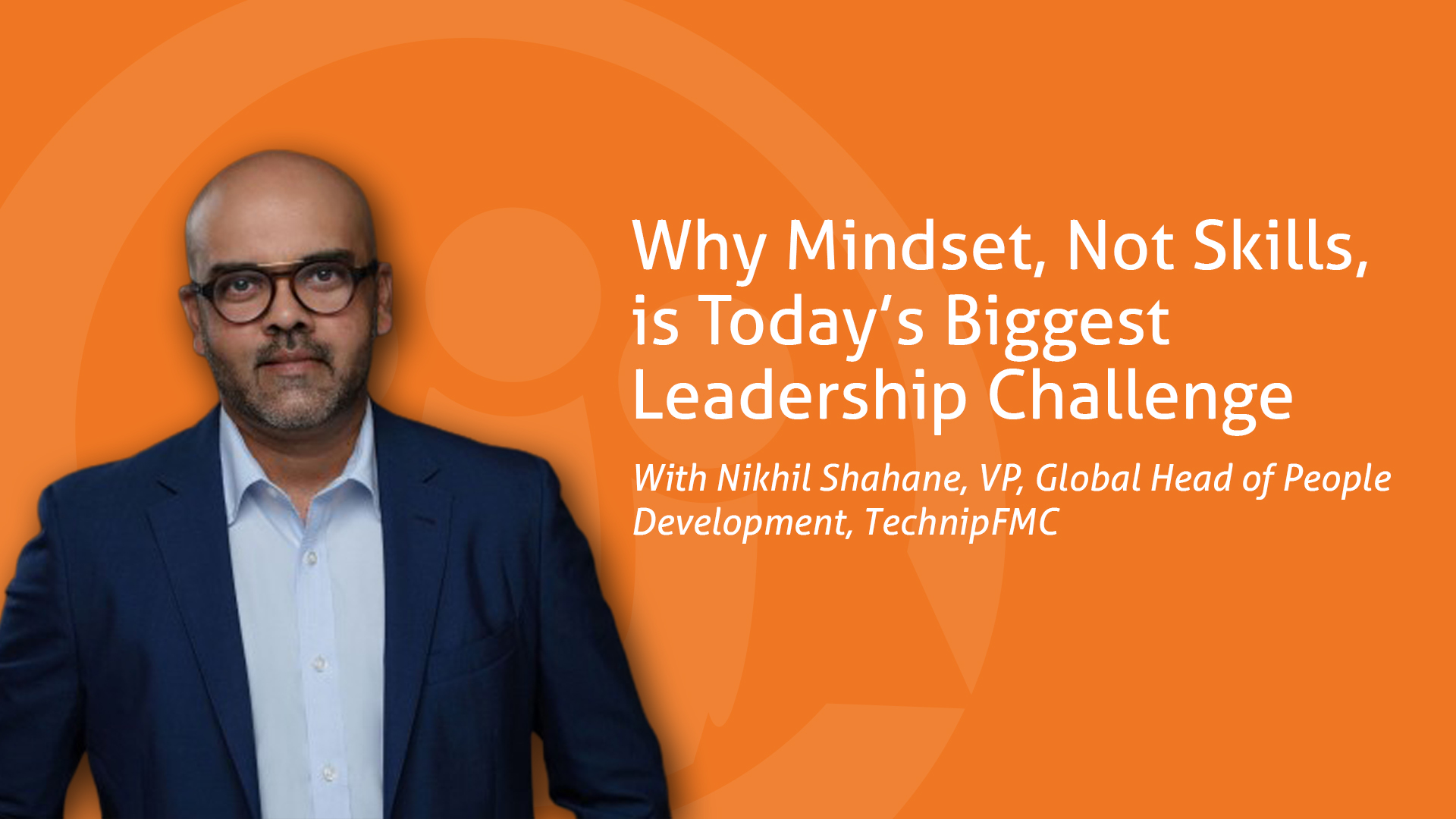
But according to Nikhil Shahane, VP Global Head of People Development at TechnipFMC, organisations may be overlooking the deeper challenge: “Mindsets are more important than skill sets.”
In a world defined by accelerating change, the ability to learn new skills matters, but the ability to change how we think, adapt how we work, and let go of legacy approaches matters even more.
For Learning and Talent leaders, this shift raises an important question: are we focusing too much on skills, and not enough on mindset?
From VUCA to BANI: Why Leadership Mindset Matters More Than Ever
For decades, leaders have used the acronym VUCA (volatile, uncertain, complex, and ambiguous), to describe the business environment. But today’s landscape may be even more unpredictable.
Nikhil points to the concept of the BANI world: brittle, anxious, nonlinear, and incomprehensible.
In such an environment, technical capability alone is no longer enough. Nikhil tells us that organisations need leaders who can navigate ambiguity, respond to rapid change, and rethink established ways of working:
“People who are able to manage ambiguity will go farther and longer.”
- Nikhil Shahane, VP Global Head of People Development, TechnipFMC
This is where mindset becomes the differentiator.
Skills can be taught. But mindsets, as Nikhil stresses, determine whether those skills are applied effectively.
For Nikhil, leaders who remain anchored to past models of work will struggle, even if they possess strong technical capabilities.
Why Unlearning Is the Hardest Leadership Skill
One of the most difficult challenges for leaders today, as Nikhil sees it, is unlearning.
In many organisations, particularly in complex industries, leaders have built successful careers by mastering specific systems, processes, and approaches.
But as business models evolve, Nikhil believes that those same approaches may no longer work:
“Letting go of how you did things in the past is challenging for people.”
- Nikhil Shahane, VP Global Head of People Development, TechnipFMC
Workflows are changing. Organisational structures are evolving. Technology is transforming how decisions are made.
Nikhil says that leaders who succeed in this environment will not necessarily be those with the deepest expertise in the old model, but those who are most willing to adapt their thinking.
For Learning leaders, this could mean that their development strategies need to address behaviour and belief systems, not just capability frameworks.
Why Skills Alone Won’t Future-Proof Your Workforce
None of this means skills are unimportant.
Nikhil makes it clear that he thinks organisations still need employees who combine functional expertise, technical knowledge, and digital literacy, particularly as AI and emerging technologies reshape the workplace.
But he says skills alone cannot guarantee adaptability. True capability comes from integrating three elements:
- Technical competence
- Behavioural capability
- Digital and technological literacy
The real challenge, as he sees it, is ensuring employees can combine these capabilities while remaining open to new ways of working.
And that requires a mindset shift.
Why Learning Must Move Beyond the Classroom
If mindset is the real challenge, then traditional training programmes are not enough.
According to Nikhil, mindset shifts rarely occur in classrooms. Instead, they occur through experience:
“Learning by doing things… learning in the flow of work, by experimenting, that’s how we learn.”
- Nikhil Shahane, VP Global Head of People Development, TechnipFMC
Organisations therefore need to create environments where employees can:
- Experiment with new approaches
- Solve real business problems
- Learn from failure
- Adapt quickly
This requires something many organisations are still developing: psychological safety.
Nikhil argues that when employees feel safe to test ideas and learn from mistakes, learning becomes embedded in everyday work rather than confined to formal programmes.
Why Leadership Role Modelling Drives Cultural Change
Mindset shifts cannot be mandated, Nikhil says, they must be modelled.
At TechnipFMC, leadership role modelling has played a critical role in embedding new ways of working.
Nikhil explains that the organisation moved from a traditional leadership competency model to a leadership standard, designed around behaviours needed for the future.
These behaviours encompass:
- Listening and asking more questions
- Connecting work to shared purpose
- Encouraging experimentation
- Learning through problem solving
Importantly, these conversations are embedded within operational rhythms.
Nikhil says that leaders at TechnipFMC regularly gather teams to make problems visible, discuss experiments, and explore what they are learning.
Over time, this transforms learning from a programme into a practice.
Why Learning Leaders Must Resist the “Shiny Object” Trap
Another key mindset challenge facing learning leaders, according to Nikhil, is resisting the pull of new trends.
In today’s HR landscape, new technologies and frameworks emerge almost daily. AI tools, new platforms, and new operating models promise transformation.
But Nikhil warns that Learning leaders must remain disciplined:
“It’s very easy to latch on to something that looks very nice and exciting… but is it really going to help us solve the problem that we have on hand?”
- Nikhil Shahane, VP Global Head of People Development, TechnipFMC
This is where mindset once again becomes critical.
Instead of starting with tools or trends, Nikhil says that Learning leaders must begin with a fundamental question: What business problem are we trying to solve?
Only then should they determine whether a new capability, technology, or learning intervention is necessary.
The Skills-Based Organisation: Evolution or Reinvention?
The concept of the skills-based organisation has gained enormous attention across HR and learning communities.
But Nikhil encourages leaders to look at the conversation critically.
“Skills and competency-based hiring has existed for decades.”
- Nikhil Shahane, VP Global Head of People Development, TechnipFMC
What is new, he argues, is not the concept itself but the technology enabling organisations to operationalise it faster and at scale.
Digital platforms, AI-driven analytics, and workforce data now allow organisations to map skills more dynamically and connect development to business needs more effectively.
However, Nikhil tells us that these tools are only effective if the underlying leadership mindset supports continuous adaptation and experimentation.
Without that mindset, even the most sophisticated systems will struggle to deliver real impact.
Why Learning Is Everyone’s Responsibility
Ultimately, the shift toward a mindset-driven organisation requires shared ownership of development.
Learning cannot be the sole responsibility of HR or the Learning function:
“Learning or people development is not our responsibility… it is the responsibility of every individual and every leader.”
- Nikhil Shahane, VP Global Head of People Development, TechnipFMC
Learning teams can design systems, provide tools, and create opportunities.
But real development happens when leaders encourage experimentation, when employees take ownership of growth, and when organisations create cultures where learning is continuous.
The Real Leadership Challenge Ahead
As organisations navigate an increasingly unpredictable world, the temptation will be to focus on the next emerging skill.
But Nikhil suggests that the real challenge may lie deeper.
Technical skills will always evolve. New technologies will continue to emerge.
What will determine success is whether leaders, and the organisations they lead, can shift their mindset fast enough to keep up.
For Learning and Talent leaders, that may be the most important development challenge of all.
Nikhil Shahane in his role as VP, Global Head of People Development is responsible for the global Talent, Engagement, Inclusion & Diversity functions at TechnipFMC. As an internationally experienced HR professional he has driven the people development mandate across multiple regulatory and socio-cultural environments. He has been with TechnipFMC for over nine years in HR Leadership roles in Middle East, India and Asia Pacific before moving to Houston in 2019.
FAQs
Why is mindset becoming a bigger leadership challenge than skills?
While skills can be learned relatively quickly, mindset shapes how leaders respond to change, uncertainty, and new ways of working. In today’s fast-moving environment, leaders must be willing to challenge established thinking, experiment, and adapt continuously; capabilities rooted in mindset rather than technical skill.
What is the difference between leadership mindset and leadership skills?
Leadership skills refer to specific capabilities such as strategic thinking, communication, or decision-making. Leadership mindset, on the other hand, relates to how leaders approach challenges; whether they are open to change, comfortable with ambiguity, and willing to learn and adapt.
Why are traditional learning programmes not enough to shift leadership mindsets?
Mindset shifts rarely occur through classroom-based training alone. Leaders develop new ways of thinking through experience, experimentation, and reflection, often in the flow of work where they face real business challenges.
How can organisations encourage the mindset needed for continuous learning?
Organisations can support mindset shifts by creating psychological safety, encouraging experimentation, and ensuring leaders model learning behaviours themselves. When leaders openly discuss what they are learning or testing, it signals that growth and curiosity are valued.
Why is managing ambiguity an essential leadership capability today?
In complex environments where change is constant, leaders often face incomplete information and evolving challenges. The ability to remain effective despite uncertainty, and to guide teams through it, is increasingly critical for leadership success.
What role does leadership role modelling play in shaping organisational mindset?
Leaders influence culture through their behaviours. When leaders demonstrate curiosity, openness to feedback, and a willingness to experiment, they reinforce the mindset needed for teams to adapt and grow.
How can learning leaders avoid chasing trends in leadership development?
Learning leaders should begin with a clear understanding of business challenges rather than adopting new tools or concepts simply because they are popular. Asking “What problem are we trying to solve?” helps ensure initiatives deliver real value.