Submitted by Kerry Summers on
Updated February 2026
By Kerry Summers, Content Marketing Coordinator, iVentiv
Listen to the podcast on Spotify and Apple Podcasts now.
Over the past year, conversations with Global Heads of Learning, Talent, and Executive Development have taken on a noticeably sharper edge. The questions CLOs are bringing to the table are no longer about individual programmes or platforms, but about how learning enables organisational adaptability, workforce resilience, and long-term performance.
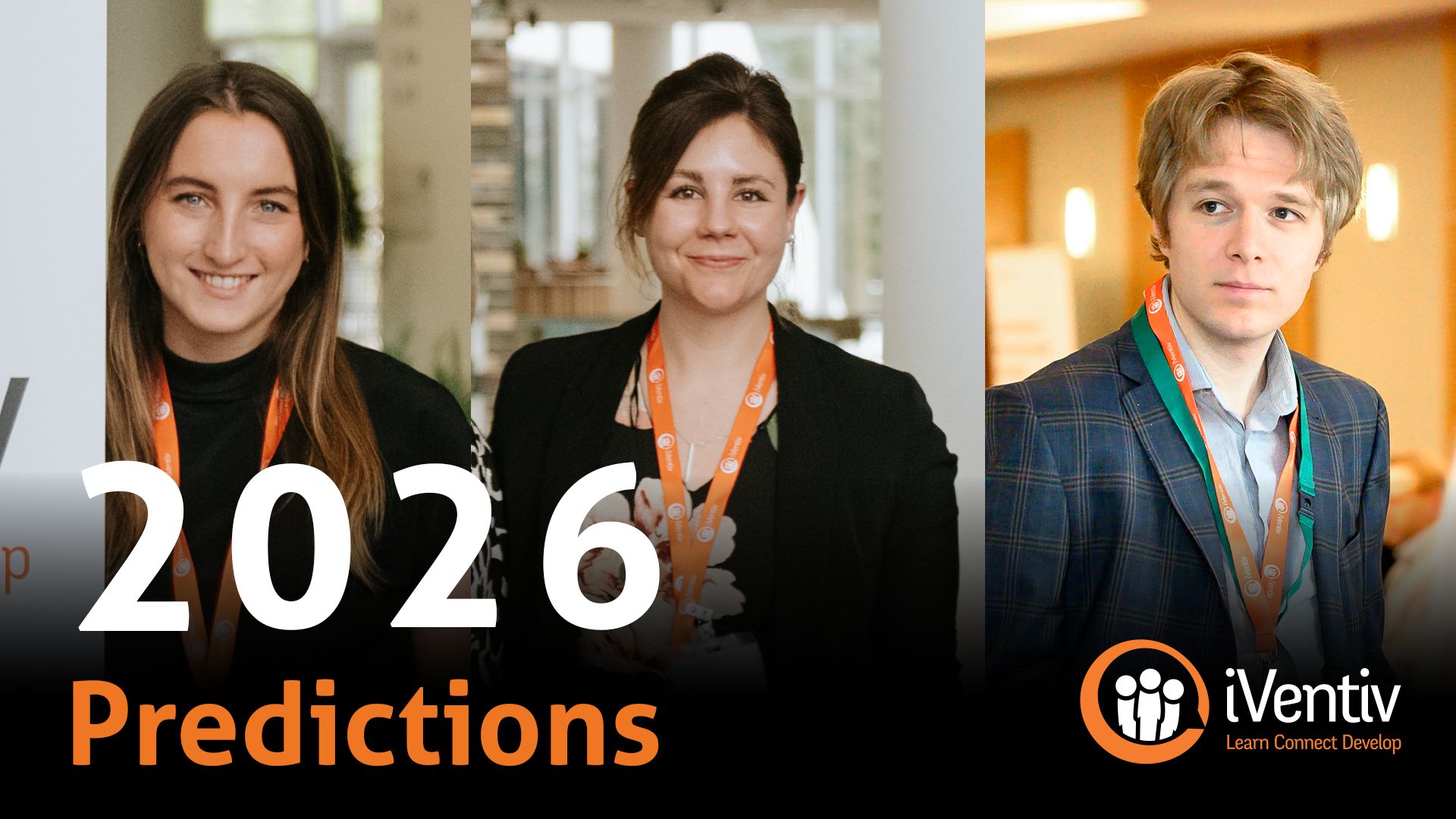
Ahead of the 2026 iVentiv Pulse Report, and drawing on insights from iVentiv’s global executive knowledge exchanges, iVentiv’s Richard Parfitt (Marketing Director), Hannah Hoey (Content Director), and Kristy Kitson (L&D Strategist), give their predictions for three trends that they believe learning leaders consistently point to as defining the L&D agenda in 2026—from the evolution of learning culture and skills-based organisations to the changing role of AI in workforce development.
Here’s the distilled view for Chief Learning Officers looking for a peer-informed read on what could dominate the year ahead.
You can also listen to the predictions as a podcast here.
Key takeaways
- L&D is moving from enablement to design
- Learning culture is becoming a strategic asset, not a soft priority
- Skills-based approaches are no longer experimental
- The hardest part of skills transformation is cultural, not technical
- AI is no longer just a technology conversation
- Responsible AI will increasingly sit at the intersection of learning, leadership, and governance
Why L&D Is Becoming Central to Organisational Design
Kristy’s prediction is bold and specific. She believes that in 2026, L&D will become more central to organisational design and organisational excellence. It will no longer act just as a support function, but as a shaping force.
What’s driving that shift, she believes, isn’t a sudden change of ambition inside L&D. Instead, Kristy argues that it’s the environment organisations are operating in. When geopolitical instability, climate risk, technology disruption, and AI capability shifts all stack on top of each other, ‘agility’ stops being a slogan and becomes an operating requirement. And that’s exactly where learning culture starts to look like a strategic asset.
Kristy pointed to a clear pattern in what learning leaders are prioritising: learning culture has risen sharply in their pre-event inputs over the past few years, from just 16% of leaders prioritising it in 2022 to 48% prioritising it in 2025. The implication, she says, is that CLOs are increasingly being asked to solve a bigger problem than course completion: how do they build an organisation that can actually adapt at pace?
In this framing, L&D’s value isn’t only in building capability. It’s in designing the conditions where capability keeps renewing. That includes the structures, the norms, the leadership expectations, and the ‘how work happens’ mechanisms that either encourage learning or quash it.
AI provides a practical example. Many organisations went through an internal tug-of-war asking whether AI adoption should sit in IT, in L&D, or somewhere else? The emerging answer is that someone needs to convene the system. L&D, she says, has increasingly played that convening role, pulling together stakeholders and moving AI from experimentation to enterprise impact.
Further, Kristy describes the digital landscape that CLOs are navigating right now, which is that organisations are beginning to treat AI agents as part of the workforce picture, forcing leaders to learn how to lead blended human + AI teams. That’s not a minor training need; Kristy believes it’s a rethink of leadership practice, management systems, and performance expectations.
Expect more requests to influence ‘how the organisation works,’ not just ‘how people learn.’ The opportunity, Kristy says, is to stop just arguing for a seat and start shaping the room: governance, operating rhythms, decision rights, leadership behaviours, and the cultural mechanics that turn learning into performance.
Skills-Based Organisations in 2026: From Buzzword to Best Practice
Richard’s prediction is that in 2026, skills-based approaches will no longer be viewed as an emerging trend, but as accepted best practice. What’s notable is how quickly the conversation has matured. Early debates focused on whether skills-based organisations were simply competency models with new language. Today, that question has largely been replaced with a more practical one: how do we make this work at scale?
For Richard, Hannah, and Kristy, clear shifts point to that change:
First, many organisations are already well underway. Having moved beyond initial skills mapping, they are now sitting on large volumes of data like skills inventories, inferred skills, demand signals, and workforce forecasts. The challenge is no longer how to get started, but where to apply this data and to what end. In short, what business problem is being solved, and what outcomes matter most?
Second, AI has increased both the feasibility and urgency of this work. Skills data is increasingly treated as organisational currency, but as Kristy noted, currency only has value when it is purposefully spent. Without clear application, skills insights risk becoming expensive data sets rather than decision-making tools.
This is where the conversation becomes more strategic and more human. For Hannah, there is a recurring theme among Global Heads of L&D which is the need for people to let go, not just to acquire new skills. Sunsetting outdated skills can challenge identity, status, and long-held definitions of expertise. Many organisations underestimate this shift; a skills platform alone will not change how work is allocated, how people are recognised, or how mobility actually happens.
Adoption is another critical factor. For skills-based approaches to stick, they must make sense to employees, not just to HR, Talent, or L&D teams. The strongest models shape how people think about themselves and navigate opportunities both inside and outside the organisation. This is why broader ecosystem thinking, for example linking education, employability, and government-led skills initiatives, is increasingly part of the conversation.
For CLOs in 2026, the implication is clear. Skills-based approaches will be table stakes in many large organisations. Differentiation will come from three things: clear alignment to business priorities, a roadmap that moves beyond mapping into real deployment, and employee-level meaning—where skills truly shape how work, opportunity, and development flow across the organisation.
AI Governance and Responsible AI: The New Priority for Learning Leaders
Hannah’s prediction is less about a single AI trend and more about a shift in how organisations are approaching it. By 2026, she expects the conversation to move beyond experimentation and become more nuanced, values-led, and operationally grounded.
Many organisations moved quickly through the early “AI can do everything” phase, layering new tools onto existing processes. In many cases, this simply made outdated ways of working more efficient. The result has been a growing backlash with AI-generated content that feels generic, communications that lose their human tone, and outputs that require more oversight than anticipated.
As a result, the focus is changing. The key questions are no longer “what can AI do?” but “what should it do?” Learning leaders are increasingly involved in discussions around governance, decision rights, and boundaries, including where human judgement, empathy, and accountability must remain central.
This is the point at which AI stops being purely a technology issue and becomes an organisational one. Decisions about how AI is used, governed, and assured cut across culture, leadership, risk, HR, legal, and brand. L&D and People Development are often well placed to help orchestrate this shift, not because they own the technology, but because they understand how learning, behaviour change, and leadership capability scale across an enterprise.
Another emerging challenge that Hannah pointed out is talent development. As AI automates many entry-level tasks, organisations are rethinking how early-career employees build judgement and experience. Hannah’s conversations with Global Heads suggest that some are revisiting apprenticeship-style models that prioritise exposure to decision-making and expert thinking over immediate productivity. This has significant implications for development design, workforce planning, and how value is defined early in a career.
As AI becomes more widely embedded, the human differentiators come into sharper focus. Empathy, critical thinking, creativity, and strategic judgement are increasingly seen as sources of competitive advantage. For CLOs, the challenge in 2026 will be balancing adoption with capability building, using AI to free up time, then deliberately reinvesting that time in the skills and behaviours the organisation cannot afford to lose.
Future of Work and Workforce Skills: What CLOs Are Focusing on Next
Across all three predictions, there’s a common direction of travel; learning shifts from delivering interventions to designing systems,
- Systems that help organisations adapt
- Systems that make skills visible and usable
- Systems that integrate AI responsibly, not just enthusiastically
If 2025 was about accelerating experiments, 2026 looks like a year where CLOs are asked to industrialise what works and redesign what doesn’t not just to keep up, but to ensure the organisation is still building the capabilities and the culture that make performance sustainable.
And if Kristy’s right, CLOs won’t just be at the table for that conversation.
They’ll be designing it. For more on the trends that Heads of L&D expect to tackle in 2026, download the iVentiv Pulse Report for free today.
FAQs
How will AI impact learning and development in 2026?
AI is reshaping L&D by automating routine tasks and enabling better skills insight. However, the focus is shifting from what AI can do to how it should be used responsibly, with clear governance, human oversight, and alignment to organisational values.
Why will learning culture be a priority for CLOs in 2026?
CLOs see Learning culture as critical because organisations are operating in increasingly volatile environments. CLOs are being asked to enable adaptability, not just deliver training. They see a strong learning culture as supporting continuous skill development, faster response to change, and long-term organisational resilience.
Why are skills-based approaches becoming best practice in 2026?
Skills-based approaches are becoming standard because CLOs feel they help organisations respond to rapid change, particularly driven by AI and shifting workforce demands. Advances in technology have made skills data more accessible, while business leaders increasingly expect clearer visibility of capability gaps and future skills needs.
Why will AI governance become an L&D concern?
AI governance becomes an L&D concern when AI moves beyond technology teams and into everyday work. Learning leaders are often well positioned to support governance by shaping capability, behaviour, and leadership practice across the organisation.
How should CLOs approach AI skills development?
CLOs should focus on developing both technical AI fluency and human capabilities such as critical thinking, empathy, and strategic judgement. The goal is not just adoption, but ensuring employees can work effectively and responsibly alongside AI.
What should CLOs focus on to create impact in 2026?
CLOs should focus on clarity: defining the business problems learning is solving, deciding where human capability must be protected and developed, and ensuring learning investment supports long-term organisational performance.