Submitted by Richard.Parfitt on
Updated April 2026
By Kerry Summers (Content Marketing Coordinator, iVentiv)
Listen to the Podcast on Spotify and Apple Podcasts now.
Key Takeaways
- Hypergrowth rewrites leadership rules
- Structure must scale the business, not slow it down
- Pace is the defining capability
- Great leaders think beyond their function
- Technology enables leadership, but doesn’t replace it
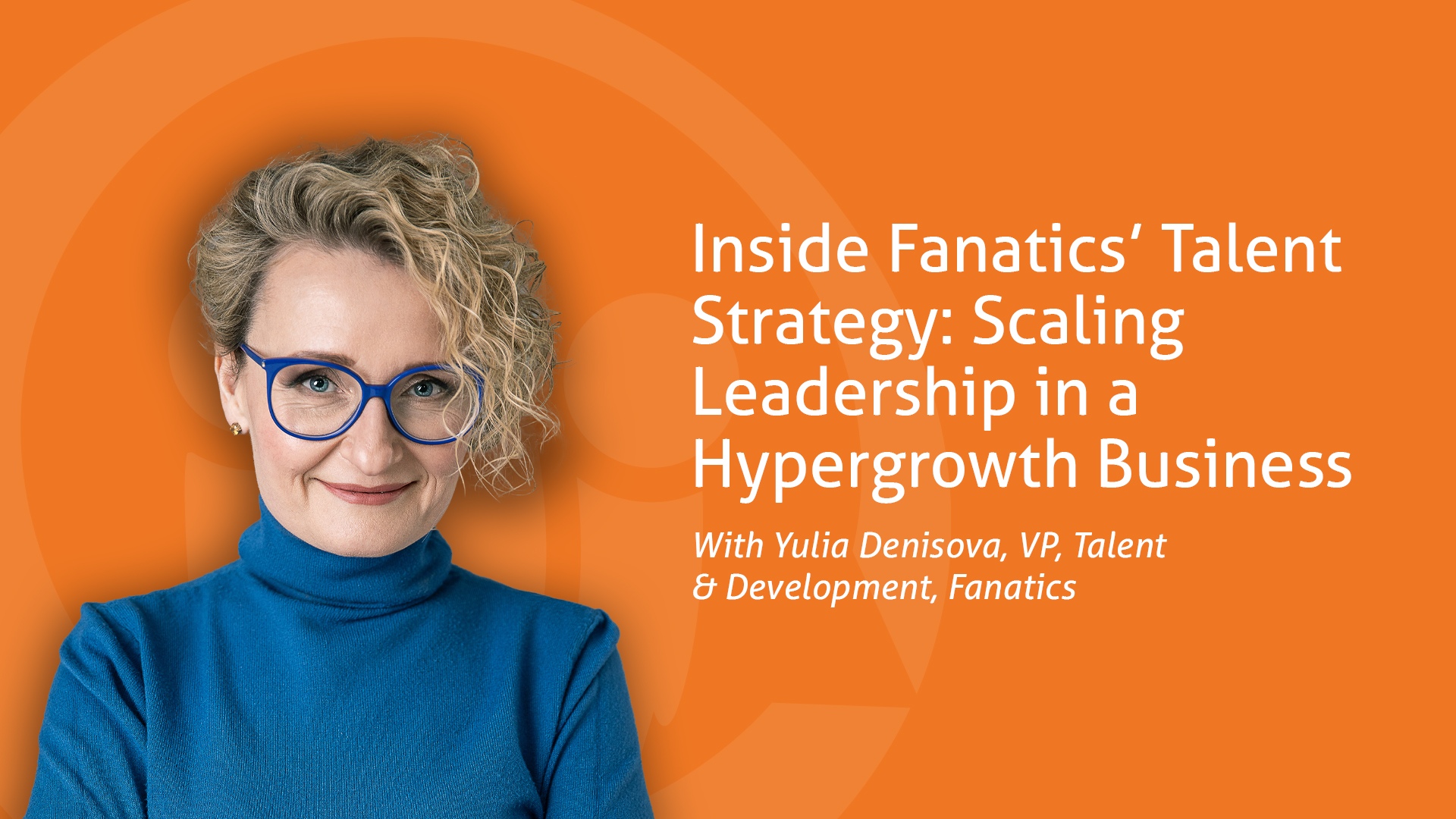
Hypergrowth changes everything. It reshapes how organisations operate, how leaders lead, and how talent functions deliver impact. Few companies embody this challenge quite like Fanatics, which has expanded from fewer than 2,000 employees in 2015 to over 20,000 today, operating across more than 200 countries.
At the centre of this transformation is Yulia Denisova, VP Talent & Development, whose role is both clear and complex: introduce the structure required to scale, without diluting the entrepreneurial energy that made the company successful in the first place.
What emerges from her perspective is not just a story of growth, but a rethink of how leadership, talent, and learning must evolve in a business that is moving at extraordinary speed.
Hypergrowth Reality: What Breaks First?
In many organisations, rapid growth exposes weaknesses in processes, systems, or communication. At Fanatics, the reality is less about things breaking and more about the rules fundamentally changing.
As Yulia explains, success is no longer about narrowing focus to a handful of priorities. Instead, leaders are expected to operate across many initiatives simultaneously, often without knowing which will ultimately succeed:
“You don’t know which of 50 projects will win… so you have to move them all forward and observe what matures fastest.”
- Yulia Denisova, VP Talent and Development, Fanatics
This shift has significant implications for leadership, for example, Yulia tells us that traditional models emphasise clarity, prioritisation, and stability. In contrast, hypergrowth demands comfort with ambiguity, rapid decision-making, and the ability to continuously recalibrate.
Leaders are not just executing strategy, they are actively discovering it in real time.
Walking the Line Between Structure and Agility
Yulia joined Fanatics with a mandate that will feel familiar to many Talent leaders in scaling organisations: bring structure, but avoid bureaucracy.
The challenge is not simply operational, it is cultural. Introducing too much structure risks slowing the organisation down and undermining the very qualities that fuelled its growth. Too little, and the organisation becomes chaotic and inefficient.
Fanatics’ approach is intentionally pragmatic. The focus, Yulia explains, is on building systems that are scalable and practical, rather than overly engineered. Solutions are designed to be implemented quickly and refined over time, rather than perfected upfront.
This philosophy is reflected in the rollout of a cross-enterprise performance management system, which, Yulia says, was designed, built, and launched in just three months. At Fanatics, it achieved an 95% adoption rate in its first cycle, rising to almost full adoption in the second.
The Defining Characteristic: Pace
If there is one factor that truly differentiates Fanatics, it is pace. Even for an experienced global leader like Yulia, the shift can be striking:
“I always considered myself a fast learner… until I joined Fanatics. These people are not even running. They’re flying.”
- Yulia Denisova, VP Talent and Development, Fanatics
This level of acceleration has led Yulia to approach leadership development in a different way. Long, structured programmes struggle to keep up. Instead, Yulia says that organisations need learning that is immediate, practical, and directly applicable to real challenges.
Leaders are expected to absorb new concepts quickly and apply them instantly, often while still building the systems they are working within. The emphasis moves from theoretical understanding to execution under pressure.
Leading Across Complexity
Fanatics is not a single, unified business. It is a collection of diverse operations spanning manufacturing, e-commerce, betting, gaming, and collectibles. Yulia describes it as “18 businesses in one.”
This complexity raises the bar for leadership. She says that understanding one function or domain simply isn’t enough. Instead, Yulia wants leaders to develop a cross-enterprise perspective, recognising how decisions in one area affect outcomes elsewhere.
This requires a deeper level of business acumen, as well as a shift in mindset. Leaders, in her view, must think beyond their immediate teams and consider the broader system they are part of. In this context, siloed thinking quickly becomes a liability.
What Great Leadership Looks Like at Scale
While many elements of leadership remain consistent, their application changes significantly in a hypergrowth environment. At Fanatics, expectations are high.
Yulia references a guiding belief from the company’s founder: “A-class talent does not work for a B-class leader.” This, she says, sets the tone for the organisation’s approach to leadership development.
Strong leaders at Fanatics are therefore expected to combine commercial awareness with the ability to lead at scale. They must understand how the business creates value, while also building the structures and leadership layers needed to deliver that value across a much larger organisation.
Equally important, Yulia says, is their ability to engage and inspire. Leadership is not just about direction, but about creating followership, ensuring that people are motivated to contribute and aligned behind a shared vision.
Resilience also becomes critical. In an environment defined by constant change, leaders must sustain performance under pressure while remaining adaptable and open to new ways of working.
From Founder Culture to Scalable Leadership
One of the most significant transitions in hypergrowth, Yulia says, is the evolution of leadership itself. In early-stage organisations, leadership is often highly personal. Leaders know their teams closely, communication is direct, and culture is built through shared experience.
As organisations scale, this model becomes unsustainable. The shift, she says, is not about abandoning the culture, but about evolving it. Leaders must build strong teams beneath them, delegate effectively, and rely more on systems and data to maintain visibility.
At the same time, she argues that organisations must find ways to preserve the human elements that define the organisation’s identity. This balance, Yulia believes, is one of the most challenging aspects of scaling leadership.
The Role of AI in Leadership and Accountability
Like many organisations, Fanatics is exploring how AI can support leadership at scale. Yulia sees clear benefits, particularly when it comes to accountability:
“What technology can give you is data that you cannot argue with.”
- Yulia Denisova, VP Talent and Development, Fanatics
Technology provides access to data that is difficult to ignore. Insights from engagement surveys, feedback mechanisms, and performance metrics are all things that, Yulia stresses, can help leaders make more objective decisions and address issues more confidently.
AI also opens up new possibilities for development, including always-on coaching and scenario-based learning; tools that can help leaders prepare for difficult conversations and improve their effectiveness in real time.
However, Yulia is clear that technology has limits. She tells us that AI can provide insight and efficiency, but:
“AI cannot create trust, psychological safety, or human connection.”
- Yulia Denisova, VP Talent and Development, Fanatics
Trust, empathy, and psychological safety remain firmly in the domain of people.
In practice, the value of AI lies in creating space. By automating tasks and providing data-driven insights, it allows leaders to focus more on coaching, influencing, and building relationships.
Keeping Leadership Human at Scale
As organisations grow, maintaining a sense of connection could become increasingly difficult. Yet many L&D and HR leaders would argue that it is also more important than ever.
Yulia highlights the importance of simple, intentional practices, such as skip-level meetings, to maintain direct connections with employees. These interactions provide unfiltered insights and help leaders stay grounded in the reality of their teams’ experiences. For Yulia:
“I would always coach leaders to retain that connection… get that unfiltered perspective.”
- Yulia Denisova, VP Talent and Development, Fanatics
These interactions, she says, also reinforce alignment, ensuring that employees understand how their work connects to the organisation’s broader strategy. In a fast-moving environment, this clarity is essential.
Technology can support these efforts, but it cannot replace them. Human connection remains a core component of effective leadership.
A Provocation for Learning and Development
Perhaps the most thought-provoking aspect of Yulia’s perspective is her challenge to traditional Learning and Development:
“If you don’t want to learn, no one can help you. If you want to learn, no one can stop you.”
- Yulia Denisova, VP Talent and Development, Fanatics
In an era where information is abundant and easily accessible, the role of L&D is shifting. Rather than acting as the primary source of knowledge, Yulia’s efforts suggests that L&D functions are increasingly becoming enablers of learning.
This requires a change in mindset, with Yulia suggesting that, instead of designing and delivering structured programmes, organisations must focus on creating environments that encourage curiosity and self-directed growth.
The question is no longer just what people should learn, but how so leaders empower them to take ownership of their own development.
Scaling Without Losing What Matters
Fanatics’ approach to Talent and Leadership development offers a clear message for organisations navigating hypergrowth. Success does not come from choosing between structure and agility, or between technology and humanity. It comes from balancing these elements deliberately.
The goal, as Yulia describes it, is to remain a “mature start-up” - combining the energy and ambition of an entrepreneurial business with the discipline required to operate at scale.
For Talent leaders, this is the challenge and the opportunity. Scaling leadership is not just about building capability. It is about redefining what leadership looks like in a world where speed, complexity, and change are the new normal.
Yulia Denisova is VP, Talent and Development at Fanatics Commerce, the leading designer, manufacturer, and seller of licensed fan gear. She has nearly 25 years of HR leadership experience building, empowering, and managing global high-performing teams of varying scale, type, and autonomy. Prior to joining Fanatics in August 2024, Yulia spent more than 11 years with The Coca-Cola Company where she held HR, talent, and development roles, and reengineered talent practices enterprise wide.
FAQs
What is leadership in a hypergrowth company?
Leadership in a hypergrowth company requires the ability to operate at speed, manage ambiguity, and lead across rapidly evolving priorities while maintaining alignment with the overall business strategy.
How do you scale leadership in a fast-growing organisation?
For Yulia, scaling leadership involves building strong leadership pipelines, introducing scalable systems and processes, and developing leaders who can operate effectively across larger, more complex teams.
How can organisations introduce structure without losing agility?
Yulia tells us that structure without losing agility comes with focusing on simple, practical systems that are easy to adopt, prioritising speed over perfection, and avoiding over-engineered processes that slow decision-making.
How does AI support leadership development and performance management?
AI can provide data-driven insights, support decision-making, enable continuous feedback, and offer on-demand coaching, helping leaders become more effective and objective.
How can leaders maintain human connection at scale?
Leaders can maintain connection by, according to Yulia’s work, creating opportunities for direct interaction, such as skip-level meetings, encouraging open communication, and staying visible and accessible to their teams.
What skills are essential for leaders in high-growth businesses?
Key skills include commercial acumen, adaptability, resilience, cross-functional thinking, and the ability to lead through uncertainty.