Submitted by Kerry Summers on
Updated September 2026
By Kerry Summers (Content Marketing Coordinator, iVentiv)
Listen to the podcast on Spotify and Apple Podcasts now
Key Takeaways
- Capability building starts with business strategy
- Learning alone does not create capability
- Capability is built across an organisational ecosystem
- L&D measurement should move closer to performance
- AI increases the need to rethink L&D’s value
From Learning Delivery to Organisational Capability Building
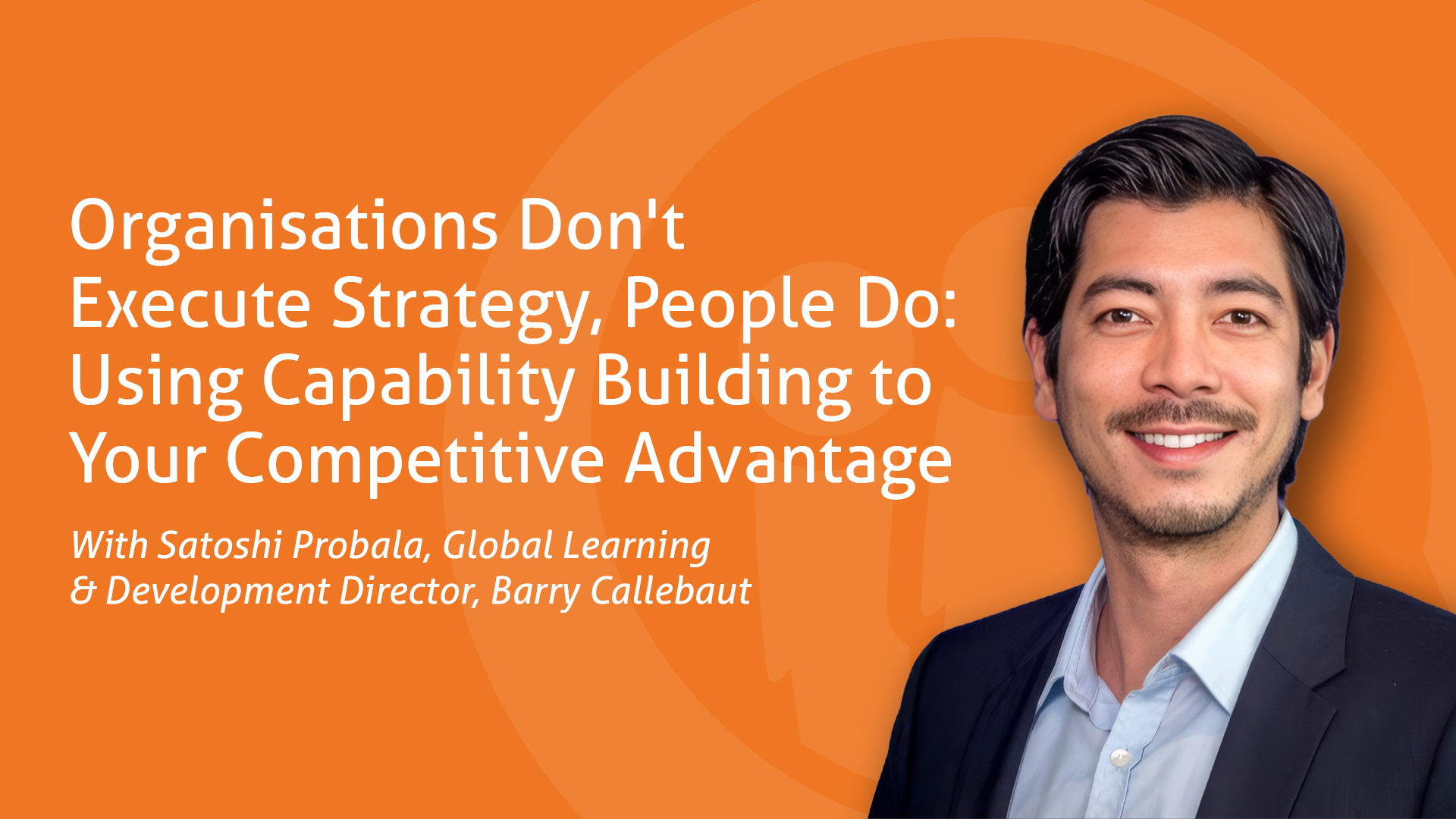
For Satoshi Probala, Global Learning & Development Director at Barry Callebaut, the starting point for capability building is simple but consequential:
“Organisations don't execute strategy, it's the people who do, and people can only execute the strategy when they have the capabilities, leadership, and the environment to succeed.”
- Satoshi Probala, Global Learning & Development Director, Barry Callebaut
In conversation with iVentiv, Satoshi described a distinction between L&D as a function that delivers learning, and L&D as a strategic enabler of organisational performance. He said that he seldom receives from senior business leaders a request for "more learning"; instead, their questions tend to be things like: how do we carry out our strategy? How do we transform the business? How do we develop stronger leaders?
For Satoshi, those are fundamentally capability challenges; although learning is still an important factor, he believes that it is capability which ultimately determines performance.
That shift has significant implications for Global Heads of Learning, Talent, and Leadership. Rather than beginning with a learning solution, Satoshi’s approach starts with the strategic outcome the organisation is trying to achieve.
Why Capability Building Should Follow Business Strategy
“We too often ask what training do people need?” Satoshi said. Instead, his preferred question is: what capabilities does the business need to execute its strategy? Only after answering that does the conversation move towards how those capabilities should be developed.
Barry Callebaut’s global manufacturing transformation provides one example. The organisation was introducing a new operating model across around 60 plants globally. The business was not asking L&D to create a leadership programme. It wanted to change the way its factories operated.
Instead of asking how plant managers should be trained, Satoshi and his colleagues explored the capabilities that plant managers and factory HR leaders needed to lead the transformation successfully.
For plant managers, the resulting journey focused on areas including:
- High-performing organisations
- End-to-end transformation leadership
- Business acumen
- Strategic thinking
- Cross-functional collaboration
For factory HR leaders, the emphasis included becoming transformation partners through:
- Coaching
- Culture shaping
- Behaviour change
- Embedding new ways of working
The two journeys were deliberately connected; in Satoshi’s view, successful transformation depended on plant managers and HR leaders speaking the same language and leading together.
Leadership Development: From Learning Content to Experience
The same philosophy shapes Satoshi’s perspective on leadership development.
Formal learning, he believes, is not the problem. He says workshops and structured development can create awareness, establish a common language, and build knowledge.
But knowledge and capability, in his view, are not the same thing:
“Knowledge can be transferred; capability has to be developed.”
- Satoshi Probala, Global Learning & Development Director, Barry Callebaut
A leader can learn what effective coaching or feedback looks like in a workshop without necessarily becoming better at either. According to Satoshi, people improve by applying concepts, reflecting on what happened, receiving feedback, and trying again.
It is this mindset that sparked his keen interest in the principles behind the 70:20:10 approach. Capability, he believes, is developed primarily through experience and support from others, with formal learning providing a foundation.
Barry Callebaut’s four-month Leadership Essentials journey reflects that thinking: designed for newly appointed leaders, it addresses the transition from individual contributor to leading through others. Live sessions and self-paced learning play a role, but Satoshi says some of the most important development happens between sessions, when participants apply coaching, feedback, and difficult-conversation techniques with their own teams.
For Satoshi, the emphasis is therefore on application rather than information.
Capability Building as an Organisational Ecosystem
A third shift identified by Satoshi is ownership.
“Capability isn't owned by L&D alone,” he explained. Instead, it develops across an ecosystem in which L&D provides architecture, business leaders create the environment, managers reinforce behaviour, and HR and other enabling functions contribute expertise.
Barry Callebaut’s onboarding approach offers another illustration. Rather than viewing onboarding as a set of induction activities, the organisation asked how new colleagues could become productive, connected, and successful as quickly as possible.
he resulting experience brings together Global L&D, local HR, hiring managers, buddies, and functional academies, each with a distinct role. Hiring managers, for example, are responsible for accelerating performance, while functional academies provide role-specific capability building.
For Satoshi, the ambition is not to assemble more onboarding activities, but instead to create one seamless experience in which responsibility for capability is shared across the organisation.
That shift in ownership matters. Managers begin to see onboarding as part of their responsibility, while functions see capability building as something they own rather than something delivered to them.
Measuring L&D Impact Through Behaviour and Business Performance
If capability is the outcome, Satoshi believes measurement also needs to evolve.
Participation, completion rates, and satisfaction data can provide early indicators, but he encourages a broader set of questions:
- Are leaders behaving differently?
- Are people applying what they learned?
- Are teams collaborating more effectively?
- Is the organisation progressing against strategic priorities?
And, ultimately, are there measurable business outcomes?
The manufacturing transformation demonstrates why patience matters. Initial outcomes included stronger collaboration, a shared language around transformation, and visible changes in leadership behaviour. These were followed by indicators including employee engagement and positive safety and quality behaviours, before lagging measures such as absenteeism, accidents, rework, and scrap began to move.
Satoshi therefore describes measurement as staggered. Early descriptive data can be followed over time by evidence of application, behaviour change, and business impact. As he puts it:
“business leaders don't invest in learning… they invest in better performance.”
- Satoshi Probala, Global Learning & Development Director, Barry Callebaut
Is Capability Building the Future of L&D?
Satoshi summarises his perspective around three connected ideas:
- Organisations do not execute strategy; people do.
- Capability starts with strategy, grows through experience, and scales through the organisational ecosystem.
- The future of L&D, in his view, lies not simply in delivering learning, but in enabling organisations to build capability as a sustainable driver of performance.
For senior Learning, Talent, and Leadership executives navigating transformation, AI, leadership change, and growing demands for measurable impact, his argument offers a different way to frame the role of the function.
The conversation moves away from asking: what learning should we deliver? Instead, it starts with a much bigger question: What does the organisation need its people to be capable of doing next?
Want to get involved in the discussion? Register to join Satoshi in Basel now.
FAQs
What is capability building in L&D?
In Satoshi’s view, capability building is broader than developing individual skills or delivering training programmes. It is about creating the combination of capabilities, leadership, experiences, behaviours, support, and organisational environment that enables people to execute business strategy effectively.
This means L&D starts by asking what people need to be capable of doing for the organisation to achieve its priorities, rather than immediately asking what training should be provided. Learning still has an important role, but it becomes one part of a wider approach to improving organisational performance.
How is capability building different from training?
Training can transfer knowledge, create awareness, introduce new concepts, and establish a common language. Capability building goes further by helping people turn that knowledge into effective behaviour and performance.
Satoshi argues that capability develops when people have opportunities to apply what they have learned in real situations, reflect on the results, receive feedback, and try again. A workshop might teach a leader what good coaching looks like, for example, but becoming a more capable coach requires repeated practice with real people and real challenges.
Capability building therefore focuses not only on what employees know, but on what they are able to do consistently in the context of their work.
Why should capability building start with business strategy?
Satoshi argues that organisations should first identify what they are trying to achieve strategically and then determine the capabilities people will need to make that strategy happen.
Starting with a predefined learning solution risks solving the wrong problem. Instead of asking, “What training do people need?”, L&D can ask, “What does the business need people to be capable of doing?”
Barry Callebaut’s manufacturing transformation illustrates this approach. The objective was not simply to create a leadership programme, but to change how factories operated across approximately 60 plants. That meant identifying the capabilities plant managers and factory HR leaders needed to lead the transformation successfully and then designing development around those requirements.
What role does experiential learning play in capability building?
Experiential learning is central to Satoshi’s view of capability development because people become more capable by applying ideas in the context of real work.
Formal learning can provide useful knowledge and frameworks, but experience gives employees and leaders the opportunity to practise new behaviours, see what happens, reflect, receive feedback, and improve. This is why Satoshi draws on the principles behind the 70:20:10 approach, where experience and support from others play a major role alongside formal learning.
Barry Callebaut’s Leadership Essentials journey reflects this thinking. While participants take part in live sessions and self-paced learning, an important part of their development happens between those sessions as they practise coaching, feedback, and difficult conversations with their own teams.
What does capability building mean for leadership development?
For leadership development, capability building means placing greater emphasis on application rather than relying primarily on the transfer of leadership knowledge.
Leaders may understand the principles of coaching, feedback, strategic thinking, or difficult conversations after attending a programme, but understanding a concept does not automatically mean they can apply it effectively.
Satoshi therefore emphasises giving leaders opportunities to practise new behaviours, learn through real situations, reflect on their experiences, and receive support and feedback. The objective is not simply to create leaders who know more about leadership, but leaders who can demonstrate stronger leadership behaviours in their day-to-day work.
Who owns organisational capability building?
According to Satoshi, organisational capability is not owned solely by L&D. It develops across an ecosystem involving business leaders, managers, HR teams, functional experts, employees, and other enabling functions.
L&D can provide the architecture, development experiences, and expertise, but business leaders also need to create an environment where new capabilities can be applied. Managers reinforce behaviours, while functional teams can provide role-specific expertise and development.
Barry Callebaut’s approach to onboarding provides an example. Global L&D, local HR, hiring managers, buddies, and functional academies all contribute different elements of the employee experience. Rather than treating onboarding as something L&D delivers to new employees, responsibility for helping new colleagues become productive and successful is shared across the organisation.
How long does behavioural change take to measure?
Behavioural change may take months or longer to become visible, particularly when L&D is trying to connect development with wider organisational or business outcomes.
Satoshi therefore advocates a staggered approach to measurement rather than expecting an immediate demonstration of ROI or business impact. Early indicators might include participation, satisfaction, stronger collaboration, application of learning, or visible changes in leadership behaviour.
Over time, organisations can then look for evidence in measures such as employee engagement, safety, quality, absenteeism, accidents, rework, scrap, or other indicators that are relevant to the strategic objective.
The key is to recognise that capability develops over time and that different measures become meaningful at different stages of that journey.
How is AI changing the role of L&D?
AI is making access to content and knowledge increasingly abundant, which Satoshi believes strengthens the case for L&D to rethink where it creates the most value.
If employees can access information and learning content more easily, the role of L&D may become less centred on creating and distributing content. Instead, the function can focus more heavily on the harder challenge of turning knowledge into capability.
That includes designing meaningful experiences, enabling behaviour change, supporting managers and leaders, connecting development with business priorities, and creating the conditions in which people can successfully apply what they learn.
In this sense, AI may make L&D’s strategic role more important rather than less important.
What is the future role of Learning & Development?
Satoshi’s view is that L&D is evolving from a function focused primarily on learning delivery towards an organisational capability enabler.
That means helping organisations identify the capabilities required to execute strategy, creating experiences through which those capabilities can develop, supporting the wider organisational ecosystem, and measuring whether development is translating into behaviour and performance.
Learning programmes will continue to have a role, but the bigger opportunity is for L&D to help people continuously learn, adapt, perform, and respond to changing business priorities.
For senior Learning, Talent, and Leadership leaders, that represents a shift in the question they are trying to answer: not simply “What learning should we deliver?”, but “What does the organisation need its people to be capable of doing next?”