Submitted by networkadmin on
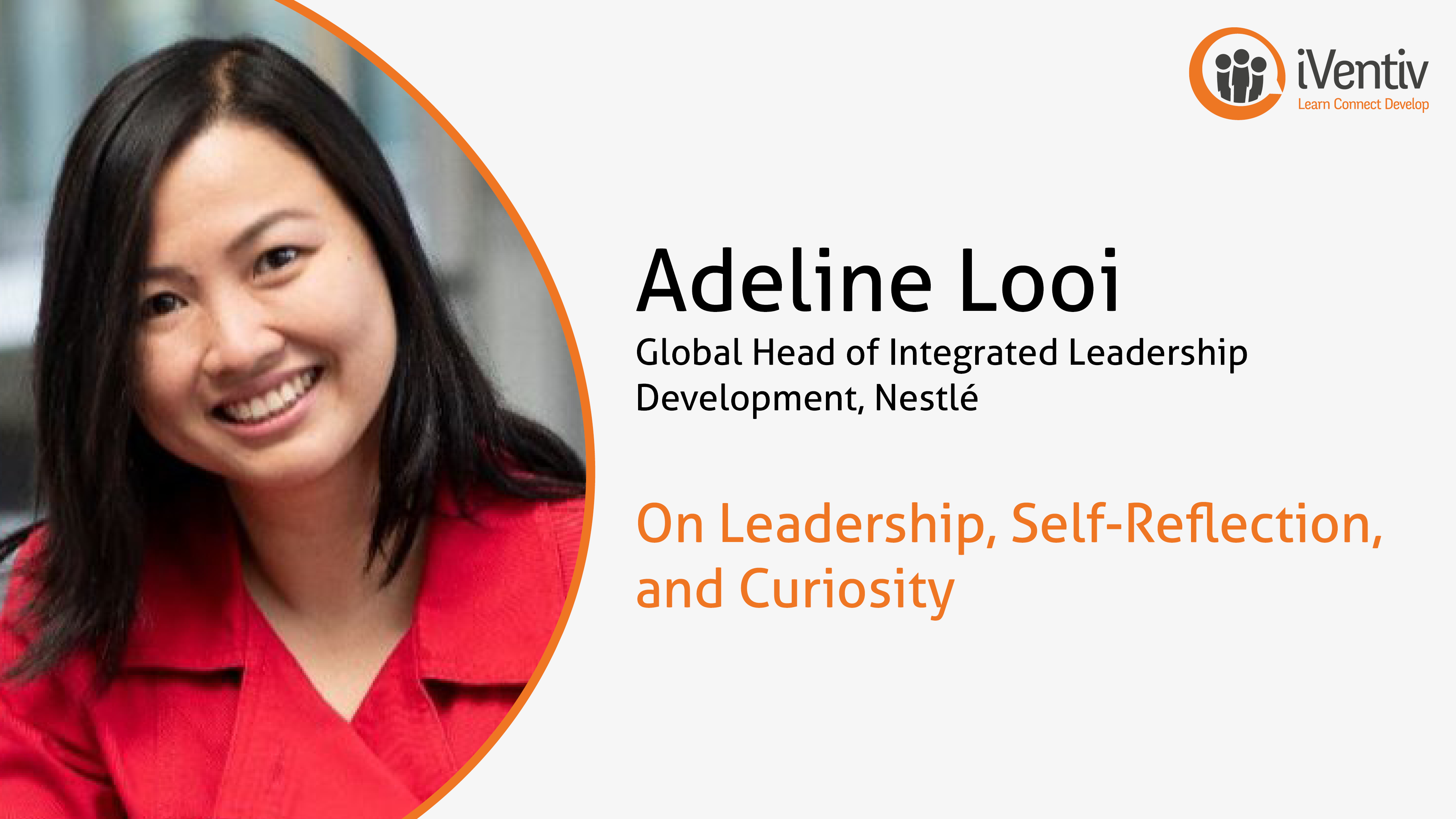
Adeline Looi, Global Head of Integrated Leadership Development at Nestlé is responsible for helping 30,000 people leaders and 273,000 full-time employees in over 180 countries grow in leadership. Speaking to iVentiv’s Temi Bamgboye, Adeline discusses about the Nestlé Leadership Framework, her own philosophy on leadership, and why it is that fewer people now want to be leaders.
What is the Nestlé Global Leadership Framework?
Adeline explains how the Leadership Framework is embedded across the organisation's talent and HR practices. The framework targets various levels of leaders within Nestlé with specific leadership behaviours required for each level, with the ultimate aim of making the framework an integral part of the company culture, not just a sign on the wall. "Let's make sure that we really live, breathe, and embed it into every level of the organisation," she explains. When asked to identify the most important leadership behaviours, Adeline highlight two that resonate with her. The first is "Making a Difference," which is about having an impact and being a force for good. She explains that this behaviour looks different for individual contributors versus leaders of an entire business, but the focus remains on pushing for excellence, collaborating, and creating an impact. As she states, "How do we create that impact by collaborating, by encouraging, by connecting externally and internally? And very importantly, in Nestlé, we talk about being a force for good."
The second behaviour she emphasises is growing people and teams, most critically being self-aware, understanding your strengths and areas of development, and coaching and developing others. Adeline believes that it's not just about individual success but also about the legacy that one leaves behind. As she stated, "growing teams, growing people, that's absolutely critical."
How do you define and practice curiosity?
For Adeline, the link between self-awareness and curiosity is critical. “No one can force someone to be curious, nor can they force him or her to be self-aware, and yet that's the bedrock on which we build everything else,” she explains.
It starts, she says, with “being curious about ourselves.” What are your strengths? Your gaps? Your motivations and values? If we start with that introspection, she says, we become more fulfilled and more effective. By being clear about “who we are, how we show up, and what's important to us," we avoid the situation where “we could be climbing a ladder and in a few years' time realise that it's leaning against the wrong wall.”
Next, Adeline argues, it’s all about showing curiosity about your team. See the strength and diversity around you and recognise that not everyone “needs to be a cookie-cutter”. Create psychologically safe spaces, understand what they bring to the table, and advocate for them.
Finally, be curious about the organisation and the world around you. Have empathy for other teams and other divisions and understand the ecosystem in which you operate. Adeline’s advice is to help people “see the Grand Vision and then find their parts to contribute towards it.” Looking beyond your own organisation is an important part of that. “What is required,” she encourages us to ask, “so that we can then be an answer to part of the circular economy, to part of the grander ecosystem?”
Why do fewer people want to be leaders?
Based on that advice, being a leader is a big undertaking and it requires a lot of introspection. Is it any wonder, then, that fewer people want to be leaders? In the past, the idea that you progress into a leadership position as part of a natural career path But now research published in the Harvard Business Review shows that “more people are saying that they don't want this unenviable job of being a people manager.” Only a third now aspire to leadership positions. The responsibility is too high, the personal and emotional skills required too complex. “In the past,” Adeline reflects, “people felt like that was the only way to grow. If I wanted to draw a higher salary, this is the only way. But now, people ask that question: do I want to become a people leader?”
That may be no bad thing. “Frankly speaking, not many people have the skill to become a people leader, nor want to pursue that.” Instead, they “take a specialist path, and there's nothing wrong with that,” but Adeline says she would still encourage those with the right skills to become people leaders and it’s still important for organisations to “equip people with the right skills and the right clarity of what it takes to be a people leader.”
Asked if she would try to persuade someone who said they don’t want to be a leader to change their mind, Adeline says it’s important to let people choose their own path. When a baby is born, she says, nobody says “Congratulations, you have a leader.! A leader is born”. Adeline’s advice is to fall back on three Cs:
1. Clarity: Give Clarity of what being a people leader means and also what it doesn't mean. “Sometimes,” Adeline says, “people get overwhelmed because they go, ‘Ah, the fate of the universe is in my hands!"’ and as a result they self-select out before they need to. Likewise, others might say "Okay, I'm a leader now. It's time for me to rule the world!" and, in that scenario, Adeline advises helping them to see that “it's not about being an egomaniac. It's about helping other people succeed." Help them to clarify what they believe makes them unsuitable to a leadership position and then, says, “80% of the time” they can make a better choice.
2. Capacity: Giving employees the capacity to choose their own path is vital, “to know that I have agency, I can still choose, and the organisation trusts me to choose, and I will have a path that makes sense for me.” Once you’re confident that they know what a leadership position entails, you need to empower them with the knowledge that if they’re going to attain that leadership position, they “need to want it.”
3. Capability: Finally, Adeline says, employees need to have the right capabilities to become leaders. You have to “set people up for success, and not up for failure.” Leaders who “don't feel like they have the agency nor the capability to be able to do that job well” will always find it more difficult. If you can build the right capabilities before they reach that point, Adeline says, you “will have more leaders and more purposeful leaders who can really make a difference.”
What made you want to be a people leader?
Reflecting on her own leadership journey, Adeline speaks firstly about her parents. “My Dad's side of the family come from the States, my mom is from Malaysia, and currently, I'm working in Europe. So, you can imagine sometimes that mishmash of different culture.”
But the key thread has always been “to leave the world in a better place than from when I came.” When Adeline started her career as a chemical engineer, she was the only female chemical engineer and she was leading people twice her age.
“I realised very quickly that these people that I was leading knew so much more,” she recalled, “and all I could do was recognise their value, create space for them to grow, listen to them, and support them.” That thread carried her through roles in brand management, commercial roles, consulting and HR, “but I always gravitated to helping people grow.”
That led to a role in leadership development, but Adeline is keen to credit those who supported her. “I had so many people who took bets on me when I was way younger in my career, who gave me feedback, who mentored me, who challenged me. I would encourage all of us to surround ourselves with people like that, and in a space like iVentiv, where you have peers that challenge one another.”
Adeline will be speaking more about the Nestlé Leadership Development framework at iVentiv’s Executive Development Amsterdam on the 7th and 8th of November. Find out more, including information on how to register, here.
Adeline Looi is the Global Head of Integrated Leadership Development at Nestlé, based in the HQ in Switzerland with her hybrid team located across four different regions. She provides thought leadership and steers the global strategy on assessment, coaching, mentoring, learning experiences and executive education in the areas of leadership development. Prior to this role, she had set up the function of Corporate Talent Assessment - use of analytics, external benchmarks and data to supplement talent decisions in selection and development.
Before Nestlé, her passion for people transitioned her from the technical field of chemical engineering and commercial brand management into HR. She thereafter built her career in HR with significant focus on organisation transformation, leadership development and talent management, even while she was an HR Business Partner for the commercial division of a Dutch multinational.