Submitted by Kerry Summers on
Updated April 2026
By Kerry Summers (Content Marketing Coordinator, iVentiv)
Listen to the Podcast on Spotify and Apple Podcasts now.
Key Takeaways
- 80% of teams experience some form of collaborative dysfunction
- Only 28% of organisations measure team performance
- Atomic teams provide a new model for improving organisational performance
- Continuous, team-based development is key to long-term performance improvement
- Traditional leadership development programmes fail to improve team effectiveness
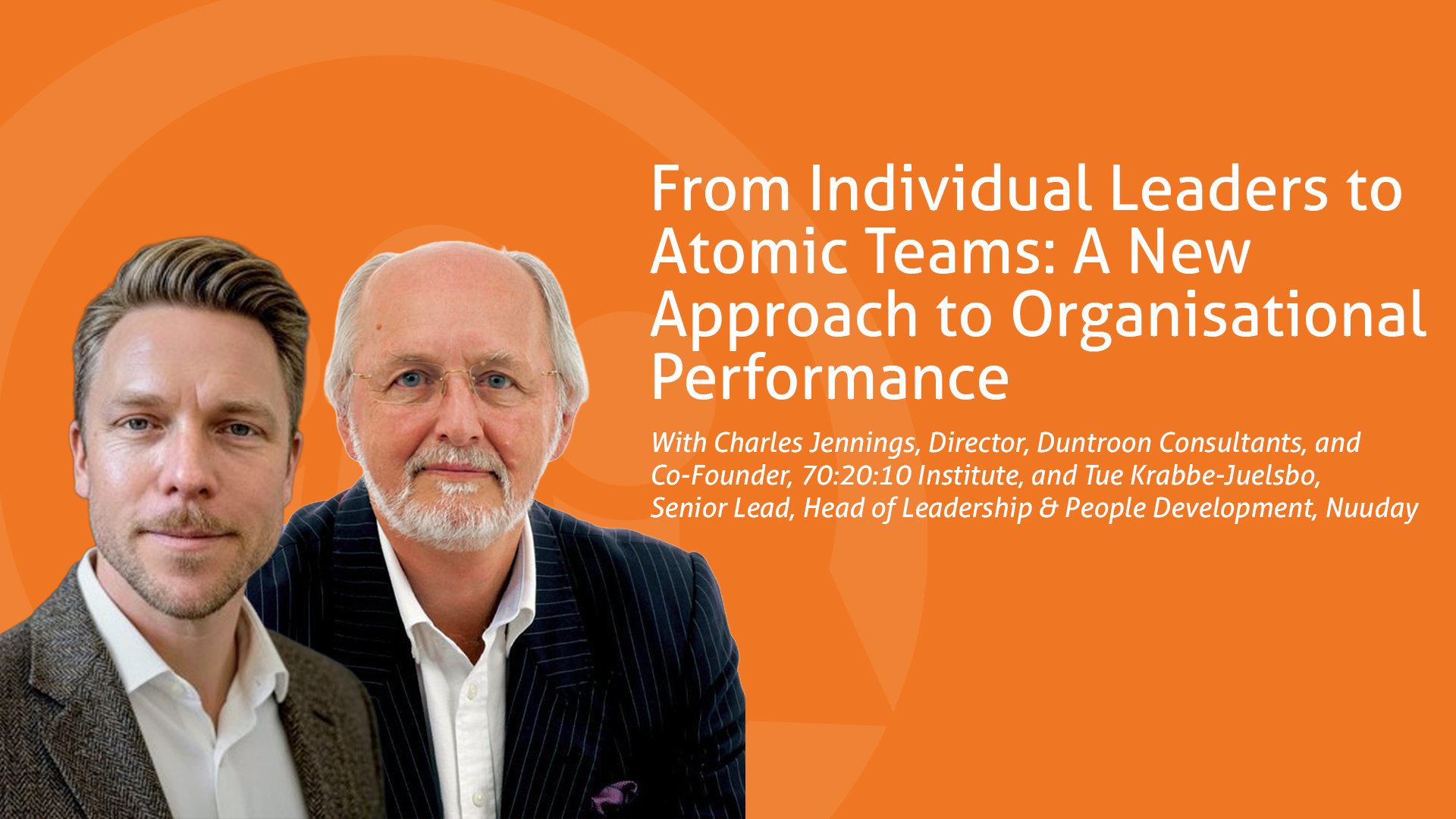
What if the true unit of value is not the individual at all, but the team? This question sits at the heart of how Charles Jennings and Tue Krabbe-Juelsbo have approached their latest research. Their discussion challenges deeply embedded assumptions about leadership and offers a compelling case for shifting focus from individuals to the management team as the true engine of performance.
Most organisations already talk extensively about teamwork. They encourage collaboration and cross-functional initiatives, and they expect leadership teams to deliver collective outcomes. However, beneath this rhetoric lies a persistent disconnect. As Tue Krabbe-Juelsbo observes:
“Across the board, we seem to optimise for individuals, even though we talk about teams.”
- Tue Krabbe-Juelsbo, Senior Lead, Head of Leadership & People Development, Nuuday
This contradiction, he argues, is deeply embedded in organisational systems. HR processes are structured around individual performance, learning programmes focus on personal capability, and success is typically measured through individual metrics. Even when leadership development is framed as team-based, it often remains rooted in individual growth, with coaching and assessment centred on the person rather than the collective.
What Are Atomic Teams and How CouldThey Transform Organisational Performance?
Atomic teams are small, aligned units that operate as the primary driver of performance within large organisations. Rather than viewing leadership as something that resides within individuals, the concept of “atomic teams” positions the management team as the smallest unit of value creation.
As Charles describes it, this is about recognising:
“The team being the atomic unit of value… of performance, of production, of function within organisations.”
- Charles Jennings, Co-Founder, 70:20:10 Institute
This shift reframes how organisations think about performance. It is no longer about aggregating individual excellence, but about how effectively the team operates as a cohesive system.
The analogy is familiar. In elite sport, Charles says, a group of star players does not necessarily outperform a well-coordinated team. His argument is that the same principle applies in organisations. Without alignment, trust, and effective collaboration, he says, even the most capable individuals will struggle to deliver collective outcomes.
By reframing the team as the atomic unit, organisations are encouraged to focus on collective capability, shared accountability, and the dynamics that enable or inhibit performance.
The Hidden Cost of Poor Team Dynamics and Low Employee Engagement
One startling statistic revealed by Tue was that only “28% of organisations measure team performance”. At a global level, Tue and Charles’ research suggests that poor team dynamics and low engagement are estimated to cost the economy $8.9 trillion annually. Their studies further suggests that around “80% of teams experience some form of collaborative dysfunction”.
These figures point to a systemic issue rather than isolated inefficiencies. As Charles sees it, the continued focus on what he describes as “the cult of the individual” is leaving significant value untapped.
Even more concerning to both Tue and Charles is how performance is measured, with Charles pointing out that much of the usual evaluation metrics still sit at the level of reaction, asking leaders how they felt about an intervention rather than whether it changed behaviour or outcomes. For Charles:
“It’s very much like being asked for a review before you’ve even opened the box”
- Charles Jennings, Co-Founder, 70:20:10 Institute
Why Traditional Leadership Development Programmes Fall Short in Large Organisations
Part of the challenge lies in how organisations interpret leadership effectiveness. According to Tue, research often shows that a large proportion of team engagement variance can be traced back to the individual manager. However, he believes this insight is frequently misunderstood.
As he explains:
“From that single data point, we then extrapolate into something wrong… let’s then develop that individual instead of looking at the context, the relationships and the leadership team.”
- Tue Krabbe-Juelsbo, Senior Lead, Head of Leadership & People Development, Nuuday
This reinforces an already dominant pattern; leadership development becomes increasingly focused on the individual, while the system in which leadership operates remains unchanged.
Yet leadership is not a solo activity. Tue and Charles say that it is inherently relational. It depends on how people interact, how decisions are made, and how aligned the team is around shared goals.
Tue is unequivocal on this point:
“No matter how talented or brilliant the individual is… if you as an individual try to tackle this, you will fail.”
- Tue Krabbe-Juelsbo, Senior Lead, Head of Leadership & People Development, Nuuday
Charles echoes this through lived experience. Leaders, he says, often leave programmes inspired, convinced that they will change how they work, only for little to shift over time:
“I’ve seen people say, ‘that’s the most life-changing thing I’ve ever had’… 18 months later, nothing’s happened.”
- Charles Jennings, Co-Founder, 70:20:10 Institute
Why Episodic Leadership Training Doesn’t Improve Team Performance
One of the most striking insights from the discussion addresses the limitation of traditional, event-based leadership development. Offsites, workshops, and team-building activities often generate energy and optimism in the moment, but. As Charles and Tue reiterate, their impact rarely endures.
Tue points to research showing that without ongoing structure and support, the impact of team interventions can diminish or even reverse over time:
“If you don’t do something afterwards… the effect is actually negative,” he explains.
- Tue Krabbe-Juelsbo, Senior Lead, Head of Leadership & People Development, Nuuday
The issue as Tue sees it is not that these interventions lack value, but that they are disconnected from the systems and processes that shape daily behaviour. Without reinforcement, even the most powerful insights struggle to translate into lasting change.
To address this, Charles and Tue advocate for a shift in how leadership is understood. Rather than treating leadership as a set of competencies tied to a role, they frame it as a practice that must be continuously developed.
This perspective draws on the concept of deliberate practice, where improvement is achieved through ongoing effort, feedback, and reflection. Tue describes this as:
“turning leadership into a practice… the social practice of leadership.”
- Tue Krabbe-Juelsbo, Senior Lead, Head of Leadership & People Development, Nuuday
In high-performance environments, individuals and teams routinely analyse their actions, identify areas for improvement, and refine their approach. Yet, as Tue points out, in many organisations, leadership teams rarely engage in this level of reflection.
Instead, he says, the focus tends to remain on outcomes rather than process. Teams evaluate what decisions were made, but not how those decisions were reached, whether all perspectives were considered, or how effectively the group worked together. Charles draws a comparison to elite performance environments:
“Can you imagine a top tennis player… coming off the court and not reflecting on what happened?”
- Charles Jennings, Co-Founder, 70:20:10 Institute
Charles and Tue argue that embedding leadership as a practice requires a cultural shift towards continuous improvement, where reflection becomes a regular and valued part of team activity.
The Atomic Team Cycle: A New Model for Continuous Team Effectiveness
To bring “atomic team” thinking into practice, Charles and Tue’s research introduces a four-part, iterative framework for developing leadership teams, beginning with design, and moving through diagnosis, development, and finishing with deployment.
Part One: Design
The process begins with design, which focuses on setting the team up correctly. As Tue explains, this means considering:
“how do you set the right team up in terms of resources, mandates, competencies, skills and knowledge?”
- Tue Krabbe-Juelsbo, Senior Lead, Head of Leadership & People Development, Nuuday
Part Two: Diagnosis
It then moves into diagnosis, where the team assesses its current state and identifies what needs to change. We’re told that this is not about generic development, but about aligning capability with the specific challenges the organisation is facing.
Part Three: Development
Development follows, but in a way that moves beyond one-off interventions. Tue challenges traditional approaches directly, noting that while activities like offsites may be enjoyable:
“it’s just not very effective… if it’s not embedded into the way the team works.”
- Tue Krabbe-Juelsbo, Senior Lead, Head of Leadership & People Development, Nuuday
Part Four: Deployment
Finally, the focus shifts to deployment, ensuring that improvements in team effectiveness translate into organisational impact. Crucially, this is not a one-time process. As Tue emphasises,
“it’s a cycle… an iterative framework.”
- Tue Krabbe-Juelsbo, Senior Lead, Head of Leadership & People Development, Nuuday
A Practical Challenge for CLOs and Talent Leaders: Rethinking Development Strategy
Leadership development remains one of the most significant areas of investment, yet, according to Charles and Tue, much of that investment may not be delivering its full potential.
Charles is clear on where to begin: “arguments are usually won by having the right data,” he says, emphasising the importance of evidence-based conversations.
Tue adds a practical lens, encouraging leaders to start by asking a fundamental question: does the challenge actually require a team? If it does, then a different approach is needed.
He also advises against attempting a large-scale transformation all at once. Instead, organisations can begin by “slowly twisting some of the interventions you’re already doing” and embedding team-based thinking into existing processes.
Rather than attempting a wholesale transformation, we’re told that organisations may find greater success by starting small. Integrating team-based thinking into existing initiatives, piloting new approaches with specific leadership teams, and gradually building momentum can create a more sustainable path forward.
Both Tue and Charles say their research shows that Identifying leaders who have experienced the impact of high-performing teams can also help accelerate this shift, as their perspective can influence others at the most senior levels.
From Individual Capability to Team Capability: A Critical Mindset Shift
Ultimately, the move towards atomic teams represents a deeper shift in mindset. It challenges the assumption that leadership resides within individuals and instead positions it as something that emerges through collective effort.
Charles captures this idea simply but powerfully:
“We learn from others… conversations are the stem cells of learning.”
- Charles Jennings, Co-Founder, 70:20:10 Institute
For organisations, this means recognising that leadership effectiveness cannot be fully understood or developed in isolation. It must be viewed within the context of the team and the broader system in which it operates.
Ultimately, for Tue and Charles, if organisations continue to optimise for individuals, they will continue to leave performance untapped.
However, those willing to rethink leadership through the lens of atomic teams have an opportunity to unlock something far more powerful. As Tue and Charle’s research suggests, the real lever for performance is not individual brilliance, but collective capability.
In an increasingly complex and interdependent world, Charle’s and Tue’s message is clear: the organisations that succeed will be those that understand a simple but profound truth: leadership is not what individuals do alone, but what teams achieve together.
As a respected consultant, advisor, author and speaker, Charles is particularly known for his work with the 70:20:10 model and its use in helping to re-focus L&D’s efforts beyond formal training. Charles co-founded the 70:20:10 Institute which provides global services, strategic consultancy, accelerators, toolkits, clinics, and accreditation programs to help L&D leaders improve their business impact using the 70:20:10 and Performance-Based Learning Methodology.
Tue Krabbe-Juelsbo is a seasoned leadership advisor and organisational development specialist with a strong track record of helping businesses align strategy, people, and performance. Currently working with Nuuday, he focuses on strengthening leadership practices to support large-scale transformation initiatives. With a background spanning consulting, research, and executive coaching, Tue brings a unique blend of analytical depth and practical insight to his work.
FAQs
What are atomic teams in organisations?
Atomic teams are small, aligned leadership or management teams that act as the core unit of value creation and performance within an organisation.
Why do traditional leadership development programmes often fail?
According to Charles and Tue, traditional leadership development programmes fail because they focus on individual capability rather than team dynamics, ignoring the relational and systemic nature of leadership.
Why is focusing on individual leaders not enough in large organisations?
For Charles and Tue, a focus on individual leaders is not enough in larger organisations because performance is created through interactions, relationships, and team alignment rather than individual effort alone.
What is the atomic team cycle?
The atomic team cycle, according to Charles and Tue, is an iterative framework consisting of four key stages, namely design, diagnosis, development, and deployment which help to to continuously improve team effectiveness.
Why doesn’t episodic leadership training improve performance?
For Charles, one-off workshops or offsites lack reinforcement and integration into daily work, so their impact fades over time.
How can organisations improve team performance?
Team performance can be improved by embedding continuous development, focusing on team dynamics, and aligning leadership practices with real organisational challenges.
How can CLOs and talent leaders shift towards team-based development?
The advice from Charles and Tue is to start small, integrating team-focused approaches into existing programmes, and using data to demonstrate impact.