Submitted by Richard.Parfitt on
Updated February 2026
By Richard Parfitt (Marketing Director, iVentiv and author of the iVentiv Pulse Report)
Learning, Talent, and Executive Development, and the businesses they serve, are undergoing rapid change. AI is changing the way that employees work and learn. External disruption means that the markets businesses operate in are nothing like they were ten years ago. And the expectations on Learning and Talent leaders are enormous.
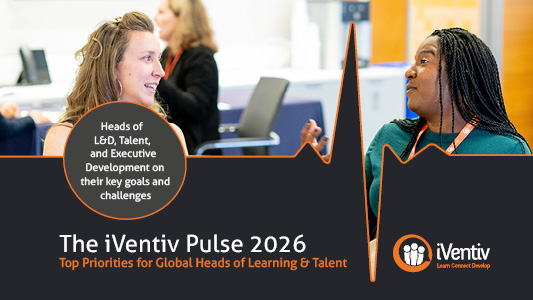
As a leader in L&D and Talent, what should you prioritise? iVentiv has surveyed almost 500 Global Heads of Learning, Talent, and Executive Development from 394 companies in 16 cities across 8 countries on three continents to find out what they are focusing on in their work. Together, their views provide a unique perspective on the state of Learning and Talent in 2026.
Read the full report for a detailed breakdown of the top topics, with expert comment from some of the leading thinkers in Learning and Talent Development. In this blog, we share some of the headline takeaways.
Key Takeaways
- The iVentiv Pulse Report is compiled based on the views of 468 senior L&D and Talent leaders in 394 companies
- Leadership and Executive Development remains the number one priority for L&D in 2026, with global organisations continuing to invest in leadership capability at all levels.
- Artificial Intelligence is the fastest-rising priority, as Learning and Talent teams adopt AI-driven learning platforms, skills intelligence, and personalised development tools.
- Reskilling and upskilling programmes are accelerating, supporting the shift towards skills-based organisations and future workforce agility.
- Learning culture and change management are growing focus areas, reflecting the pressure on organisations to adapt quickly to external disruption.
- People data, performance support, and the Future of Work round out the top themes shaping how CLOs and Global Heads of Learning and Talent will focus their strategies in 2026.
CLO Priorities: What is the iVentiv Pulse Report?
iVentiv runs Knowledge Exchange events for senior executives in Learning, Talent, and Executive Development. Before each of those events, participants complete a survey outlining the top priorities for them and their organisations. Survey respondents select their focus areas from a list of prompted topics and then provide additional, qualitative comments. Those responses are then combined with the multiple-choice selections to provide an overall picture of trends and ideas shaping the work of senior leaders.
The sample represents:
- 468 senior leaders in global businesses
- 394 companies with 12 million employees combined
- $4 billion in combined budget
- 16 cities in eight countries, on three continents
What are Chief Learning and Talent Officers’ Biggest Priorities for 2026?
The combined data in the iVentiv Pulse Report shows that the top 10 priorities for CLOs, VPs, and Global Heads of Learning, Talent, and Executive Development in 2026 are:
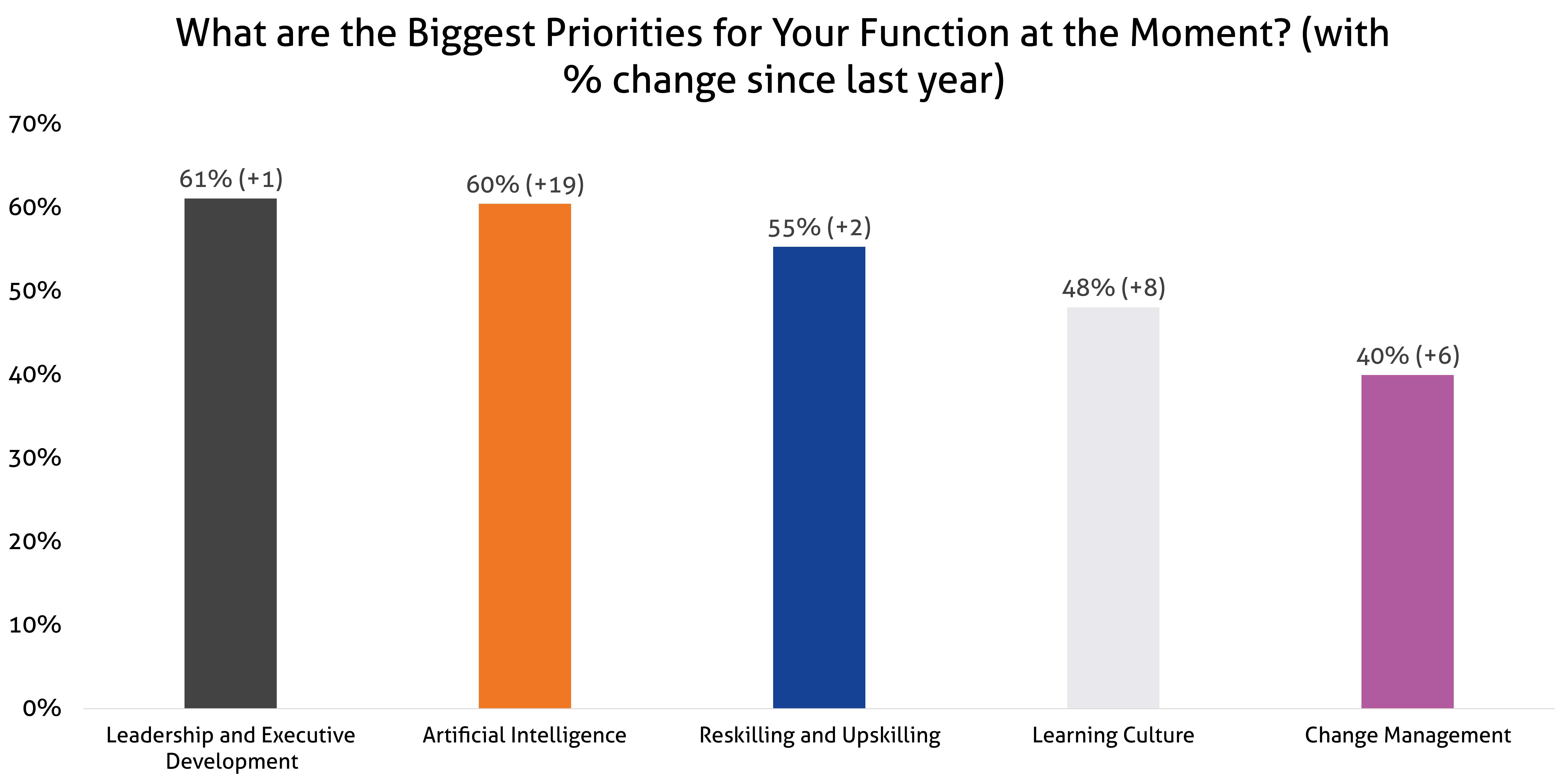
- Leadership and Executive Development: 61% (+1 compared to 2025)
- Artificial Intelligence: 60% (+19)
- Reskilling and Upskilling: 55% (+2)
- Learning Culture: 47% (+8)
- Change Management: 40% (+6)
- People Data/Insights, Measurement and ROI: 38% (+7)
- Future of Work: 34% (+10)
- Performance Management and Performance Support: 31% (+6)
- Coaching and Mentoring: 28% (+5)
- Learning Platforms: 20% (+1)
That means that Leadership and Executive Development remains the outright top priority for senior Learning and Talent executives at large organisations, a position it has held for as long as iVentiv has been collating these stats. AI is the biggest mover, with the proportion selecting it as a priority 19 percentage points higher than in 2025. The Future of Work has grown as a topic of importance as well, with 34% saying it is one of their top priorities compared to 24% in 2025.
Why is Leadership Development a Bigger Priority than AI for Learning and Talent Leaders?
At first glance, it might be surprising to see that Leadership and Executive Development beats AI to the top spot among the Global Heads who completed these surveys. In reality, however, it makes a lot of sense.
Leadership underpins everything. From handling external change to implementing business-wide transformations and building a culture that can survive in the new world of work, L&D leaders believe that developing the right kind of leadership capability could be a make or break factor for their organisations.
As Dr Shaheena Janjuha-Jivraj puts it in the report, leadership development “is no longer limited to the most senior individuals; successful leaders recognise the need to invest in leadership capabilities across their whole organisation.” Respondents refer to developing leaders at “all levels” to maintain “courage and confidence” regardless of the next seismic change that comes over the horizon.
Leadership responsibility, in other words, could sit with almost anybody in an organisation at any given time. Leadership skills, therefore, need to do likewise.
Why are Heads of Learning, Talent, and Executive Development Prioritising AI?
Although rapid change and instability means that leadership holds the top spot, there is a strong argument to say that AI is the most important disruptive factor that leaders are tackling.
Statistically, there is little importance to be placed on more executives selecting Leadership and Executive Development as a priority. The difference between the two is minute – in the single figures, in terms of number of respondents – and both were selected by almost two thirds of those completing surveys.
It’s no surprise as to why, either. AI is transforming the Learning function. Where traditional learning methods have often required employees to step away from the flow of work, many L&D leaders believe that AI will allow them to learn with live feedback and coaching instead. At the same time, many Talent leaders are using AI to better map the skills and talent within their organisations. In doing so, they say, they believe they can better “simulate succession scenarios” and “enhance career pathing, skill development and capability building.”
AI therefore underpins many of the other priorities we see in the iVentiv Pulse Report in several ways:
- It drives new possibilities for skills-based organisations.
- AI increases the speed of and need for change inside and outside of organisations.
- Coaching and live performance support become both more accessible and scalable.
- It increases the need for a learning culture.
- Expectations for learning platforms and learning data rise.
When one Talent leader at a global technology firm says that they are “looking for AI-driven learning platforms, with providers offering adaptive learning systems that personalise development journeys”, they show how much the market has shifted. AI is the means, but rapid and relevant learning is the expected outcome.
Where should Learning Leaders Focus their Work in 2026?
The data and detail in the full iVentiv Pulse Report demonstrate that the range and depth of ambition among Learning and Talent leaders is greater than ever. While AI, leadership, and change take the headlines, the value is in the detail.
What should L&D and Talent executives be prioritising with their time in 2026? In the report, you’ll find recommendations from experts including:
- Dr Shaheena Janjuha-Jivraj FRSA (CEO, Author, and Academic, Delta Futures, HEC Paris, Hult Ashridge, London Business School, Aga Khan University) on how “successful leaders recognise the need to invest in leadership capabilities across their whole organisation”.
- Jay Moore (Senior Advisor, ICEO & former CLO GE Corporate, GE) on how Learning leaders need to “Function as strategic partners by aligning learning initiatives with organisational AI goals”.
- Uli Heitzlhofer (Former Head of L&D, Lyft) on how skills-based approaches done well can help organisations “respond to market shifts with unprecedented speed”.
- Kimo Kippen (Former CLO, Hilton) on how “businesses with a culture and purpose that encourages and celebrates learning will be the businesses that succeed”.
- Simon Brown (Global Learning & Development Leader and Partner, Talent Team, EY)
- Tyra Malzy (Chief People Officer, Zoi) on why the "faster we can move, the more often we must recalibrate".
- Karen Kocher (Global GM, Future of Work, Workforce of the Future & Talent & Learning Experiences, Microsoft) on how “success depends on building agile systems that prioritise reskilling, redeployment, and employability at scale”.
- Nigel Paine (Former Head of People Development, BBC) on “the inevitability of AI playing a major role at work”.
- David Watkins (VP, Head of HR, Member of ExCom, RKW Group) on how “organisations need stronger frameworks to prioritise work [and] manage performance consistently”.
- Kate Evans (CPO, EMEA, Norton Rose Fulbright) on why “we need to learn to fail fast and understand what we should do differently in future”.
- Brian Murphy (Global Head of Learning & Development, NTT Data) on why coaching can provide “the ultimate in personalised development solutions”.
- Charles Jennings (Co-Founder, 70:20:10 Institute) on how “platforms that personalise assistance in real-time will become essential tools”.
- Jonathan Donner (Former Unilever, UN World Food Programme, Amazon) on how "AI gives us new ways to move beyond completion rates and get closer to real performance and business impact data."
- Gary Kildare (Independent Chair and NED, and former CHRO Europe, IBM) on why “DEIB fails only when leaders stop owning it as part of how the business runs.”
Frequently Asked Questions
1. What are the biggest priorities for Learning and Talent leaders in 2026?
According to the iVentiv Pulse Report, the top priorities for Global Heads of Learning, Talent, and Executive Development in 2026 include Leadership and Executive Development, Artificial Intelligence, Reskilling and Upskilling, Learning Culture, and Change Management. These priorities show a clear shift towards skills-based organisations and leadership capability in an AI-driven world.
2. Why is leadership development still more important than AI for L&D?
Leadership continues to come first because organisations need capable leaders to guide transformation, build culture, and navigate disruption. AI can accelerate learning and talent processes, but strong leadership is what enables those technologies to be adopted, scaled, and embedded across the business.
3. How is AI changing Learning and Talent Development?
AI is changing the function through adaptive learning platforms, personalised development journeys, skills mapping, succession planning, and talent intelligence. CLOs and Talent leaders say AI is helping employees learn in the flow of work and enabling organisations to make faster, data-driven workforce decisions.
4. What skills are Learning and Talent teams focusing on for 2026?
The Pulse Report shows growing investment in leadership capability, change and transformation skills, AI literacy, skills data, internal mobility, and digital fluency. These skills support future workforce agility and the shift towards continuous reskilling and employability.
5. How was the data for the iVentiv Pulse Report collected?
The 2026 report is based on survey data from nearly 500 Global Heads of Learning, Talent, and Executive Development across 394 companies in 16 cities, 8 countries, and three continents. Respondents selected their top priorities and shared qualitative comments about their focus areas and challenges.
6. What is driving the rise of AI in Learning and Talent?
The surge in AI adoption is being driven by demand for faster reskilling, better job-to-skills matching, real-time coaching, and more personalised learning experiences. Leaders are also using AI to map internal talent, support succession planning, and improve workforce insights, which accelerates talent decision-making.
7. What will Learning and Talent functions look like by 2026?
The report suggests that Learning and Talent functions will become more skills-focused, data-driven, and AI-enabled. Leaders expect more learning in the flow of work, faster development cycles, stronger leadership pipelines, and systems that support redeployment, reskilling, and employability at scale.