What Makes a Good Learning and Development Budget in 2026?

Updated April 2026

By Richard Parfitt (Marketing Director, iVentiv and author of the iVentiv Budget Report)

As an L&D leader, you are certainly not alone in wondering if your budget matches up to the expectations placed on you and your team. It’s no surprise that 60% of CLOs say measuring ROI is one of their top priorities.

But what makes a good L&D budget in 2026? How much should your organisation be spending? What figures should you be benchmarking against?

Download the iVentiv Budget Report today for a detailed breakdown of how much senior Learning and Talent Executives have at their disposal in 2026, including average budget per employee. The report also lays out what L&D’s biggest spenders and biggest employers are prioritising.
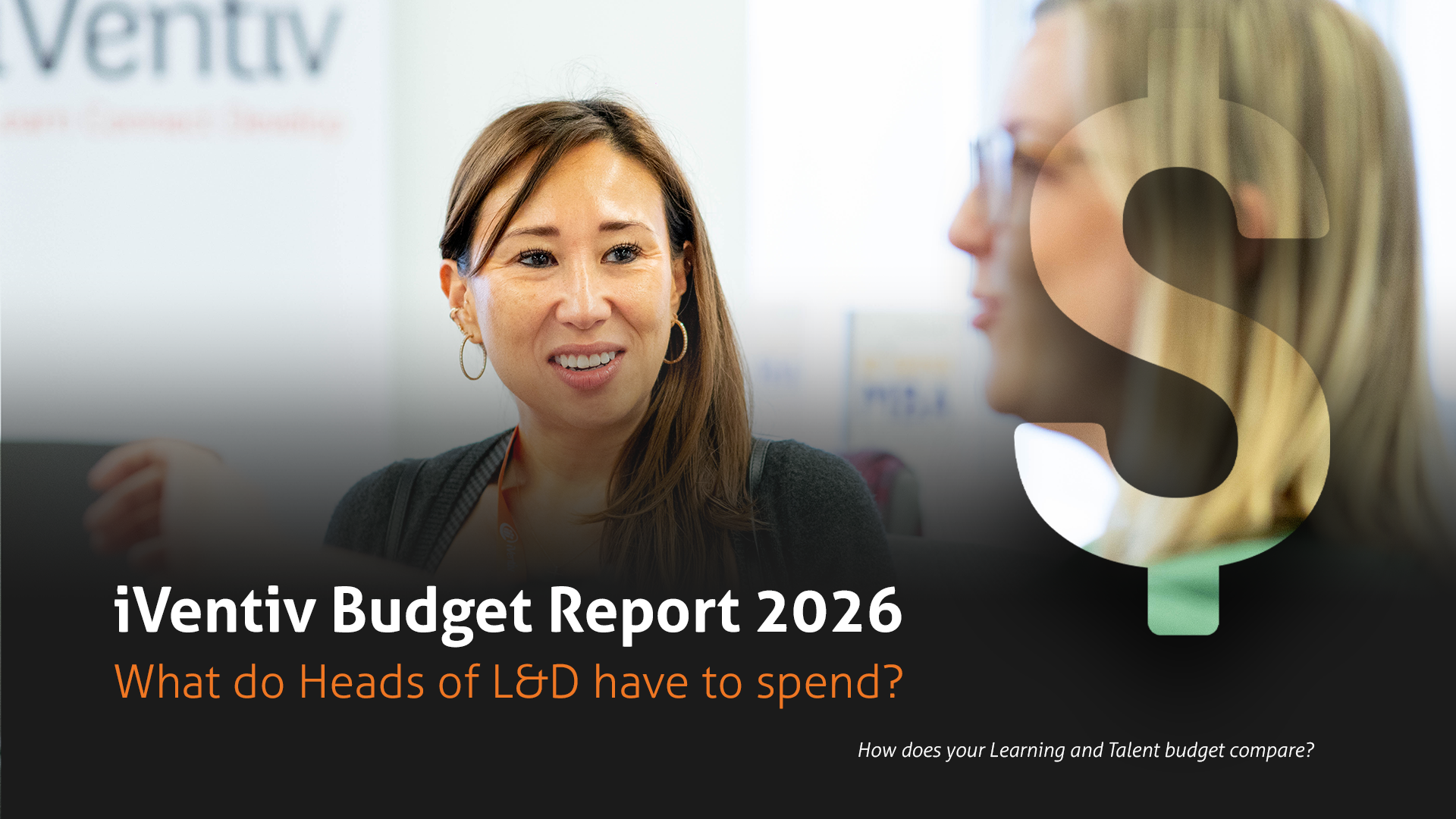
The cover of the iVentiv Budget Report 2026

Key Takeaways

  • The average L&D budget for senior leaders in 2026 is $11.8 million, with significant variation across organisations
  • Spend per employee differs widely, from over $1,700 in smaller organisations to under $300 in larger enterprises
  • CLOs with the largest budgets prioritise Future of Work, Skills, and Learning Platforms
  • The biggest employers place more emphasis on AI as a core L&D priority

What is the Average L&D Budget in 2026?

In terms of the headline number, the average L&D executive holds a budget of $11.8 million.

That’s based on survey responses from almost 500 global Heads of Learning & Development and Talent, from organisations with tens of thousands of employees on average. Each respondent completed a survey between April 2025 and March 2026 ahead of an iVentiv event for senior Learning and Talent leaders.

Respondents were asked to share the budget under their specific control, so that number may reflect the discretionary budget under the control of the individual Chief Learning Officer, rather than the absolute total spend on L&D.

That said, the spread is revealing, with around 50% of L&D leaders holding a budget of $1 million or more, and 6% over $100 million.

What is the Average L&D Spend Per Employee?

Survey respondents were also asked to share the number of employees or internal customers under their remit. Based on those responses, the average Learning spend per employee is $902.

Once again, there is a wide range of spending levels. Executives responsible for fewer than 5,000 employees manage an average total budget of $4.3 million, but a spend per employee of $1,735. In larger organisations, employing over 100,000 people, the average budget is over $25 million, but the spend per employee is $259.

Where do CLOs with the Biggest Learning & Development Budgets Spend Their Money?

What the report also shows is that the Executives with the biggest budgets are more likely to prioritise certain topics compared to their less well-resourced peers. Respondents with budgets of $100 million+ were more likely to be focusing on:

  • The Future of Work
  • Reskilling and Upskilling
  • Learning Platforms (LMS/LXP)

Learning leaders with the biggest budgets are concerned with designing work and the “skills needed for the future”, driving culture change in a scalable way amidst “persistent change”.

Where do the Biggest Employers Spend Their Learning & Development Budgets?

Pricing for many Learning products and platforms is based on a price per user, so it is worth asking where the biggest employers are most likely to focus their efforts and their money as well.

When it comes to how the biggest employers spend their Learning & Development budgets, Chief Learning Officers and Heads of Learning & Talent are more likely to focus on three key areas:

  • Artificial Intelligence (AI)
  • Learning Platforms (LMS/LXP)
  • Future of Work

The difference is especially striking when it comes to AI, with 74% of L&D budget holders at organisations with more than 100,000 employees saying that Artificial Intelligence is a top priority compared to only 54% at organisations with fewer than 5,000 employees.

Benchmark Your L&D Budget: Download the iVentiv Budget Report

The full iVentiv Budget Report includes a detailed breakdown of the different budgets managed by Learning & Development Executives. That includes figures on the average Learning budget per employee in organisations of different sizes, and how the top priorities for Chief Learning Officers change depending on the size of their budget and workforce.

Download the report for free today.

Frequently Asked Questions

What is an L&D budget?

An L&D budget (Learning & Development budget) refers to the total amount an organisation allocates to training and development activities over a set period, typically annually. This includes spending on leadership development, learning platforms (LMS/LXP), external providers, internal programmes, and workforce development initiatives. Understanding what an L&D budget is helps organisations plan how they invest in skills, performance, and long-term capability building.

What is a good learning and development budget in 2026?

A good learning and development budget depends on organisational size, industry, and strategic priorities. However, current benchmarks suggest that the average L&D budget for senior leaders is around $11.8 million. Rather than focusing solely on total budget, organisations should assess whether their budget for learning and development aligns with business goals, supports key initiatives like Artificial Intelligence and leadership development, and delivers measurable impact.

What is the average L&D budget per employee?

The average L&D budget per employee is approximately $902, based on recent data from global Learning & Development leaders. However, this figure varies significantly. Smaller organisations often invest more per employee, sometimes exceeding $1,500, while larger enterprises may spend closer to $250 per employee. Benchmarking your L&D spend per employee is essential to understand whether your investment is competitive and effective.

How do you calculate a training and development budget per employee?

To calculate a training and development budget per employee, divide your total L&D budget by the number of employees or learners in your organisation. For example, if your annual L&D budget is $10 million and you support 10,000 employees, your Learning & Development budget per employee would be $1,000. This metric is widely used to compare Learning budgets across organisations and to benchmark investment levels.

What should be included in a learning budget?

A comprehensive learning budget should include all costs associated with training and development. This typically covers:

  • Leadership development programmes
  • Learning platforms and technology (LMS/LXP)
  • External training providers and consultants
  • Internal programme delivery and resources
  • Content creation and curation
  • Workforce development initiatives

A well-structured L&D budget ensures that spending is aligned with both immediate training needs and long-term organisational capability.

How can you benchmark L&D budgets effectively?

Benchmarking L&D budgets involves comparing your spending against similar organisations in terms of size, industry, and geography. Key metrics include total Learning budget, L&D spend per employee, and investment in priority areas such as leadership development. Effective benchmarking goes beyond numbers. It also considers how budgets are allocated and whether spending supports strategic outcomes like reskilling, culture change, and digital transformation.

How does L&D spend impact ROI and business performance?

L&D spend plays a critical role in driving organisational performance, but ROI depends on how effectively the budget is used. Investment in training and development can improve employee engagement, productivity, retention, and leadership capability. To maximise ROI, organisations should align their Learning budgets with business priorities, focus on applied learning, and measure outcomes such as performance improvement and skill acquisition rather than just participation rates.
Thumbnail: 
News category: 
Learning & Development
ROI and Data
Latest Trends in Learning

More Insights

The advent of generative AI has sparked widespread discussions across industries, but for Learning and Development, its potential remains a double-edged sword.

On the one hand, for many leaders, AI promises to revolutionise the way learning is designed and delivered. On the other, it risks reinforcing old habits and hindering meaningful change.

In a recent episode of The Learning Hack Podcast, hosted by John Helmer, guest Charles Jennings— iVentiv Advisory Board member, regular iVentiv Event Chair, pioneer in L&D transformation, and Co-Founder of the 70:20:10 framework—offered deep insights into these challenges.

This blog unpacks the key themes from their conversation and asks how can L&D leaders avoid complacency? How can they leverage AI responsibly? How can they refocus on performance improvement over outdated methodologies?

Read more

In an age of constant change, Zurich Insurance has embraced a skills-based approach as a core strategy to future-proof its workforce and drive business success. 

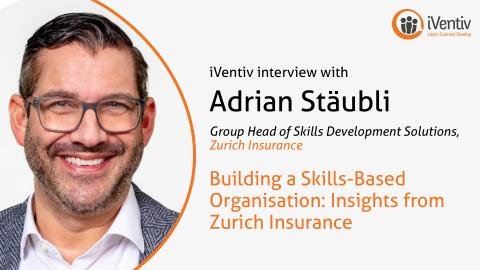
In an interview with iVentiv, Adrian Stäubli, former Group Head of Skills Development Solutions at Zurich Insurance, highlighted Zurich’s commitment to identifying, developing, and deploying skills across its global workforce. 

This model isn’t just a tool— to Adrian it’s a "secret ingredient" that touches every aspect of employee development, from career progression to job design, setting Zurich apart as a truly agile and resilient organisation.

Watch our interview now to see how Adrian embraced skills, and how it’s transformed Zurich’s employee experience.


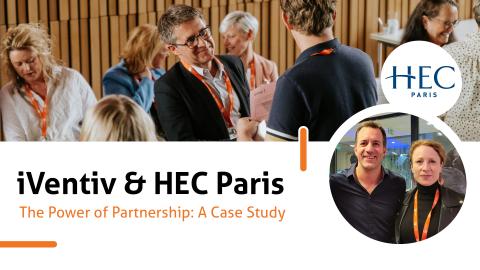
In the ever-evolving world of executive education and corporate learning, partnerships are key to success. iVentiv has nurtured a long-standing relationship with HEC Paris, a prestigious European business school that was founded in 1888, since 2010 and has become a leading institution in Executive Development. Through this collaboration, HEC Paris has not only elevated its presence within the corporate learning community but has also provided valuable insights and support to iVentiv’s events worldwide.

Join us as we dive into the partnership between iVentiv and HEC Paris, how it's bloomed over the years, and where it will go next.

In today’s complex global landscape, even the most experienced L&D executives face a persistent challenge: ensuring alignment and collaboration within large Learning & Development teams spread across geographies, business units, and time zones.

Too often, L&D functions in multinational companies operate in silos. Teams set objectives independently, repeat each other’s work unknowingly, or miss opportunities to scale successful initiatives. Despite good intentions, the lack of structured knowledge-sharing and alignment can hinder progress, dilute impact, and ultimately affect how well organisations respond to change. 

So, how do you create an event designed to build a strong, connected L&D team that learns from each other and works towards a shared vision? Read on to find out.

Whether you’re launching a new initiative, or planning a team-building day, internal corporate events need more than just good food and a decent venue. Without the right strategic groundwork, even the most beautifully executed event can fall flat. 

Instead, before diving into logistics, you should pause and ask the foundational questions that shape a purposeful, effective experience.

This guide explores the key questions to ask before you start planning an internal event to help you clarify objectives, understand your audience, and align the event with your broader organisational goals. Read more.

In today’s competitive, hyper-informed market, you can’t win customer loyalty with a strong product or slick branding alone. Instead, you need trust, relevance, and a consistent demonstration that you understand your customers' needs. 

That’s where customer education events come in. 

These aren’t just glorified sales pitches. They’re strategic opportunities to deliver value, deepen relationships, and build communities around your offering.
When done well, these events don’t just teach; they transform customers into advocates. They help your business stay front-of-mind while giving your clients the tools and insights to succeed with your product or service at the centre of their strategy.

Curious to learn more? Read now.

Large, global Learning and Talent teams are both a strategic advantage and a serious leadership challenge. They stretch across regions, time zones, and business units, and are expected to deliver transformation while operating in a constant state of change themselves. 

For many Chief Learning Officers, the only regular opportunity to bring their teams together is the annual offsite or occasional away day.

The result often defaults into “team building”. Although icebreakers, marshmallow toothpick towers, and trust falls are activities that might boost morale, they rarely help a learning professional facing the practical pressures of AI adoption, skills taxonomies, or strategic workforce planning. 

Global teams need more than a bonding experience. They need shared language, shared strategy, and shared confidence to deliver. 

They need knowledge transfer, not just camaraderie. 

They need team learning.

This is where the distinction matters, and this is exactly what our blog discusses. Read it now.

Leading a global Learning and Development function is both a privilege and a puzzle. You have talent in every corner of the world—people who understand local markets, cultures, and business needs—who often work in silos, separated by time zones, priorities, and communication styles.

The irony is clear: the very people responsible for enabling learning across the business often struggle to learn from each other. When global L&D teams rarely connect, knowledge gets trapped, duplication creeps in, and alignment suffers.

That’s where a well-designed team event comes in. Whether virtual or in-person, a thoughtfully structured gathering can do more than boost morale—it can create alignment, build capability, and spark collaboration that carries through the rest of the year.

This blog offers a practical framework for running effective L&D events for global teams—one that transforms an annual offsite or virtual workshop into a shared learning experience with measurable business impact. Read it now.

In many large learning organisations, global L&D teams face a recurring challenge: knowledge silos. 

Why?

Regional groups or functional departments often operate in isolation, creating, developing, and executing learning programmes with little visibility into what their peers are doing elsewhere. That isolation leads to duplicated effort, inconsistent practices, and lost opportunities for synergy.

In this blog, we’ll explore how thoughtfully designed events—virtual or in-person—can break down silos, strengthen global L&D collaboration, and foster sustained knowledge sharing across your organisation. Read it now.

In today’s workplace, knowledge is your most valuable asset, but it’s also the easiest to lose. As staff turnover rises, careers become more fluid, and hybrid work scatters teams across time zones, keeping that knowledge alive and connected has never been harder. 

For anyone running a large global L&D operation, it can feel like trying to keep dozens of spinning plates in the air at once.

Yet when knowledge sharing breaks down, the costs are high: duplication of effort, inconsistent experiences, and ideas that never reach beyond the local team. The solution lies in intentionally designed knowledge sharing workshops and internal knowledge sharing events that make collaboration systematic, not accidental.

This blog explores how to design those events effectively, turning conversation into impact and connecting the dots across your global Learning organisation. Read it now.

Pages