Submitted by Kerry Summers on
Updated February 2026
By Kerry Summers (Content Marketing Coordinator, iVentiv)
Key Takeaways
- Judgement, not knowledge, is becoming the true leadership differentiator
- AI should enhance learning quality, not steal the spotlight
- Traditional training cannot build judgement, but practice can
- Leadership Development needs a tighter, more functional definition
Leadership Development is under increasing scrutiny. As AI reshapes how work is done, organisations are questioning whether their leadership programmes are building the capabilities leaders actually need to succeed in an environment defined by speed, complexity, and uncertainty.
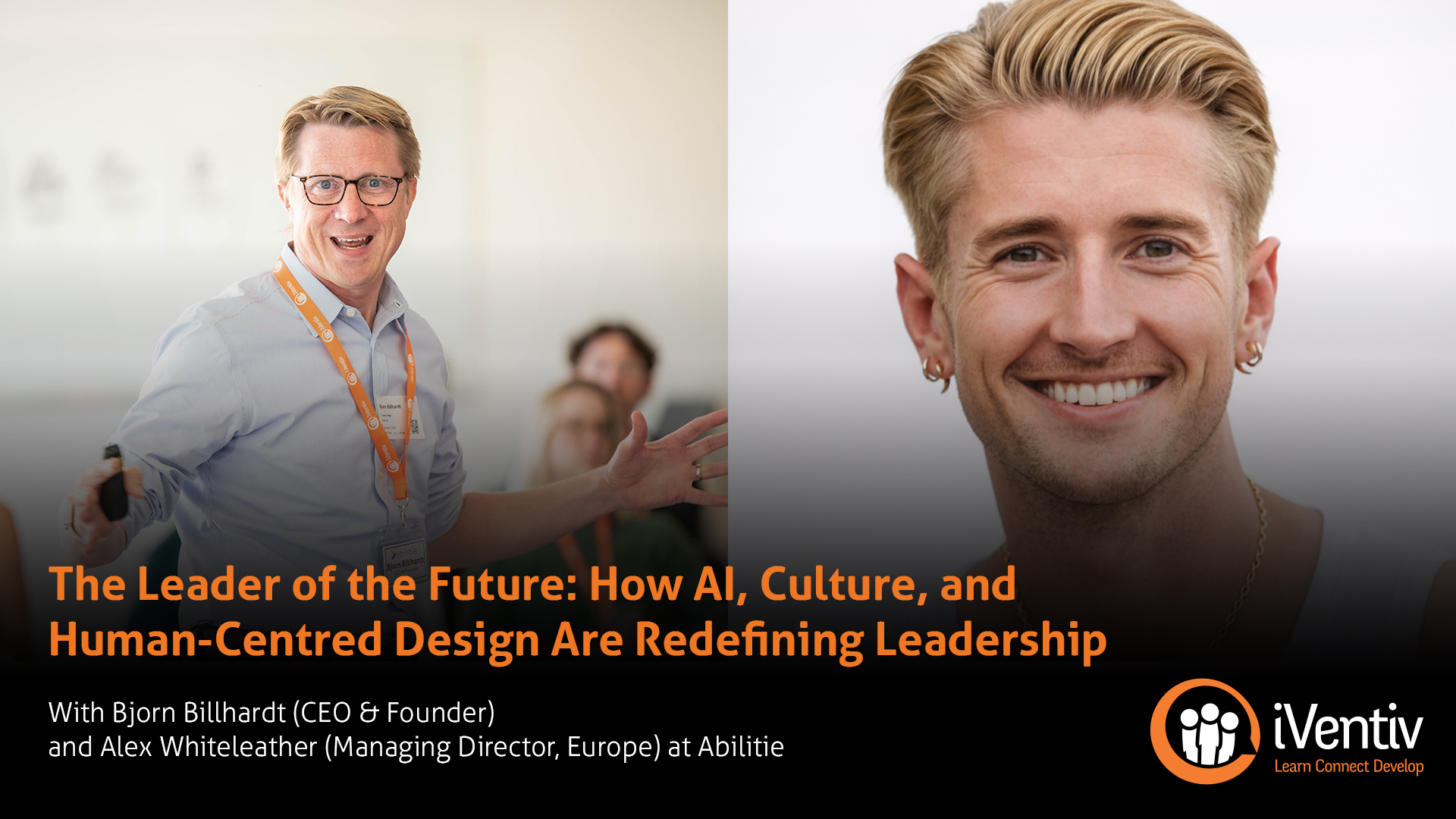
In this conversation with Bjorn Billhardt, Founder and CEO, and Alex Whiteleather, Managing Director, Europe, at Abilitie, the pair highlight one consistent message: as they see it, the era of Leadership Development centred primarily on knowledge acquisition is ending. What organisations now require is leadership judgement.
For Chief Learning Officers and senior Talent leaders, this shift has significant implications for Leadership strategy, programme design, and much more. Watch our interview now to learn more about the future of Leadership Development, and how ‘judgement’ is now an organisations competitive advantage.
Why “Leadership” Has Become an Unclear and Overused Term in L&D
One of the fundamental challenges facing Leadership Development today, Bjorn says, is definitional. ‘Leadership’ has become an umbrella term used to describe a wide range of skills, behaviours, and values, often without sufficient precision.
Bjorn argues that this lack of clarity weakens Leadership Development efforts rather than strengthening them:
“Leadership has come to mean almost everything to everyone […] and not in a healthy way.”
- Bjorn Bilhardt, CEO & Founder, Abilitie
His argument is that when leadership is used interchangeably to describe virtue, influence, communication style, people management, or organisational values, development programmes tend to expand without focus. Frameworks grow more complex, competency models become unwieldy, and measurement becomes increasingly difficult. Abilitie’s approach is intentionally simpler. Bjorn offers a functional definition:
“Leadership is enabling common action. It’s getting others to work together toward a common goal.”
- Bjorn Bilhardt, CEO & Founder, Abilitie
The idea is that this is a practical definition CLOs can actually build around, because it naturally pushes the learning strategy toward alignment, communication, decision-making, and execution.
It also creates a healthier separation between:
- What leadership is
- What leadership is for
- What we personally believe “good leadership” should look like
This definition does not prescribe what leaders should value or how they should behave in every context. Instead, it provides a practical foundation for development, one that focuses on alignment, decision-making, and execution. For learning leaders, this distinction enables greater precision in identifying what capabilities to build and how to build them.
The Three Core Leadership Capabilities That Matter in the Age of AI
For Alex, one aspect of leadership that should be a crucial thinking point for capability building is:
“what does the organisation do to create value, and how are we building leaders to understand how are they making decisions that then filter into the value that the organisation creates?”
- Alex Whiteleather, Managing Director, Europe, Abilitie
To try and answer this, Bjorn explains that Abilitie has distilled leadership into three teachable buckets, which he says encompass capabilities that remain stable even as business models, organisational structures, and technologies shift:
- Understanding business
- Working with others
- Working through others
As Bjorn explains, “those are the three big areas in which we believe leaders can truly level up.”
- Bjorn Bilhardt, CEO & Founder, Abilitie
These capabilities are particularly relevant as organisational structures evolve; traditional hierarchical “pyramids” are flattening, and many entry-level tasks are increasingly automated. Bjorn describes a shift toward a “diamond-shaped” organisation, with fewer layers and faster decision cycles.
In such environments, Bjorn and Alex say, leaders must develop judgement earlier in their careers, often without the benefit of prolonged experience in lower-risk roles; a reality which places greater pressure on Leadership Development to provide meaningful practice, not just conceptual understanding.
Why Does Traditional Leadership Training Fail to Build Judgement?
If judgement is the defining leadership capability of the AI era, the question becomes ‘how can it be developed?’
According to Bjorn, traditional learning approaches are insufficient:
“You’re not going to get to judgement by listening to a PowerPoint slide. You get there by being immersed in an environment, making decisions, and seeing the outcomes.”
- Bjorn Bilhardt, CEO & Founder, Abilitie
This is where simulation-based learning plays a central role. Unlike individual, self-paced digital learning, Abilitie’s simulations are team-based, synchronous, and facilitated. Participants assume roles, compete with other teams, and make decisions in real time under conditions that mirror organisational complexity.
Alex highlights an important nuance:
“It’s not always about what you’re doing, but how you’re doing it.”
- Alex Whiteleather, Managing Director, Europe, Abilitie
Leadership simulations surface these behavioural dynamics, for example, how leaders communicate, negotiate, prioritise, and align others, providing insight that cannot be captured through assessments or content consumption alone.
Using AI-Enabled Simulations to Accelerate Leadership Learning
Bjorn and Alex argue that AI is not simply another topic to add to Leadership curricula. It is fundamentally changing how leadership capability can be developed.
Bjorn explains that AI enables a qualitative leap in simulation design. Rather than relying on scripted scenarios or multiple-choice branching, learners now interact with AI-driven characters which include virtual employees, peers, negotiators, or external stakeholders, who respond dynamically to the learner’s input.
"You’re placed in front of an AI character and they say, ‘Tell me what you think.’ You have to figure out what to say, what to ask, and how to respond.”
- Bjorn Bilhardt, CEO & Founder, Abilitie
Equally important, they say, is AI’s impact on facilitation. AI can analyse conversations, decisions, and interactions in real time, providing facilitators with immediate insight into patterns, misalignment, and decision quality.
Alex argues that this dramatically accelerates learning:
“AI allows facilitators to get to those awareness moments much more quickly than we ever could in the past.”
- Alex Whiteleather, Managing Director, Europe, Abilitie
Crucially, both Alex and Bjorn say that AI should remain invisible to the learner. The objective is not to showcase technology, but to enhance the quality of the learning experience itself.
Why?
“We never want the tool to feel like ‘cool AI.’ We want it to feel like a great learning experience enriched with AI.”
- Alex Whiteleather, Managing Director, Europe, Abilitie
Enhance Your Leadership Skills through Human Judgement and AI
As AI increasingly handles information processing and routine execution, leadership work shifts toward interpretation, coordination, and judgement. Leaders must understand complex systems, manage trade-offs, and align human and technological resources toward shared outcomes.
Alex highlights the growing importance of cross-functional leadership by asking:
“How do we better understand how all these systems are working together, and remain vigilant in how we communicate and collaborate across the business?”
- Alex Whiteleather, Managing Director, Europe, Abilitie
Bjorn adds an important perspective on language and thinking. With AI enabling work to be conducted through natural language, skills traditionally associated with ‘being human’, for example, critical thinking, structured reasoning, and precise communication, are becoming central to Leadership effectiveness. He says:
“We may not need to code in programming languages anymore. We can code in words.”
- Bjorn Bilhardt, CEO & Founder, Abilitie
In this context, durable human capabilities such as empathy, clarity of thought, and ethical judgement become more valuable, not less.
Why Over-Engineered Leadership Competency Models Are Holding L&D Back
One of the more provocative insights from the discussion concerns the growing complexity of leadership competency frameworks.
While acknowledging the value of skills-based talent strategies, Bjorn questions whether the pursuit of granular measurement has gone too far:
“I’m seeing leaders tie themselves into knots creating competency maps with hundreds of skills… and I wonder if we’re losing sight of the bigger picture.”
- Bjorn Bilhardt, CEO & Founder, Abilitie
He challenges the assumption that increasingly precise measurement necessarily leads to better Leadership outcomes:
“I don’t know if it’s possible to measure whether someone is empathy six or empathy seven. And if we can’t, what’s the value of pretending we can?”
- Bjorn Bilhardt, CEO & Founder, Abilitie
For CLOs, this raises an important strategic question: Does complexity build credibility, or does it distract from what actually develops leaders; practice, reflection, and feedback?
Bjorn suggests that Learning leaders may strengthen their impact by simplifying, not expanding, their models and focusing on fundamental capabilities that can be observed and developed through experience.
Three Takeaways for Heads of Learning
What do Bjorn and Alex suggest for CLOs and Talent leaders moving forward? There are three broad takeaways:
- Leadership programmes must move beyond knowledge transmission toward judgement-building experiences. Simulations, social learning, and facilitated practice are no longer optional enhancements; they are central to developing leaders capable of navigating uncertainty.
- AI, when applied thoughtfully, can accelerate insight and deepen learning without replacing the human elements of Leadership Development. At the same time, Learning leaders should resist the temptation to over-engineer frameworks in pursuit of false precision.
- As organisations face increasing volatility, Leadership Development has an expanded responsibility, not only to prepare leaders for business outcomes, but to equip them to make sound decisions that shape culture, trust, and long-term value.
In the words of Bjorn,
“The fundamental tasks of Leadership won’t change. What will change is how fast decisions travel and how far they reach.”
- Bjorn Bilhardt, CEO & Founder, Abilitie
For today’s Chief Learning Officers, the challenge and the opportunity is to ensure their Leadership strategies are built for that reality.
FAQ
How is AI changing Leadership Development programmes?
AI is transforming Leadership Development by enabling more immersive, experiential learning. AI-powered simulations allow leaders to practice real-world scenarios, interact with dynamic virtual stakeholders, and receive immediate, data-informed feedback, accelerating insight and behaviour change beyond traditional classroom or content-based training.
Is knowledge still important for leaders?
Yes, but knowledge alone is no longer a differentiator. AI makes information widely accessible; effective leadership now depends on how well individuals apply knowledge through judgement, context, and decision-making rather than simply possessing it.
Why are Leadership simulations effective for developing leaders?
They allow leaders to learn by doing. Rather than passively consuming content, participants make decisions, experience consequences, and reflect on outcomes in a social, facilitated environment. This approach builds judgement, business acumen, and cross-functional leadership skills that are difficult to develop through lectures or e-learning alone
How do AI-enabled simulations differ from traditional simulations?
AI-enabled simulations move beyond scripted scenarios and multiple-choice decisions. Leaders interact with AI-driven characters that respond dynamically, allowing for more realistic conversations, negotiations, and people-management challenges. AI also supports facilitators by analysing interactions and surfacing insights in real time.
What Leadership skills are most important for the future?
The most important future leadership skills include judgement, critical thinking, cross-functional collaboration, communication, empathy, and business acumen. These human capabilities become more valuable as AI handles knowledge-based and transactional work.
What role do facilitators play in AI-driven leadership development?
Facilitators remain essential. AI enhances their role by providing richer data, faster feedback, and clearer insight into participant behaviour. Skilled facilitators use this information to guide reflection, discussion, and learning transfer.
An organisational and Leadership Development expert, Bjorn Billhardt has designed Leadership Development programmes and collaborated with world-class institutions for two decades. Since 2015, Bjorn has been CEO of Abilitie, a provider of Leadership Development and mini-MBA programs. Prior to founding Abilitie, Bjorn was Co-founder and CEO of Enspire Learning, Inc.
Since joining Abilitie in 2016, Alex Whiteleather has played a pivotal role in developing and delivering Leadership Development programmes, supporting global launches for a diverse range of clients. His success in the United States led to his current role as Managing Director of Abilitie’s European operations.