Submitted by Kerry Summers on
Updated March 2026
By Kerry Summers (Content Marketing Coordinator, iVentiv)
Listen to the podcast on Spotify and Apple Podcasts now.
Key takeaways
- Corporate universities must evolve from prestige projects to enterprise learning ecosystems
- Federated learning models balance scale with relevance
- Skills strategies only create value when connected to business strategy
- AI will push L&D toward hyper-personalised learning at scale
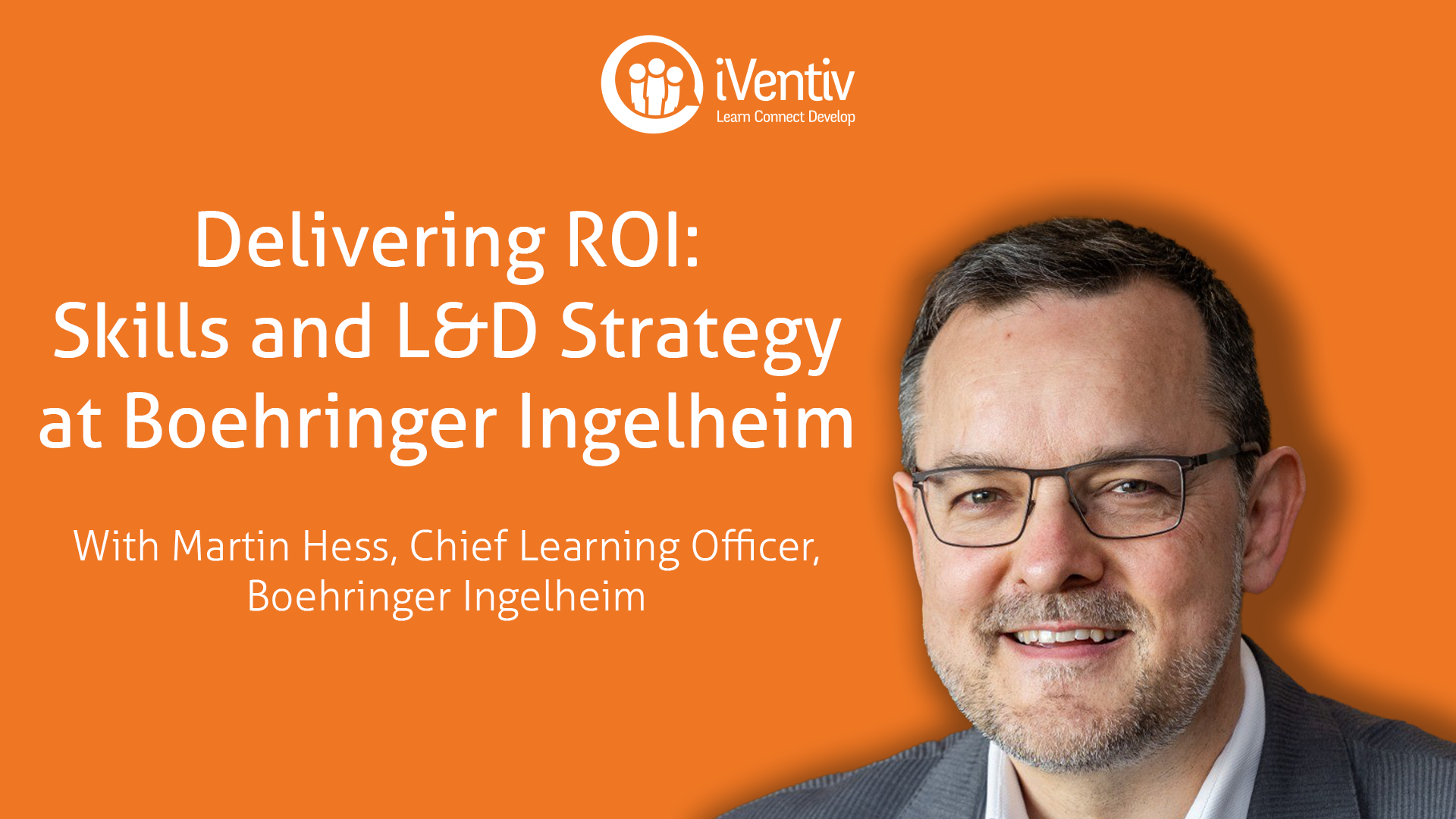
Corporate universities are nothing new. For decades, they’ve served as symbols of prestige and places where senior executives sharpen their leadership skills. But at Boehringer Ingelheim, the “university” concept has been reimagined as a global ecosystem serving every one of the company’s 54,000 employees.
At the centre of this transformation is Martin Hess, Chief Learning Officer and Head of Boehringer Ingelheim University. His remit spans everything from skills-based learning and culture-building, to global vendor management and ROI. The common thread? Moving learning from the periphery to the heart of business strategy.
Boehringer Ingelheim’s “University” isn’t a campus—it’s a company-wide operating model for learning. Under Martin, the University functions as a strategic “roof brand” that unifies dozens of local learning units across regions and functions. The aim is simple and ambitious: one ecosystem that serves all 54,000 employees, not just senior leaders, with both virtual and face-to-face opportunities accessible through a single “virtual campus.
A federated model that scales without diluting relevance
Rather than centralising everything, Boehringer Ingelheim runs a federated model: roughly 500 people around the business create and curate content. This keeps learning close to real work while a lightweight alignment mechanism ensures offerings map to enterprise and functional strategies. The centre provides the platform, standards, and governance; local teams contribute context and speed. The result is breadth without bloat: global consistency where it matters, local fit where it counts.
Anchoring learning in skills
Martin tells us that, two years ago, Boehringer Ingelheim introduced a skills-based approach at enterprise scale. Every employee was prompted to build a skills profile, and the system’s AI surfaced an initial skills map. The exercise did more than populate a database: it shifted mindsets. People began to “think in skills” across geographies, levels, and job families, creating a common language that travels well inside a complex organisation.
A pivotal move came next: connecting those skills to strategy. Business leaders identified the capabilities required over the next 12–24 months; aggregated skills data from teams was then compared to those targets. The gap analysis gave direction at every level. Leaders could articulate clear expectations (e.g., target proficiency levels by a given date), and individuals could see their starting point and path forward. That clarity pulled learning out of the “nice-to-have” category and into the weekly operating rhythm.
Avoiding the “now what?” trap
Many organisations stall after skills mapping. Martin tells us that this wasn’t the case for Boehringer Ingelheim. He says that the organisation’s LXP uses each person’s skills profile to recommend focused learning assets; teams get curated pathways aligned to agreed capability goals; leaders receive aggregated insights rather than individual data, preserving trust while enabling decision-making. This closes the loop from intent to action and makes progress visible.
Getting serious about ROI
Martin is candid about a widely shared challenge: most HR and L&D teams avoid ROI because the data is thin and the formulae fall apart. Boehringer tackled a measurable slice first—external learning spend—by implementing global learning vendor management. All purchases for training, coaching, and content now flow through one mechanism co-designed with Sourcing. The short-term reaction in countries wasn’t enthusiastic; the medium-term benefits were unequivocal.
Consolidation delivered three wins:
1. Transparency
Country HR and the central team can see who’s buying what, where, and why, finally enabling portfolio steering.
2. Quality and price
Aggregating similar needs drives better vendor selection and materially better rates.
3. Credibility with Finance
With comparable, year-on-year cost and volume data, L&D can show how much more the company receives for fewer euros.
This doesn’t “solve” ROI for everything L&D does, and Martin doesn’t claim it does. But it reframes the dialogue: measurable efficiencies in external spend underwrite the freedom to invest in higher-value, harder-to-quantify areas like culture, leadership, and innovation.
As Martins says: “Those numbers give us permission to operate in less quantifiable areas.”
AI and hyper-personalised learning
Boehringer’s next horizon is hyper-personalisation. The vision: AI-enabled real-time curation and real-time content generation that produces an individualised “prescription” for each employee’s upskilling needs. For a 54,000-person company, that’s not a marginal improvement; it’s a structural shift. L&D operating models, roles, and governance will need to evolve accordingly, from programme scheduling to orchestration, from content production to experience design and quality assurance.
Martin frames this not as hype but as near-term reality. The organisation has already built the foundations: a unified platform, a shared skills language, federated creators, measurable efficiencies, and a leadership habit of aligning learning with strategy. Hyper-personalisation builds on each of those bricks.
Five practical lessons for global Learning leaders
Boehringer’s approach offers five practical lessons for global learning leaders:
Make the university a system, not a site. Use a unifying brand and platform to bring everything together but keep creation close to the business with a federated model.
Operationalise skills, don’t just catalogue them. Map enterprise strategy to capabilities, compare to aggregated skills data, and set explicit targets. Let that drive curation and pathways.
Close the “so what?” loop. Ensure your LXP and operating cadence convert skills intent into prioritised learning and visible progress.
Pick a measurable ROI area. External spend is often the fastest route to credible numbers. Use those savings and insights to fund and protect higher-order work.
Upgrade the L&D capability stack. Data literacy, vendor management, and finance partnership aren’t side quests, instead they’re core competencies for the modern function.
Boehringer Ingelheim’s experience is a reminder that L&D’s influence grows when it behaves like part platform, part consultancy, and part product organisation—anchored in the business and accountable for outcomes.
Or, as Martin puts it “we align learning to business goals.” Everything else flows from there.
Martin Hess is a proven executive, senior strategist, and strong innovator with robust experience driving large scale initiatives from strategy to execution, with a passion for driving change. In his current role at Boehringer Ingelheim, he is responsible for implementing a skills-based Learning approach at scale, nurturing and growing a learning culture, uniting L&D across the organisation, providing a powerful global learning infrastructure, helping the organisation to implement state-of-the-art standards for Learning as CoE, and supporting the business with its own global Academies.
Related Resources
- The ROI of a Great Place to Work: How Engagement Drives Performance
- Transformation, Competence, and Marketing L&D at Fugro with Wouter Jan Kleinlugtenbelt
- Selling L&D in a Talent Development-Focused Global HR Organisation with Dean Cannarozzi
- The iVentiv Pulse: What Are The Top Priorities for Heads of Learning and Talent in 2025?